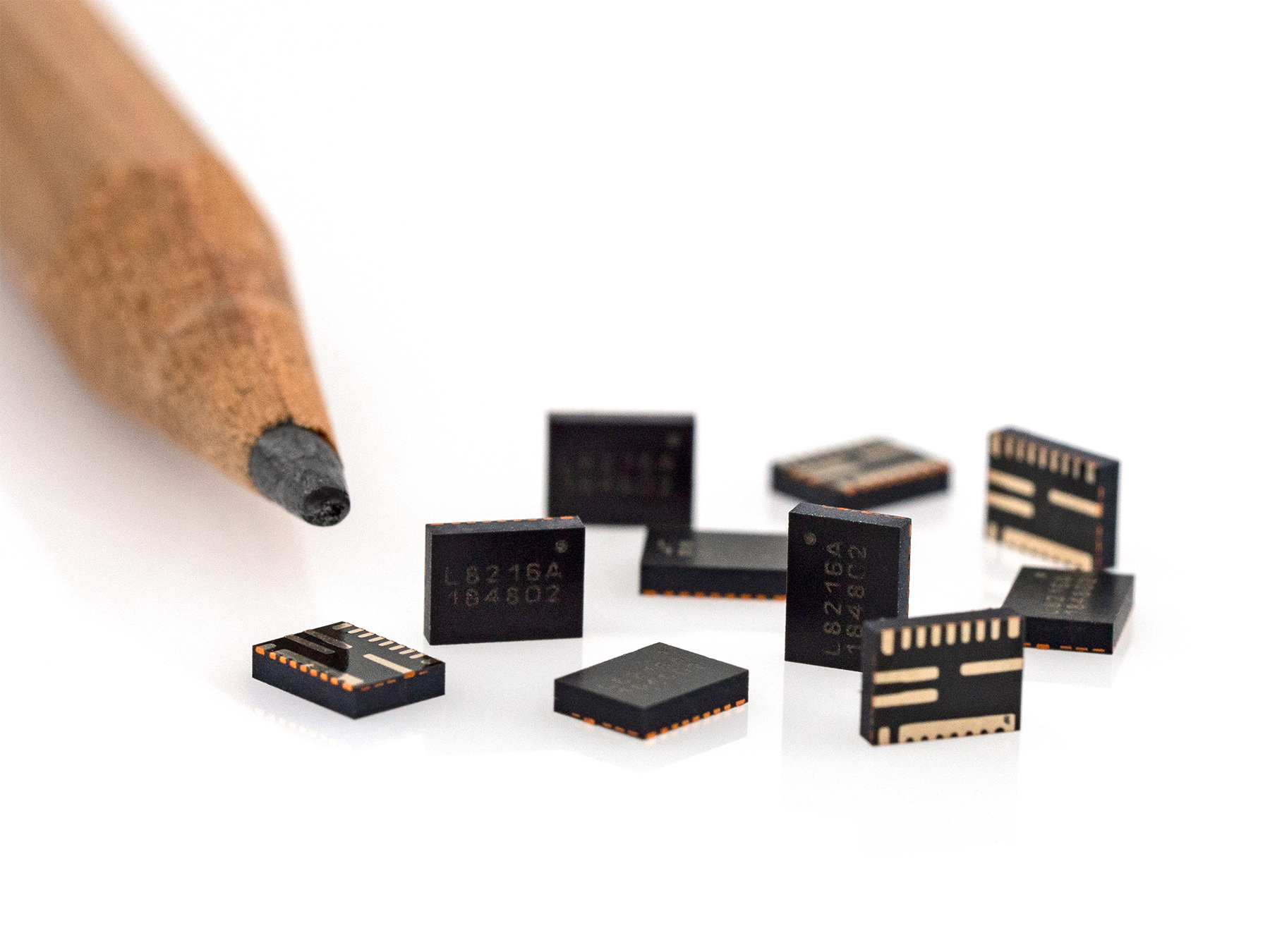
Silanna Semiconductor announced its highly integrated SZPL8216A family of synchronous point-of-load (PoL) buck converters. These DC/DC buck converters integrate the functions of the DC/DC constant-on-time (COT) controller, output gate drivers and output power blocks all in one compact 3mmx4mm QFN package to deliver the best power density with a minimum external component count. The devices enable designers to achieve ultra-compact PCB layout, high power density and high efficiency for low power loss in demanding and space-constrained applications such as enterprise servers, telecommunications, and networking equipment.
The SZPL8216A-A, SZPL8216A-B and SZPL8216A-C family of devices delivers up to 12 Amps with 94% peak efficiency when converting from a nominal 12 V input down to a 0.6 V to 5.5 V output voltage range. Providing design versatility, the devices feature a selectable switching frequency, 600 kHz to 1 MHz, allowing users to make design-specific decisions to optimize their component size versus efficiency. With the ability to operate at 1MHz, designers can use a smaller output filter to minimize their total PCB solution size.
Other features include programmable current limit and soft start time; remote output voltage sensing; pre-biased start-up and a full suite of robust power supply protection features including UVLO/OCP/OVP/UVP and OTP. Providing additional design versatility, the devices may operate from a single supply using their internal LDOs, or designers may bypass them and instead use an external 3.3 V or 5 V bias supply to increase conversion efficiency further.
The SZPL8216A COT controlled devices employ Silanna’s proprietary S-Loop control architecture which provides near instantaneous response to load transitions with minimal increase in overshoot or undershoot. Such performance is critical for multi-core CPU and FPGA applications that quickly power on and off with high current load transients and require a very stable power supply voltage.
Key Specs:
- Ultra-compact QFN 3mmx4mm package
- 94% peak efficiency
- Up to 1 MHz switching frequency
- 4.5V to 16V input voltage range
- 0.6V to 5.5V output voltage range
Key Features:
- Proprietary S-Loop control and adaptive COT architecture for fast load transient response
• All ceramic output capacitor solution
- Programmable current limit
- Internal LDO for MOSFET driver bias
- Output tracking with external reference input
- UVLO/OCP/OVP/UVP/OTP protections
- Pre-bias startup with programmable soft start time
- Diode emulation mode for light load efficiency boost
Availability:
The family includes three different versions, all packaged in the same 21-lead, 3mmx4mm QFN package, allowing for different fault mode behaviors, voltage references, and AVCC operating voltages:
SZPL8216A-AE34: Latched Fault Mode; VREF 0.9 V; AVCC 3.3 V
SZPL8216A-BE34: Hiccup Fault Mode; VREF 0.6 V; AVCC 3.3 V
SZPL8216A-CE34: Hiccup Fault Mode; VREF 0.6 V; AVCC 5.0 V
Sample quantities are available now. The devices are priced at $0.86/1,000 pieces and will be available in mass production in Q3. An evaluation PCB is also available.
More information is available at: https://www.silannasemi.com