Data Centers
Current

Artificial intelligence workloads are redefining the power requirements of modern data centers.
Infineon Introduces 27 kW Three-Phase PSU Solution for Next-Generation AI Server Power Architectures
Artificial intelligence workloads are redefining the power requirements of modern data centers. Increasing GPU performance and rising rack densities are driving a shift toward 800 VDC or ±400 VDC power supply architectures. To address these requirements, Infineon Technologies AG (FSE: IFX / OTCQX: IFNNY) is
. . . Learn More
Date:
10/08/2026

Renesas Expands GaN Portfolio with First Low-Voltage GaN FETs for AI Data Centers and Robotics
Renesas Electronics Corporation, a premier supplier of advanced semiconductor solutions, has expanded its GaN portfolio into low-voltage applications with its first family of 100V enhancement mode (E-mode) GaN-based discrete power transistors. The RTP100E005G1FL, RTP100E2P6G1FL, RTP100E1P8G1FL-DSC and RTP100E1P2G1FL-DSC lo
. . . Learn More
Date:
10/07/2026

Wärtsilä has secured an order to supply a 282 MW onsite power solution for a data center project being developed by a major US independent power producer in the United States.
Technology group Wärtsilä has secured an order to supply a 282 MW onsite power solution for a data center project being developed by a major US independent power producer in the United States. The power plant will operate with 15 Wärtsilä 50SG engines. The order demonstrates the growing need for fast-deployable on
. . . Learn More
Date:
10/05/2026

Navitas and Microchip Collaborate to Deliver 800V Reference Design for Next-Generation AI Data Centers
Navitas Semiconductor and Microchip Technology - As AI data centers scale to support high-power GPU clusters, the industry is shifting toward 800V DC rack power architectures to improve distribution efficiency, increase power density and support next-generation server designs. To help accelerate this tr
. . . Learn More
Date:
10/05/2026

Adam White, Division President Power Systems at Infineon
Infineon Technologies AG announced the completion of its acquisition of C2i Semiconductors, a Bengaluru-based technology company specializing in software-defined multiphase controllers and smart power stages for AI data center applications. C2i Semiconductors’ technology complements Infineon’s leading po
. . . Learn More
Date:
10/05/2026
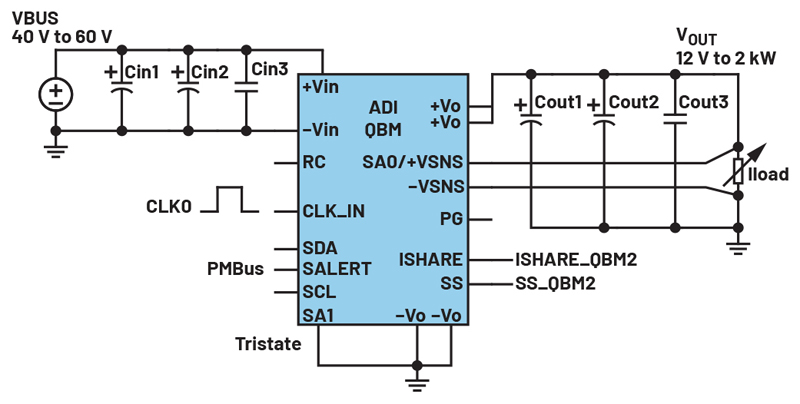
Click image to enlarge
Figure 1. ADI’s quarter brick PSU block diagram.
As data centers scale up to support more powerful servers, networking equipment, and storage systems, they require higher power, which involves several stages of power conversion from the power transmission line down to the usable DC voltage level inside the rack. The legacy architecture in data centers is co
. . . Learn More
Date:
10/01/2026
Archive