1500V Power Module Doubles Up for Both Solar and Storage Use
It is often the case that when components are targetted at large currents and voltages the amount of applications that they can be used in shrinks.
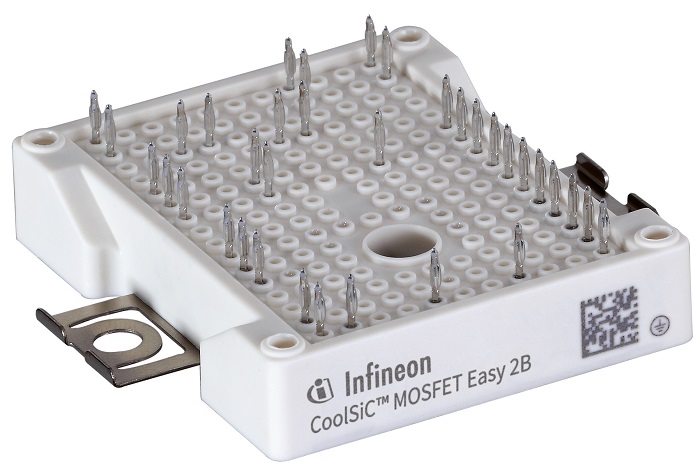
This is partly due to packaging requirements and partly due to the bespoke requirements for individual use cases. This drives up the cost of components for high-power applications as there is very little economy of scale. Infineon has tried to buck this trend somewhat with its new EasyPACK CoolSiC MOSFET module that can support fast-switching DC-link voltage of 1500 V for both solar systems and energy storage systems (ESS), while being flexible enough to cover other applications in the same power range.
The new Easy module F3L11MR12W2M1_B74 operates over the entire power factor (cos φ) range. A single module per phase is capable of supplying a power level of up to 75 kW in energy storage applications. For solar applications a power level of up to 150 kW can be reached by operating two modules in parallel per phase.
The module is an upgrade on the company’s V65 module. It has a 3-level Active NPC (ANPC) topology and integrates some of Infineon’s most up to date components, including its latest CoolSiC MOSFETs, and TRENCHSTOP IGBT7 devices. The combination of SiC MOSFETs and silicon IGBT technology along with a diode that has been upgraded from 75A to 100A supports the 1500V DC link application for solar and 1200V operation for energy storage. The ANPC topology was chosen for the module as allows the optimal integration of the components and the layout prioritizes short, clean signal paths with low inductance. The components have been physically placed in the module at the optimal points for removing heat, while allowing for a pin-out with low inductance.
Packaging is becoming more important to the power industry all the time. As we use higher density, currents and switching speeds, the ability to draw heat away from the electronics and disperse it is vital to the operation of products. The F3L11MR12W2M1_B74 is one of the first designs to use Infineon’s new Easy 3B package.
The Easy 3B package extends the DCB (direct copper bonding substrate) surface area of the current package by a factor of two while maintaining the same height of 12mm. Infineon has also changed the material used in its ceramic from Aluminium Oxide to Aluminium Nitride, which offers a much better thermal conductivity. The thicker AlN ceramic minimizes the cavity between the module and the heatsink, reducing the layer-thickness of the thermal interface material. While Al2O3 has a typical thermal conductivity of 24W/mK, AlN can provide a much improved 170W/mK. In practical terms, the design shows an RthJH improvement of 40%, meaning that the output of the module can be increased from 100 to 140KW, or it could have a 100KW output that would put much less thermal stress on the module providing a longer operational lifetime.
Infineon has also attempted to increase the possible number of applications that the module is suitable for by making it as flexible as possible. The module has been designed without a baseplate and with a flexible pin grid system to allow the customization of the layout and pinout.