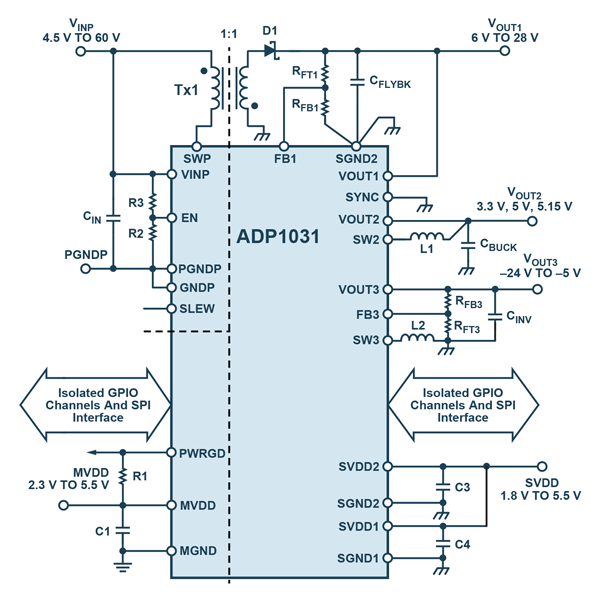
The ADP1031 is a high performance, isolated micropower management unit (PMU) that combines an isolated flyback dc-to-dc regulator, an inverting dc-to-dc regulator, and a buck dc-to-dc regulator, providing three isolated power rails. Additionally, the ADP1031 contains four, high speed, serial peripheral interface (SPI) isolation channels and three generalpurpose isolators for channel to channel applications where low power dissipation and small solution size is required.
Operating over an input voltage range of +4.5 V to +60 V, the ADP1031 generates isolated output voltages of +6 V to +28 V (adjustable version) or+ 21 V and +24 V (fixed versions) for VOUT1, factory programmable voltages of +5.15 V, +5.0 V, or +3.3 V for VOUT2, and an adjustable output voltages of −24 V to −5 V for VOUT3.
By default, the ADP1031 flyback regulator operates at a 250 kHz switching frequency and the buck and inverting regulators operate at 125 kHz. All three regulators are phase shifted relative to each other to reduce electromagnetic interference (EMI). The ADP1031 can be driven by an external oscillator in the range of 350 kHz to 750 kHz to ease noise filtering in sensitive applications.
The digital isolators integrated in the ADP1031 use Analog Devices, Inc., iCoupler chip scale transformer technology, optimized for low power and low radiated emissions.
The ADP1031 is available in a 9 mm × 7 mm, 41-lead LFCSP and is rated for a −40°C to +125°C operating junction temperature range.
Applications
- Industrial automation and process control
- Instrumentation and data acquisition systems
- Data and power isolation
For more information, visit www.analog.com.