Graphene sheets are immensely strong, lightweight and excellent at conducting electricity. Theoretically, macroscopical three-dimensional graphene assemblies should retain the properties of nanoscale graphene flakes. However, recent attempts to make 3D graphene have resulted in weak conductivity due to poor contact between graphene sheets. Loss of strength is also a problem, and self-supporting 3D graphene has not yet been produced.
Now, Xuebin Wang and Yoshio Bando at Japan’s World Premier International Center for Materials Nanoarchitectonics (WPI-MANA), together with co-workers across Japan and China, have created a new way of making 3D graphene using bubbles blown in a polymeric glucose solution. The resulting 3D graphene is robust and maintains excellent conductivity.
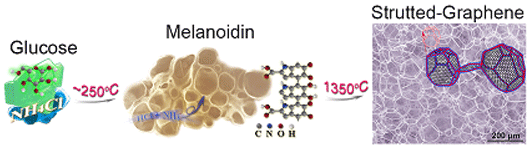
Inspired by the ancient food art of ‘blown sugar’, Bando and his team reasoned that the strutted, coherent nature of conjoined bubbles would lend itself to strength and conductivity if graphene could be structured in the same way. The researchers created a syrup of ordinary sugar and ammonium chloride. They heated the syrup, generating a glucose-based polymer called melanoidin, which was then blown into bubbles using gases released by the ammonium. The team found the best quality end-product resulted from a balance of equal ammonium decomposition and glucose polymerization during this stage.
As the bubbles grew, the remaining syrup drained out of the bubble walls, leaving within intersections of three bubbles. Under further heating, deoxidization and dehydrogenation, the melanoidin gradually graphitized to form ‘strutted graphene’: a coherent 3D structure made up of graphene membranes linked by graphene strut frameworks, which resulted from original bubble walls and intersectional skeletons respectively.
The bubble structure allows free movement of electrons throughout the network, meaning that the graphene retains full conductivity. Not only this, but the mechanical strength and elasticity of the 3D graphene is extraordinary robust– the team were able to compress it down to 80% of its original size with little loss of conductive properties or stability.
Following their discovery, Bando and his team reliably produced gram-level strutted 3D graphene with a cost $0.5 per gram in their lab. The low-cost, high scalability of this new method could have many applications in engineering and electronics. Selectively the abundant product was applied as a highly effective super-capacitor; its maximum-power-density is highest among 3D graphene-based aqueous super-capacitors, ca. 10^6 W/kg. This illuminates an amazing future for quick start-up of electric vehicles and launching of aircrafts.
The researchers on this project are associated with the following institutions:
1. World Premier International Center for Materials Nanoarchitectonics (WPI-MANA), National Institute for Materials Science (NIMS), Tsukuba 3050044, Japan.
2. School of Chemistry and Chemical Engineering, Southeast University, Nanjing 211189, China.
3. Department of Physics and Materials Science, City University of Hong Kong, Hong Kong 999077.
Reference: Wang, X. et al. Three-dimensional strutted graphene grown by substrate-free sugar blowing for high-power-density supercapacitors. Nature Communications, 4:2905 doi: 10.1038/ncomms3905 (2013).
Scanning electron microscopy images for showing sugar blowing process: glucose were polymerized and blown by released ammonia into melanoidin bubbles in heating, which bubbles were finally converted into strutted graphene containing mono-/few-layered graphene membranes and graphitic struts.