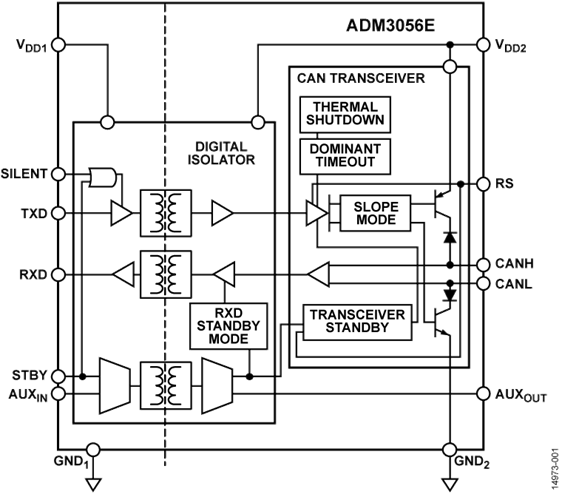
The ADM3056E is a 5.7 kV rms isolated controller area network (CAN) physical layer transceiver. The ADM3056E fully meets the CAN-FD ISO 11898-2: 2016 requirements and is further capable of supporting data rates as high as 12 Mbps.
The device employs Analog Devices, Inc., iCoupler technology to combine a highly robust 3-channel isolator and a CAN transceiver into a single SOIC, surface-mount package. The ADM3056E provides galvanic isolation between the CAN controller and physical layer bus.
Safety and regulatory approvals (pending) for 5.7 kV rms isolation withstand voltage, 849 VPEAK working insulation voltage, 8 kV surge, and 8.3 mm creepage and clearance, ensure that the ADM3056E meets isolation requirements for high-voltage applications.
Low propagation delays through the isolation support longer bus cables. Slope control mode is available for standard CAN at low data rates. Standby mode can minimize power consumption when the bus is idle, or if the node goes offline. Silent mode allows the TXD input to be ignored for listen only functionality.
Dominant timeout functionality protects against bus lock-up in a fault condition, and current limiting and thermal shutdown features protect against output short circuits. The device is fully specified over the −40°C to +125°C industrial temperature range and is available in a 16-lead, increased creepage, wide-body SOIC package.
Applications
- CANOpen, DeviceNet, and other CAN bus implementations
- Solar inverters and battery management
- Motor and process control
- Industrial automation
- Transport and infrastructure
For more information, visit www.analog.com.