NEWS: INDUSTRY NEWS

    A Novel Analog Processor for High-Performance Computing

    08/30/2021
    GEORGE WASHINGTON UNIVERSITY
    Mario Miscuglio
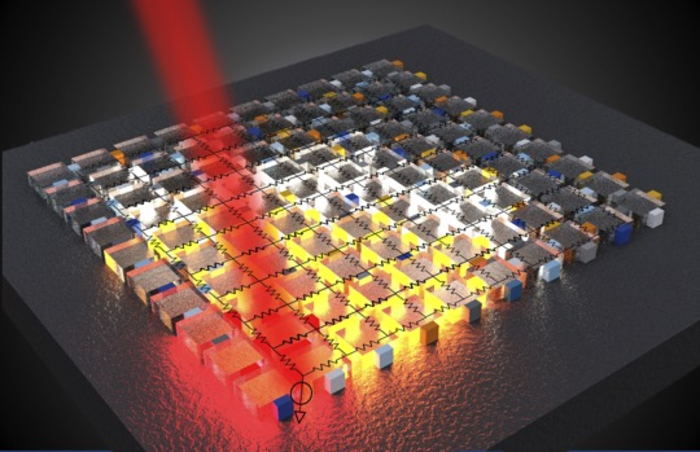
    Researchers at the George Washington University have developed a nanophotonic analog accelerator to solve challenging engineering and science problems, known as partial differential equations, in fractions of a second.

    Analog photonic solutions offer unique opportunities to address complex computational tasks with unprecedented performance in terms of energy dissipation and speeds, overcoming current limitations of modern computing architectures based on electron flows and digital approaches.

    In a new study published today in the journal Nature Communications Physics, researchers led by Volker Sorger, an associate professor of electrical and computer engineering at the George Washington University, reveal a new nanophotonic analog processor capable of solving partial differential equations. This nanophotonic processor can be integrated at chip-scale, processing arbitrary inputs at the speed of light.

    The research team also included researchers at the University of California, Los Angeles, and City College of New York.

    EurekAlert!, the online, global news service operated by AAAS, the science society: https://www.eurekalert.org/news-releases/926776
    Related

    Power Systems Design

    146 Charles Street
    Annapolis, Maryland 21401 USA

    Power Systems Design

    Power Systems Design is a leading global media platform serving the power electronics design engineering community. It delivers in-depth technical content, industry news, and product insights to engineers and decision-makers developing advanced power systems and technologies.

    Published 12× per year across North America and Europe, Power Systems Design is distributed through online and fully digital editions, complemented by eNewsletters, webinars, and multimedia content. The platform covers key areas including power conversion, semiconductors, renewable energy, automotive electrification, AI power systems, and industrial applications—supporting innovation across the global electronics industry.