ams' latest light sensors can shrink smart phone apertures up to 50%
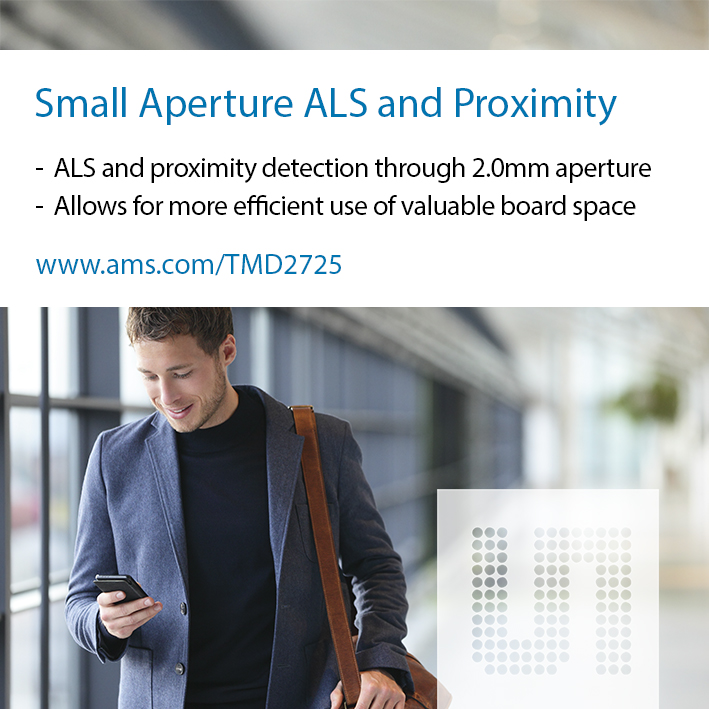
ams, a leading provider of high performance sensors and analog ICs, introduced new proximity sensing and proximity/ambient light sensing modules which enable android smartphone manufacturers to reduce the sensor aperture in the display’s cover glass to its smallest diameter.
Use of the TMD2620 proximity sensor or the TMD2725, a combined proximity and ambient light sensor, enables phone manufacturers to reduce the aperture’s size by as much as 50%, improving aesthetic appeal, especially in devices with a white or light-colored bezel. The TMD2620 and TMD2725 enable aperture size as small as 1.4 and 2.0mm respectively.
The TMD2620 and TMD2725 feature a breakthrough in optical module packaging which allows the emitter – an infra-red (IR) LED – and photodiode to be placed just 1.0mm apart. Lenses on top of the emitter and sensor along with an optical barrier between them help to minimize crosstalk, caused by reflections from the surfaces of the cover glass. Offset adjustment registers eliminate the effect of any residual crosstalk from the module’s proximity calculations. Automatic ambient light subtraction further enhances the accuracy of the device’s proximity measurements. The ability to measure up to a range of 100mm is comparable to laser-based solutions.
“Until now, inability to overcome the effects of optical crosstalk have prevented android phone manufacturers from reducing proximity sensing apertures below 3.0mm”, said Herbert Truppe, Senior Marketing Manager at ams. “Now the TMD2620 and TMD2725 overcome those challenges and enable a smaller aperture than has previously been possible.”
The TMD2620 and TMD2725 are in volume production now. Unit pricing in order quantities of 1,000 is $0.36 for the TMD2620, and $0.43 for the TMD2725.