Appending Triphenyltriazine to 1,10-Phenanthroline
A robust electron-transport material for stable organic light-emitting diodes
There has been an increasing demand for high-performant and cost-effective organic electron-transport materials for organic light-emitting diodes (OLEDs). The design of a desirable electron-transport material may present a demanding challenge since many factors and the complex trade-offs therein have to be taken into account, such as glass transition temperature, charge mobility, triplet energy, electron injection and hole blocking characteristics. Frequently, the pursuit of high-mobility ETMs (10-4-10-3 cm2 V-1 s-1) encounters difficulties in purification. Moreover the potential halogen-containing impurities may create a source of operational instability.
1,10-phenanthroline is a rigid, planar and electron-deficient chemical structure and well known as a versatile chelating agent. Phenanthroline derivatives such as 4,7-diphenyl-1,10-phenanthroline (BPhen) and 2,9-dimethyl-4,7-diphenyl-1,10- phenanthroline (Bathocuproine, BCP) have been widely used as an electron-transport material. However, the low morphological stability may hamper the practical application.
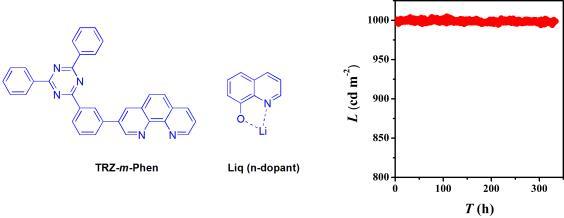
Recently, Xu-Hui Zhu and co-workers at State Key Laboratory of Luminescent Materials and Devices, South China University of Technology developed a series of high Tg phenanthroline derivatives, which may provide a promising approach to high-performant and cost-effective organic electron-transport materials. Through appending triphenyltriazine to 1,10-phenanthroline, they obtained a simple compound 3-(3-(4,6-diphenyl-1,3,5-triazin-2-yl)phenyl)-1,10-phenanthroline (TRZ-m-Phen): Tg = 112 °C, HOMO = -6.5 eV, LUMO ? -3.0 eV, the triplet energy ET ? 2.36 eV. n-Doping TRZ-m-Phen with 8-hydroxyquinolatolithium (Liq, 1:1) leads to a considerably improved electron mobility of 5.2 *10-6-5.8 *10-5 cm2 V-1 s-1 @ E = (2-5)*10 5 V cm-1, in contrast with the triarylphosphine oxide-phenantroline molecular conjugate reported by the same group previously. Based on optimizing the device architecture and hence suppressing polaron-exciton annihilation, introducing this single Liq-doped electron-transport layer led to high-efficiency and stable green phosphorescent OLEDs. At a luminance of ca. 1000 cd m-2, LE = 55.1 cd A-1, PE = 57.7 lm W-1. After being driven under a constant current for ca. 330 h, the initial luminance of 1000 cd m-2 showed little decay.
EurekAlert!, the online, global news service operated by AAAS, the science society: https://www.eurekalert.org/pub_releases/2018-05/scp-att052318.php