Atmel delivers low power MCU ATmegaRFR2 for 2.4GHz ISM band apps
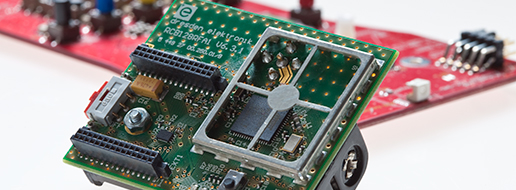
ATmegaRFR2 consumes 50% less power than nearest competitor
Atmel Corporation, the microcontroller and touch technology manufacturer has announced the ATmegaRFR2 AVR family of devices, its next-generation ULP (ultra-low power) single-chip wireless solution for the 2.4GHz ISM (industrial, scientific, medical) band applications worldwide. Expanding on its existing ATmega128RFA1, the new family consists of several devices including the ATmega64RFR2, ATmega128RFR2 and ATmega256RFR2 with new memory derivatives, offering a smaller 64K to a larger 256K device. The ATmegaRFR2 family integrates a number of industry-leading features including the lowest power using advanced hardware assist, best-in-class RF performance and additional memory options to meet today's demanding wireless requirements. Delivering <6mA in listen mode, <14.5mA in transmit mode and <1.5uA in deep sleep mode, the new single-chip wireless family offers up to 50% lower power consumption than exist on the market including the lowest power budget for today's 2.4GHz wireless applications. The new family also offers a true 1.8V operation at 16MHz and a wider temperature range, up to 125°C, for deployments in more demanding environments such as wireless lighting control. To simplify and accelerate a wireless design, a Wireless Composer is available through the Atmel Studio 6 Gallery, the company's new app store featuring extensions and plug-ins. The Wireless Composer provides a GUI (graphical user interface) for RF performance measurements, while running the ATmegaRFR2 evaluation kit. Atmel's ATmegaRFR2 family can be used with proprietary communication stacks and solutions compliant to the IEEE 802.15.4 standard. Atmel has already obtained 'golden units status' with the ZigBee Alliance for its new ZigBee Light Link reference implementation. The new family is also ideal for other ZigBee PRO-compliant wireless networks running the ZHA (ZigBee Home Automation ), ZBA (ZigBee Building Automation), or ZSE (ZigBee Smart Energy). The Atmel ZigBee PRO and ZigBee RF4CE reference implementations can be downloaded free of charge from Atmel. Key new features for the ATmegaRFR2 family:
- Advanced Hardware assisted RPC (Reduce Power Consumption) in listen mode
- Excellent RF link budget of 103.5dB
- Improved link efficiency and reliability using receive override
- Improved channel mask on CH25/CH26
- High data rates for up to 2Mbs
- Antenna diversity to automatically select the antenna with a stronger signal
- AES 128-bit encryption engine for high-speed communication