University of Texas at Austin researchers find that making better performing batteries may require a complete overhaul of both design and manufacture.
It is no exaggeration to say that scientists around the world are working on every aspect of lithium-ion batteries to improve their performance. Consumers are crying out for extended battery life on cellphones, and also longer range and faster charging for EVs, among a million other things. More energy dense batteries would also ease the pressure on the lithium supply chain, which is now struggling to keep up with global demand until new sources of lithium come online. Meanwhile, researchers are trying to develop better anodes, cathodes and electrolytes for LIBs, as well as batteries using chemistries that don’t use lithium at all.
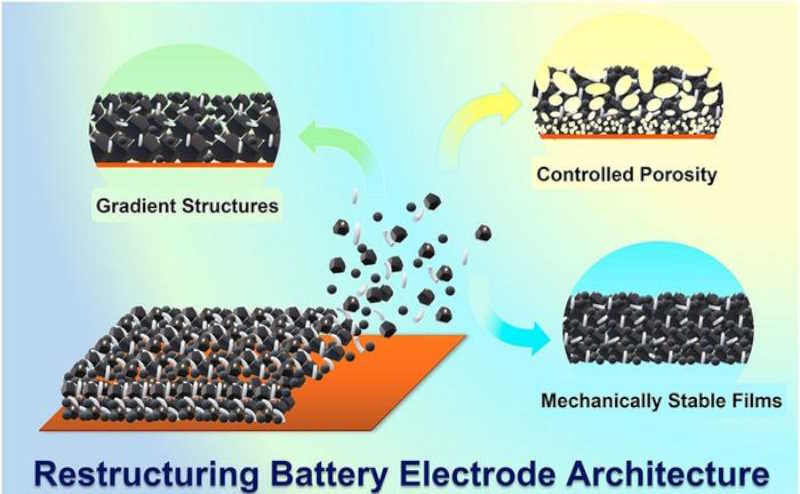
One team of researchers from the University of Texas at Austin thinks one of the most productive ways to create better batteries could be to go back to the drawing board and completely rethink how batteries are designed and manufactured. The group has recently published a paper in the journal eScience that outlines the strategies that it has been working on to restructure the electrodes in LIBs beyond traditional manufacturing methods. The team’s research looks into templating, gradient, and freestanding electrode design approaches, and the impact of those techniques on energy density, charging speed, and commercial viability. The study also takes a look at process tunability, scalability, and material compatibility.
These strategies looked at by the team include the development of templating techniques to create precise pore structures for improved ionic transport, the use of gradient designs that vary composition and microstructure across the electrode to optimize energy storage and transfer, and the introduction of freestanding electrodes that eliminate the need for metal foil current collectors, and therefore offer enhanced mechanical stability and energy density.
Integrating these architectural innovations with advanced materials is crucial to unlocking superior battery capabilities. The study also emphasizes the necessity of scalable, economically feasible production methods to transition these advancements from the lab to the market.
Co-author of the study, Professor. C. Buddie Mullins, emphasized the significance of this research in advancing energy storage solutions. He said, "This research marks a significant milestone in our quest for more efficient, reliable, and sustainable energy storage solutions. By reimagining electrode design, we can overcome existing limitations and pave the way for batteries that are not only more powerful but also more adaptable to a range of applications."
In addition to electrode restructuring, a recently published in the same journal discuss from another viewpoint on the formulation of electrolyte and solid-electrolyte interphase (SEI) properties for better LIB. Advancement in novel solutions like liquefied gas, weakly solvating, and localized high-concentration electrolytes, together with electrode structure innovation, promise to overcome traditional limitations, ensuring reliable battery function even at sub-zero temperatures.

.jpg)