Bidirectional Charging and the New Energy Paradigm

As solar and wind capacity continues to scale, the challenge is shifting from generation to management, storage, and distribution.
Figure 1: V2G bidirectional charging diagram
This shift is already visible in policy and planning. In the UK alone, the government’s Clean Power Action Plan projects that battery energy storage system (BESS) capacity will need to reach between 23 GW and 27 GW by 2030, a substantial increase from around 4.5 GW in 2024.
Globally, the scale of the transition is even more pronounced. To support a tripling of renewable capacity by the end of the decade, energy storage must expand sixfold, reaching around 1,500 GW in the International Energy Agency’s Net Zero scenario.
At the centre of this transformation sits a fundamental rethinking of how energy flows through a system – bidirectional charging (BDC). Rather than treating batteries as passive endpoints, BDC allows storage systems to actively participate in balancing supply and demand, marking a structural change in how electricity networks operate.
From One-Way Networks to Dynamic Energy Systems
Traditional electricity grids were designed for unidirectional flow, from centralised generation to end users. That model is increasingly misaligned with a decentralised, renewable-heavy energy network, with the transition shifting distribution networks from consumption-driven systems to supply-capable systems, where reverse power flows become normal rather than exceptional.
In practical terms, this means homes, vehicles, factories, and storage systems all become nodes in a distributed network, capable of both consuming and supplying power.
Bidirectional EV Charging
Nowhere is this transition more visible than in electric mobility. Electric vehicles (EVs) are no longer just loads on the grid; they are increasingly seen as distributed energy assets.
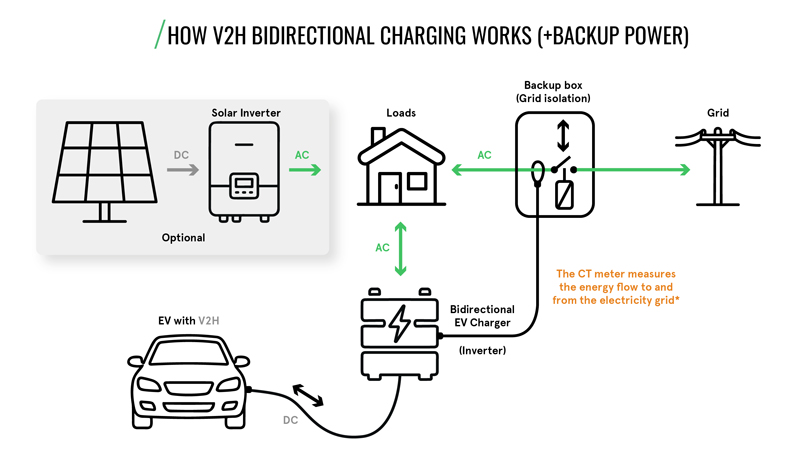
With bidirectional capability, EVs can operate across a range of scenarios. Vehicle-to-Home (V2H) enables backup power and energy optimisation at the household level. Vehicle-to-Load (V2L) supports direct powering of tools and equipment. Vehicle-to-Vehicle (V2V) introduces peer-to-peer energy transfer. Most significantly, Vehicle-to-Grid (V2G) allows EVs to supply energy back into the wider network.
Major automotive OEMs are now moving bidirectional charging from pilot activity towards deployment across selected vehicle platforms and energy ecosystems. This includes German OEM groups such as BMW, Volkswagen, and Mercedes-Benz, alongside manufacturers including Hyundai, Kia, Ford, Nissan, Volvo, and Polestar, reflecting the growing momentum behind Vehicle-to-Everything (V2X) capability.
Collectively, these capabilities reposition EVs within the energy system, allowing them to alleviate grid pressure instead of increasing it. The exact partitioning of the power conversion depends on the charging architecture. In AC bidirectional systems, the vehicle’s onboard power electronics play a direct role, while in DC wallbox-based V2H and V2G implementations, much of the high-power bidirectional conversion is handled in the external charger. This makes 1200 V class Silicon Carbide (SiC) devices especially relevant in the wallbox and associated energy conversion hardware, where high efficiency and power density are critical.
Grid Infrastructure
At the grid level, the implications of bidirectional energy flow are significant. BESSs are already being deployed to stabilise networks, storing excess generation during periods of low demand and releasing it during peak usage. Countries such as the UK, Germany, and parts of Australia have already experienced sustained periods of negative electricity pricing during peak renewable generation, highlighting the need for flexible storage and load balancing.
This capability becomes critical as renewable penetration increases. Solar and wind generation are inherently variable, and without sufficient storage and flexibility, they introduce instability into the system. BDC-enabled storage addresses this by enabling time shifting, effectively decoupling generation from consumption.
The challenge of supporting entire national grids, however, is scale. As inverter power levels rise and renewable installations grow, higher voltage operation becomes necessary to maintain efficiency. Wide bandgap power semiconductors can satisfy the high voltage and power requirements for grid infrastructure, while also offering significant improvements in efficiency. Even a modest 1% rise in conversion efficiency can translate into gigawatts of energy savings, thereby reducing infrastructure burdens and bolstering grid stability.
Static and Mobile Off-Grid Applications
Beyond the grid, bidirectional systems are enabling new approaches to energy management in off-grid and constrained environments.
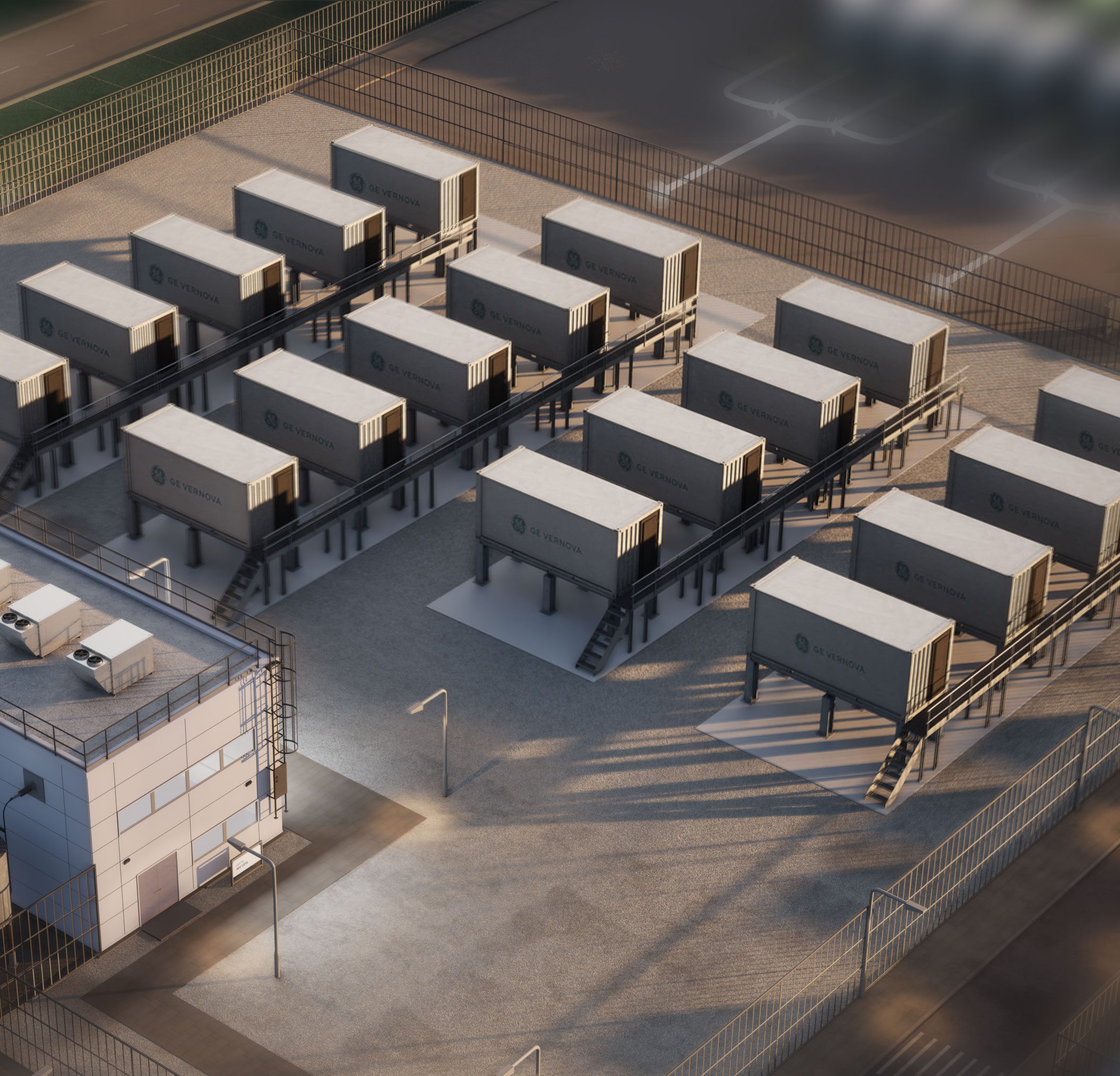
In containerised installations, compact, integrated power conversion helps maximise usable storage within a fixed enclosure, while in remote deployments it can support architectures that reduce logistics, fuel dependency, and maintenance burden. This is visible in remote Australian energy projects, where many isolated Indigenous communities have historically relied on diesel generation and are now integrating solar and storage to improve resilience. In Australia’s Northern Territory, 28 remote communities and 29 outstations have already had diesel generation augmented by solar, including a 2 MWh battery-supported system at Daly River. In these kinds of distributed energy systems, BDC can simplify the charge and discharge path, reducing conversion hardware and supporting more compact, scalable energy storage architectures.
In mobile and industrial contexts, the same principles can apply. Energy that would otherwise be lost, such as kinetic energy from braking or load descent, can be captured, stored, and reused. This improves system efficiency and reduces overall energy demand. The maritime sector is also beginning to adopt these concepts. Vessel-to-grid solutions allow electrified ships to interact with port infrastructure, not only drawing power but also supporting local grids when capacity is constrained.
Residential, Commercial and Industrial Applications
Closer to the point of use, BDC is beginning to reshape how energy is consumed and managed across residential and commercial environments.
In homes, bidirectional wallboxes combined with battery storage systems allow for backup power, load shifting, and optimisation of energy use. Typical residential storage capacities range from 5 kWh to 20 kWh. Bidirectional charging systems commonly operate at 11 kW and 22 kW three-phase power levels, while higher power residential and commercial inverter platforms can scale beyond this range. At these power levels, SiC MOSFET-based converter designs can reduce switching and conduction losses, improving efficiency, thermal performance, and power density in compact bidirectional charging infrastructure.
Click image to enlarge
Figure 2: V2H bidirectional charging diagram
In commercial and industrial settings, the scale increases significantly. Storage systems ranging from hundreds of kilowatt-hours to multiple megawatt-hours are being deployed to enable demand response, energy arbitrage, and operational resilience. There is also an increasing focus on system modularity. Two-stage designs that separate power factor correction and DC/DC conversion are enabling the emergence of DC distribution within facilities, simplifying infrastructure and aligning with the broader shift towards more flexible, software-defined energy systems.
Implementing a System-Level Approach for Bidirectional Charging
The design of BDC systems using advanced wide bandgap power electronics introduces a new set of challenges for engineers. Both SiC and Gallium Nitride (GaN) enable exceptionally high switching speeds, sometimes exceeding 100 V/ns, which places new demands on test, measurement, control, and protection.
Achieving the required power density and form factors, particularly in compact and scalable charging systems, is driving a shift from straightforward 2D layouts towards more complex 3D and vertical structures. That, in turn, brings additional considerations around thermal behaviour, mechanical constraints, manufacturability, and the need for more sophisticated simulation across electrical, thermal, and mechanical domains.
This is where a system-level approach becomes important. Avnet Silica’s engineers work to support customers across the full design chain, from core power components and modules through to embedded compute, connectivity, software, and cloud services. That support extends from hardware, firmware, and software development through to communications and security, helping customers bring together the building blocks needed for complete BDC solutions.
In the power domain, Avnet Silica works with leading suppliers including STMicroelectronics, onsemi, and Renesas, giving customers access to a broad portfolio of technologies for BDC and energy conversion. STMicroelectronics, for example, offers a strong wide bandgap portfolio built on decades of power electronics experience, with SiC Gen3 MOSFET technology available across industry-standard package options from 650 V to 1200 V. Its portfolio, including reference designs, shows how advanced power devices are now being translated into practical platforms for next-generation charging designs.
Through its suppliers, including NXP, Nexperia, STMicroelectronics, onsemi, Quectel, and Microsoft, Avnet Silica supports engineers with a comprehensive ecosystem for turning designs into deployable solutions. This combines supplier technologies with Avnet Silica’s engineering expertise across embedded compute, industrial displays, software, and connectivity spanning LTE, Wi‑Fi, Bluetooth, LoRa, and NFC.
From the forecourt to the cloud, the total solution approach undertaken by Avnet Silica engineers reflects the reality of modern charging infrastructure. Bidirectional energy systems are not a power challenge but instead one defined by how effectively power, control, communications, and software are brought together into a reliable whole.