Breaking Down the Key Priorities for Powering Wearables
Designers must prioritize key requirements and integrate them into the device in a manner that optimizes power management for peak efficiency
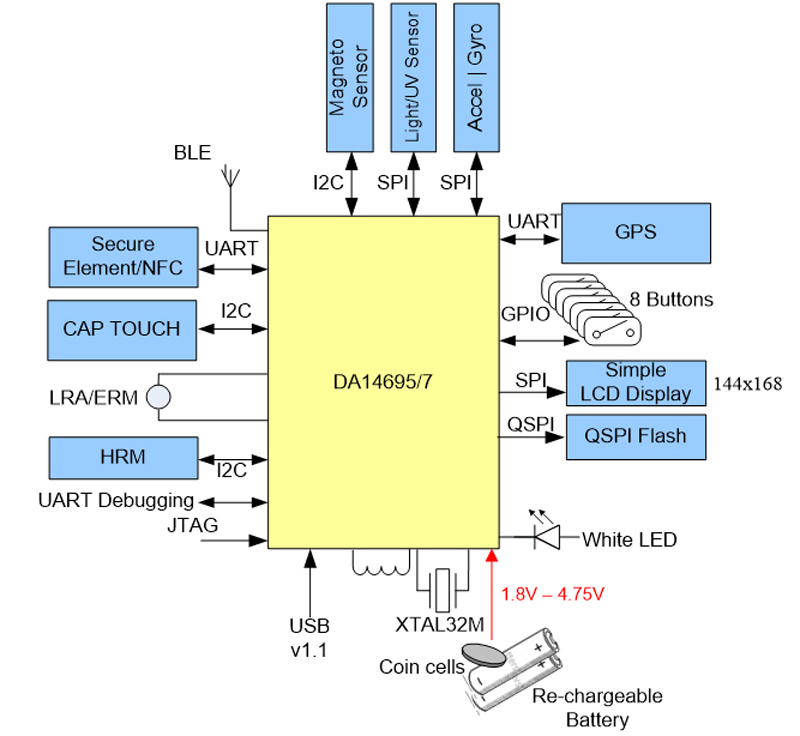
Figure 1: Activity Tracker use case
Over just the last few years, we’ve seen the popularity of wearables surge across various market segments. It’s easy to see why: these products are packed with some of the latest and complex technological advancements and aim to improve well-being and simplify day to day tasks and activities in a completely intuitive and unobtrusive manner.
Today, popular breeds of wearables include:
- Clothing Accessories & Basic Activity Trackers without displays.This segment aims to enable basic fitness tracking and other customized functionality. The Bluetooth low energy (BLE) protocol fits well as the wireless solution to meet this segment’s connectivity requirements.
- Fitness Trackers with displays and Sports Watches. This consumer segment is expected to see significant growth in the coming years. The latest product designs strive for larger and enhanced color displays with longer battery lifetimes (~1 week). They also aim to enable different fitness features, like 24 hours HRM, stress and sleep tracking, and various exercise and sports tracking like swimming, golfing etc. GPS and music options are also a growing trend. Here again BLE offers one of the most popular wireless solutions.
Click image to enlarge
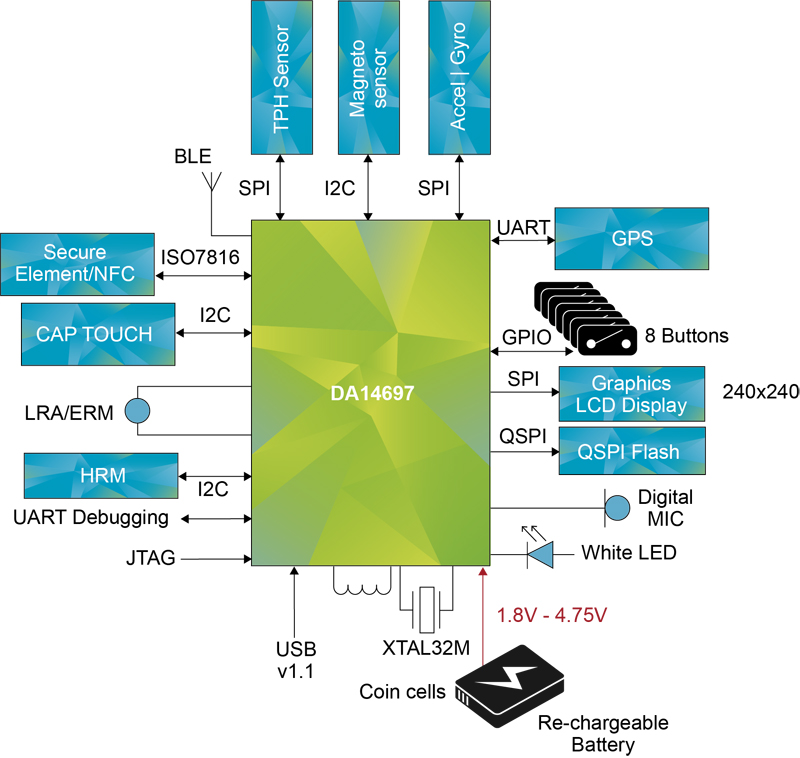
Figure 2: Sport Watch use case
- Smart Watches.This is currently the most advanced segment of the wearables space, where major tech players are constantly exploring new possibilities and demonstrating their latest innovations. Examples include the Apple Watch and Samsung Galaxy Watch. These usually incorporate a combo solution of Bluetooth, BLE and Wi-Fi for seamless wireless connectivity. These products typically have a battery lifetime of a single day, similar to a smartphone. This segment is also expected to grow at a nice pace in the coming years.
Practical Designs
A wearable product design should include all of the necessary hardware components to realize their required functionality and meet their users’ needs. Hence, power management for wearables becomes a very critical aspect to achieve robust performance coupled with a longer battery lifetime, all at a competitive cost.
Dialog’s DA1469x line of BLE solutions provide one reference point for how designers and manufacturers can integrate new system components into wearables to drive new value for customers, especially on the power management side. The following system diagrams of an activity track and sports watch that utilize the DA1469x chip illustrates this for reference:
Click image to enlarge
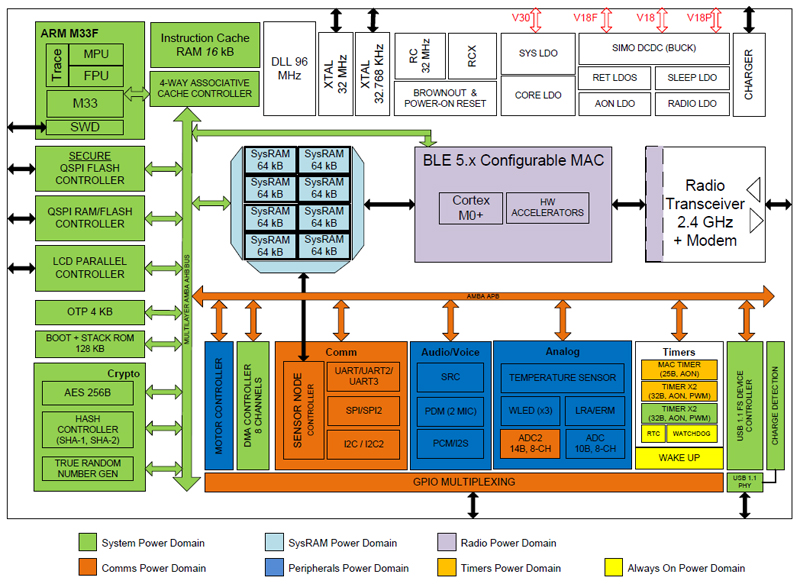
Figure 3: DA1469x digital power domains and blocks
In both diagrams, we see that an integrated PMIC functionality that is able to provide power to external components such as sensors and displays is essential for a sound wearable design. On top of the power management features, integrated hardware chargers that can enable charging of the Li-ion or Li-Po batteries, which are typically used in wearable products via the USB interface, are also important considerations for maximizing power efficiency.
Key Power Management Features for Wearables
Engineers looking to optimize the power footprints of their wearable designs should prioritize a few key requirements that we’ve similarly implemented at Dialog:
- Multiple processing cores
The DA1469x, for instance, uses three different processing cores to reduce overall power consumption, by turning them off when not used but also by selecting the correct core for each task.
- Power rails
A challenge posed to all wearable designs is the power supply and power management of all included components. Today’s wearables are made up of several different parts, not all of which require the same supply voltage nor will all of them need to be powered at the same time. The straightforward way to address this problem is by adding a separate controllable power supply unit (e.g. a PMIC) to the design. Pairing the PMIC with external power rails provides the designer with flexibility in generating the voltages needed without driving up costs or PCB area.
- Charger
A healthy battery is key to a reliable, yet affordable wearable. Integrating JEITA-compliant, full-featured, high-power battery chargers with the PMIC block enables the developer to create exceptional devices and offer a feature-rich and affordable device to end customers. This charger implementation solution is also capable of self-adjusting the charging process, ensuring it will automatically start conditioning the battery when fully charged.
- Multiple sleep modes
A combination of hibernation, deep sleep and extended sleep modes that cycle through different iterations of RAM retainment, active or non-active low-power clocks, power domains that are switched on and off and flexibility in triggers for awakening the system is crucial. Incorporating this span of differing sleep modes allows the device to self-adjust its power management needs between periods of normal operation and inactivity.
- Haptics support
An integrated haptics feedback driver and controller can be used in conjunction with both Eccentric Rotating Mass (ERM) and Linear Resonant Actuator (LRA) external devices, the latter of which consumes around 2.5 times less power than ERM. This approach automatically adapts to the resonant frequency of the haptics feedback actuator and utilizes a configurable supply current to set the force of the feedback.
- LCD controller
An LCD controller, capable of supporting Serial (SPI3/4) and parallel interfaces, enables wearable system designers to select a display from a wide range of companion controller options. These benefit power-efficient reflective displays – popular among wearables – that use a parallel interface.
- As the wearables market continues to expand in breadth and popularity, it’s essential that engineers and designers are prioritizing these key requirements and integrating them into the device in a manner that optimizes power management for peak efficiency. The most robust, features-packed wearable in the world is useless to consumers if it can’t keep a battery charge for any significant amount of time.
Dialog Semiconductor