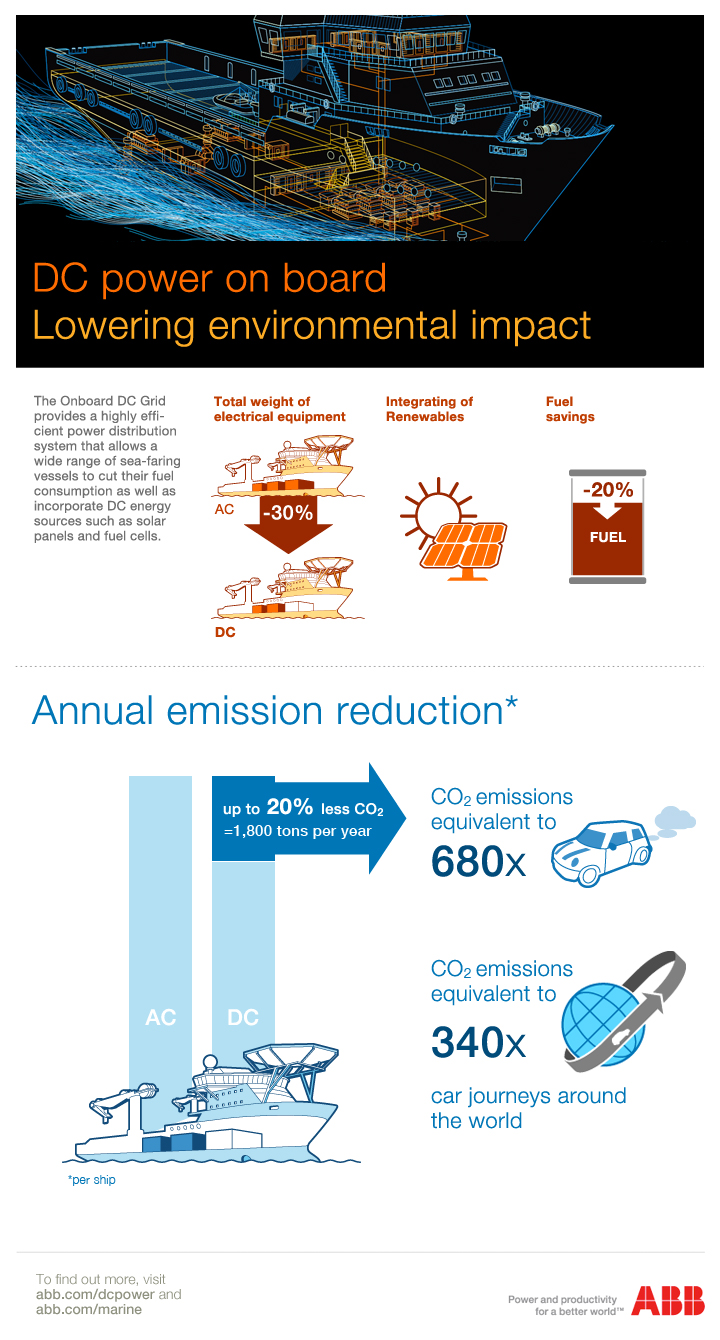
ABB, the leading power and automation technology group, has won an order from ship owner Myklebusthaug Management to supply the first ever direct current (DC) power grid on board a ship. The equipment will allow a new offshore platform support vessel, under construction in Norway, to operate at the highest energy efficiency level to minimize emissions. In traditional electrical propulsion vessels, multiple DC connections are made to thrusters and propulsion drives from an alternating current (AC) circuit, accounting for more than 80 percent of electrical power consumption. ABB's Onboard DC Grid represents a step forward in optimized propulsion by distributing power through a single DC circuit providing significant power savings. Launched in May 2011, ABB's Onboard DC Grid is part of a revival of power solutions using DC, and will provide highly efficient power distribution and electric propulsion for a wide range of vessels. It is designed for ships with low-voltage onboard circuits, such as offshore support vessels, tug boats, ferries and yachts, and can reduce fuel consumption and emissions by up to 20 percent. "With this solution, the vessel will be ready to maximize opportunities in energy savings with supplementary DC energy sources, such as solar panels, fuel cells, or batteries connected directly to the ship's Onboard DC Grid," said Veli-Matti Reinikkala, head of ABB's Process Automation division. "The Onboard DC Grid will help the vessel operate from the very first day at the highest levels of fuel efficiency with low emissions." ABB will provide its full onboard DC system, including all power, propulsion and automation systems for the 93 meter long, 5,000 ton multi-purpose oil field supply and construction vessel, which is scheduled for delivery in the first quarter of 2013. A key advantage of ABB's Onboard DC Grid is that the ship's engines no longer have to run at a fixed speed, so the engine's speed can be adjusted to optimize fuel consumption. By eliminating the need for bulky transformers and switchboards, the footprint and weight of the electrical system can be reduced by up to 30 percent, leaving more space on the vessels for passengers or cargo while also providing greater flexibility in the positioning of system components in the vessel. www.abb.com


.jpeg)