Buffer Amplifier Increases Signal Bandwidth Tenfold in Data-Acquisition Systems
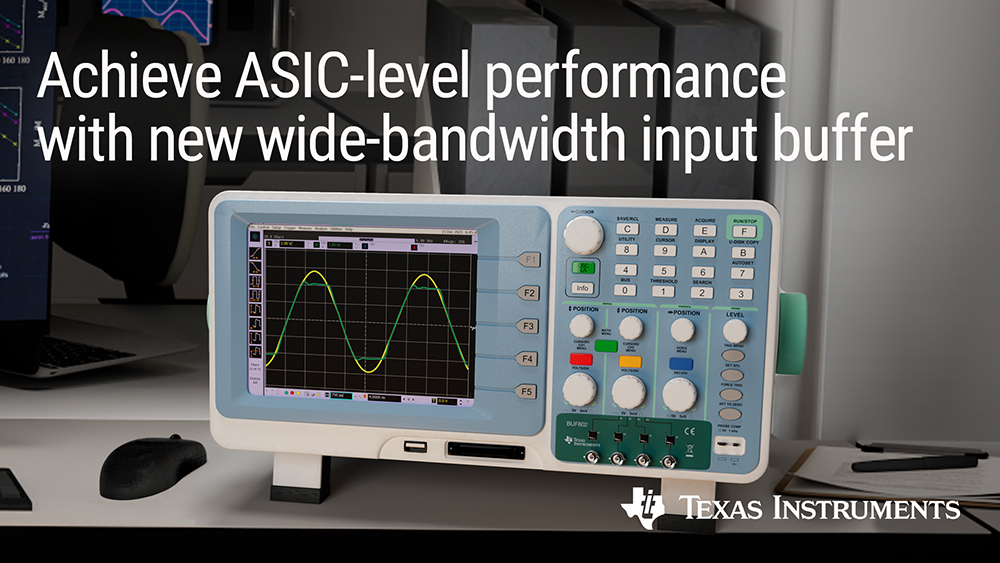
Test and measurement engineers can save months of design time by eliminating the need for custom ASICs and simplifying front-end designs
Texas Instruments (TI) introduced the industry’s widest-bandwidth high-input-impedance (Hi-Z) buffer amplifier, capable of supporting frequency bandwidths as high as 3 GHz. The wider bandwidth and high slew rates of the BUF802 enable higher signal throughput and minimal input settling time. Designers can leverage this faster throughput to measure higher-frequency signals more accurately in test and measurement applications including oscilloscopes, active probes and high-frequency data-acquisition systems.
The bandwidth achieved by the BUF802 was previously only possible by using application-specific integrated circuits (ASICs) that can increase system design time, complexity and cost. By eliminating ASICs, designers who use TI’s buffer can get to market faster while achieving a wide dynamic range at a fraction of the cost.
Achieve ASIC-level performance with the industry’s widest bandwidth
Previous alternatives to ASIC-based design implementations required dozens of discrete components such as field-effect transistors (FETs), protection diodes and transistors. These discrete, FET-input amplifier-based implementations add to a design’s bill-of-materials (BOM) cost and system complexity and are unable to deliver the same bandwidth as ASICs, thus limiting the signal throughput of data-acquisition applications.
The BUF802 provides a single-chip alternative to ASICs or FET-input amplifier-based implementations by integrating the features of discrete components while providing 10 times wider bandwidth than FET-input amplifiers, matching the performance of custom ASICs.
Scale front-end designs from 100 MHz to 3 GHz with the same BOM
The flexible BUF802 is the industry’s first buffer to enable quiescent current adjustment for a range of bandwidth and signal swing requirements, from 100 MHz to 3 GHz at 1-V peak to peak (VPP) and as high as 2 GHz at 2 VPP. This wide adjustment range for bandwidth and signal swing allows designers to easily scale their front-end designs across multiple data-acquisition applications, easing system cost and redesign.
Reduce design complexity with integrated functional modes
Integrated functional modes allow engineers to use the BUF802 as a standalone buffer or in a composite loop with a precision amplifier like the OPA140. As a stand-alone buffer, the BUF802 can help achieve high input impedance and high slew rates in applications that can tolerate 100-mV offsets or where the signal chain is AC-coupled. In a composite loop, the new buffer can achieve high DC precision and 3-GHz bandwidth in applications requiring 1 μV/°C maximum offset drift.
Package, availability and pricing
The BUF802 is available for purchase on TI.com in a 3-mm-by-3-mm 16-pin very thin no-lead (VQFN) package, and is priced at US$1.80 in 1,000-unit quantities. The BUF802RGTEVM evaluation module is available on TI.com for US$25. TI offers multiple payment and shipping options here.

_Demonstration_Application.jpg)