Capacitors for High-Frequency Coupling and Decoupling
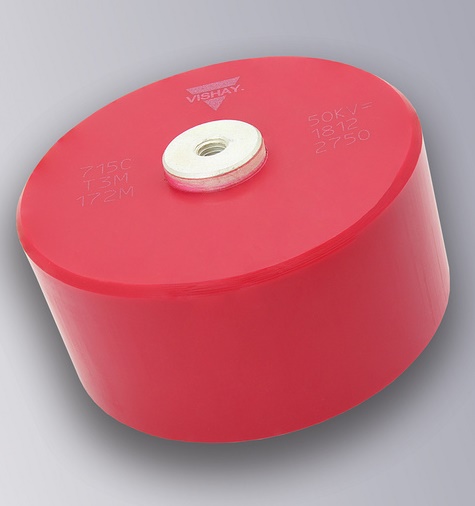
MALVERN, Pa. — Vishay Intertechnology, Inc. announced that it has extended the Vishay Cera-Mite 715CxxKT series of ceramic screw-mounting disc capacitors with higher voltages to 50 kVDC (34 kVRMS).
With low AC and DC coefficients and a negligible piezoelectric / electrostrictive effect, 715CxxKT series capacitors are specifically designed to function in circuits with high peak current and high repetition rates. The devices are optimized for high frequency coupling and decoupling, laser excitation, and fast-repetition pulse circuitry in high voltage power supplies, CO2 lasers, and X-ray and welding equipment, in which low losses and high permittivity are required.
The 715CxxKT series can be used as a replacement for the DHS ultra high voltage screw terminal type ceramic capacitors for which Murata Manufacturing Co., Ltd. recently announced a last order date of March 31, 2020. Further, it can be used as a replacement for the AVX HP and HD series for which AVX announced a last order date of March 31, 2019.
Available with diameters from 21 mm to 60 mm, 715CxxKT series devices feature a N4700 (T3M) Class 1, strontium-based ceramic dielectric in a molded epoxy case. The RoHS-compliant capacitors offer a low dissipation factor of 0.2 % at 1 kHz and a wide range of capacitance values from 100 pF to 8 nF over a voltage range of 10 kVDC (7 kVRMS) to 50 kVDC (34 kVRMS).
Samples of the extended 715CxxKT series capacitors are available now. Production quantities are available with lead times of 12 weeks for large orders.
Vishay can be found on the Internet at www.vishay.com.