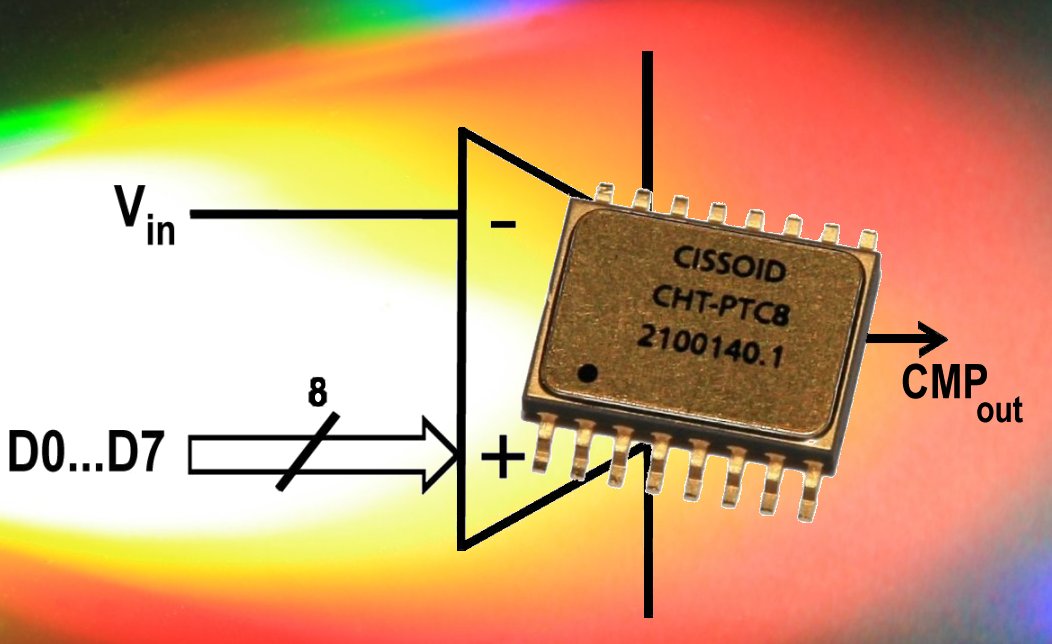
CISSOID, the leader in high temperature semiconductor solutions, introduced NILE, its high-temperature, low-power, 8-bit comparator, guaranteed for reliable operation from -55°C up to +225°C. The NILE programmable comparator complements the CISSOID family of products RIVER, which bridges the analog and digital worlds for electronics systems requiring reliable operation at high temperature. NILE compares an analog input against an 8-bit resolution portion of the 5V reference voltage, with a programmable threshold. It is based on an R-2R network and features a strictly monotonic characteristic over the whole temperature range. NILE is a continuous time device and provides a valid output within 2.6μsec for a ½ LSB (10mV) comparator overdrive. It only requires a +5V supply and an external +5V reference. Several input ranges are also available, from -15V up to +10V. The NILE comparator is latch-up free and consumes less than 250μA, even at the maximum operating temperature of 225°C. It is one more high temperature part in the toolbox of system designers for industrial, aeronautics, automotive and Oil & Gas high temperature applications. This programmable comparator will be particularly useful in signal processing and signal conditioning for sensor interfaces. The part number for NILE is CHT-PTC8. It is available in a surface mounted component package, Ceramic CSOIC16, for sampling and evaluation. Pricing starts at 195.68€ up to 200 units. For more information, visit www.cissoid.com or contact the company's representatives at www.cissoid.com/company/about-us/contacts.html