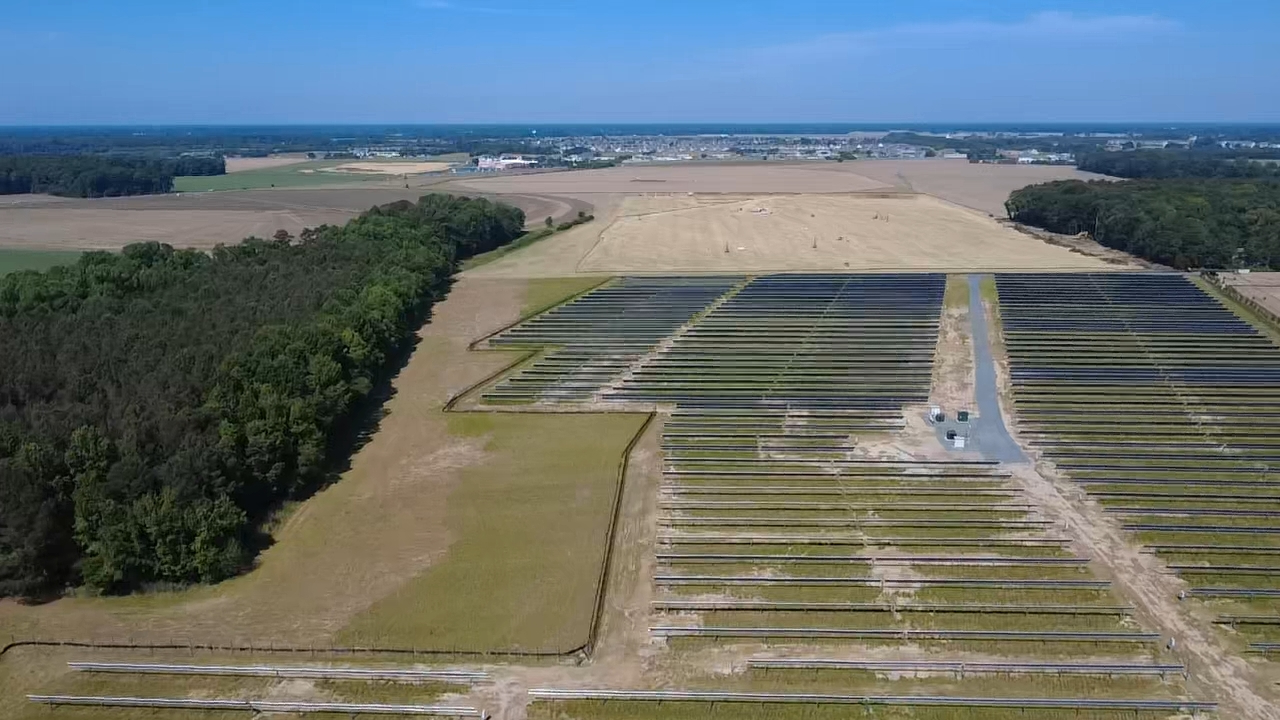
New research led by the University of Oxford and University College London (UCL) has revealed that pollution from coal-fired power plants is significantly reducing the energy output of solar photovoltaic (solar PV) installations, particularly where these are expanding side by side. The findings have been published today (15 May) in Nature Sustainability.
The new study mapped and assessed more than 140,000 solar PV installations worldwide using satellite data. By combining this with atmospheric data on air pollution, the researchers calculated how much sunlight is lost and how this reduces electricity generation. They found that aerosols - tiny particles suspended in the air - reduced global solar electricity output by 5.8% in 2023. This is equivalent to 111 terawatt-hours (TWh) of lost energy – the amount generated by 18 medium-sized coal-fired power plants.
Crucially, these losses represent a significant and often overlooked constraint on the clean energy transition. Between 2017 and 2023, new PV installations added an average of 246.6 TWh of electricity each year, while aerosol-related losses from existing systems reached 74.0 TWh annually - equivalent to nearly one-third of the gains from new capacity. This highlights a previously unrecognised interaction between fossil fuel use and renewable energy, where emissions from one system directly reduce the performance of the other.
Lead author Dr Rui Song (Department of Physics, University of Oxford, and Mullard Space Science Laboratory, UCL) said: “We are seeing rapid global expansion of renewable energy, but the effectiveness of that transition is lower than often assumed. As coal and solar expand in parallel, emissions alter the radiation environment, directly undermining the performance of solar generation.”
To identify the sources of these aerosol-related losses, the researchers traced their origins and found coal-fired power generation to be a major contributor. This effect is particularly evident in China, where solar and coal capacity have expanded in parallel and are often co-located. Regions with high coal capacity aligned closely with areas experiencing the greatest solar PV losses.
China is the world’s largest solar producer, and generated 793.5 TWh of solar PV electricity in 2023 (41.5% of the global total). But it also experienced the largest losses from aerosols, with total output reduced by 7.7%. The researchers estimate that around 29% of aerosol-related solar PV losses in China come specifically from coal-fired power plants. Coal plants emit fine pollution particles that scatter and absorb sunlight, reducing the amount that reaches nearby solar panels. As a result, the panels generate less electricity than they otherwise could.
Dr Song added: “Air pollution doesn’t just block sunlight - it also changes clouds, which can cut solar power even further. That means the real impact is likely to be bigger than we’ve measured, so we may be overestimating how much solar power can contribute to reducing emissions if we do not get pollution from coal power under control.”
Interestingly, China was found to be the only major region showing a sustained improvement. Aerosol-related solar PV losses declined by an average of 0.96 TWh per year (−1.4% annually) between 2013 and 2023. This is likely due to stricter emission standards and widespread adoption of ultra-low-emission technologies within coal-fired power plants, rather than a reduction in coal capacity itself.
To carry out the analysis, the researchers combined satellite imagery and machine learning to identify and map more than 140,000 solar installations worldwide. They then integrated these data with atmospheric observations and a validated solar energy model to estimate how much electricity each site generates and how much is lost due to air pollution.
Corresponding author Professor Jan-Peter Muller (Mullard Space Science Laboratory at UCL) said: “Global satellite imaging enabled us to map the inexorable rise of cheap non-polluting solar power during daylight hours. In the near future, we will be able to observe the impacts of dust and smoke particles on reducing solar energy at the Earth’s surface in real-time every 10 minutes from geostationary satellites spanning the Earth.”
Co-author Dr Chenchen Huang (University of Bath) said: “Our findings send a clear warning to the Sustainable Development Goals: overlooking pollution-induced solar energy losses can lead to a systematic overestimation of renewable energy output by governments, businesses and the broader community. To stay on track, policies must account for this hidden drag and shift fossil-fuel subsidies away from coal.”
Professor Myles Allen (Department of Physics, University of Oxford, and founder of Oxford Net Zero, who was not involved in the study) adds: “All scenarios that meet the goals of the Paris Agreement show a rapid transition away from unabated coal, which isn’t happening. The reason is that coal power is still remarkably cheap – as this study shows, that’s because the real costs are hidden.”