A leap forward in optical quantum computing
An international collaboration of researchers, led by Philip Walther at University of Vienna, have achieved a significant breakthrough in quantum technology, with the successful demonstration of quantum interference among several single photons using a novel resource-efficient platform. The work published in the prestigious journal Science Advances represents a notable advancement in optical quantum computing that paves the way for more scalable quantum technologies.
Interference among photons, a fundamental phenomenon in quantum optics, serves as a cornerstone of optical quantum computing. It involves harnessing the properties of light, such as its wave-particle duality, to induce interference patterns, enabling the encoding and processing of quantum information.
In traditional multi-photon experiments, spatial encoding is commonly employed, wherein photons are manipulated in different spatial paths to induce interference. These experiments require intricate setups with numerous components, making them resource-intensive and challenging to scale.
In contrast, the international team, comprising scientists from University of Vienna, Politecnico di Milano, and Université libre de Bruxells, opted for an approach based on temporal encoding. This technique manipulates the time domain of photons rather than their spatial statistics.
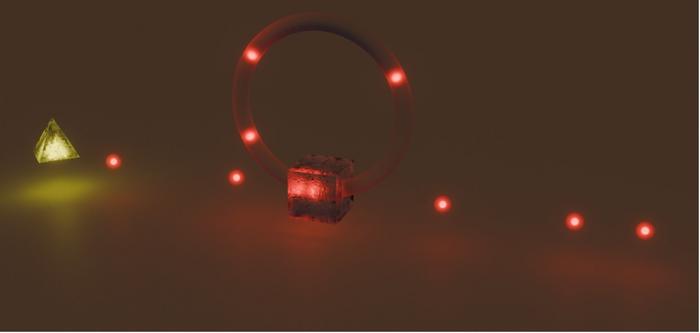
To realize this approach, they developed an innovative architecture at the Christian Doppler Laboratory at the University of Vienna, utilizing an optical fiber loop (Fig.1). This design enables repeated use of the same optical components, facilitating efficient multi-photon interference with minimal physical resources.
First author Lorenzo Carosini explains: "In our experiment, we observed quantum interference among up to eight photons, surpassing the scale of most of existing experiments. Thanks to the versatility of our approach, the interference pattern can be reconfigured and the size of the experiment can be scaled, without changing the optical setup."
The results demonstrate the significant resource efficiency of the implemented architecture compared to traditional spatial-encoding approaches, paving the way for more accessible and scalable quantum technologies.
EurekAlert!, the online, global news service operated by AAAS, the science society.