Devices Deliver Longer Useful Life, Higher Ripple Current, and Lower Impedance Than Standard Aluminum Capacitors
Conductive and Hybrid Conductive Aluminum Polymer Capacitors Save PCB Space and Lower Costs
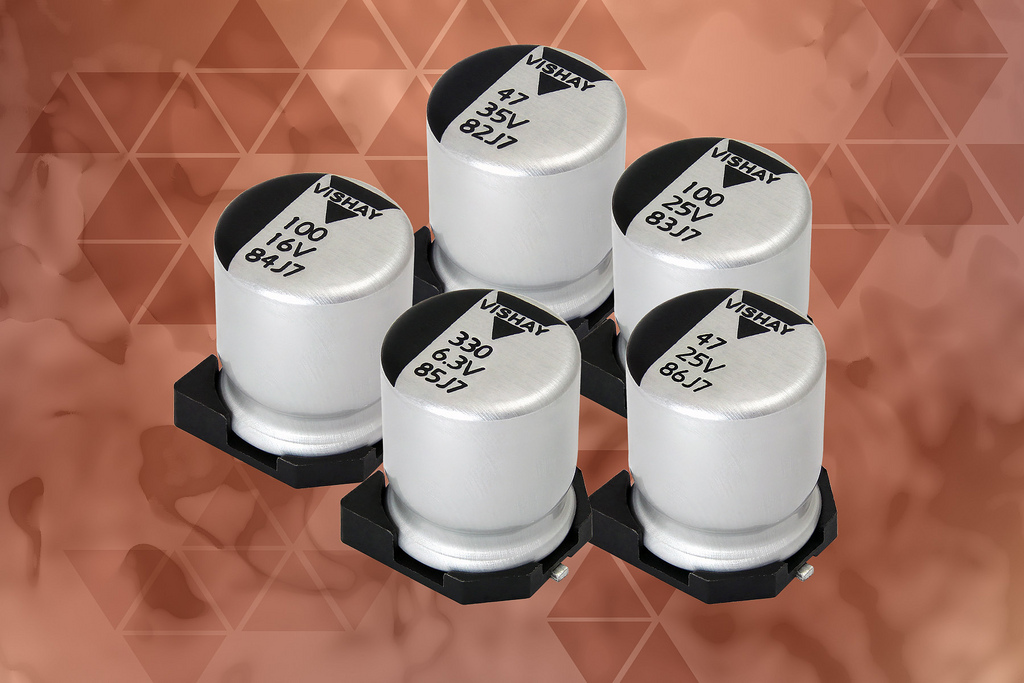
MALVERN, Pa. — Vishay Intertechnology, Inc. introduced new conductive (184 CPNS, 185 CPNZ, and 186 CPNT series) and hybrid conductive (182 CPHZ and 183 CPHT series) aluminum polymer capacitors in a variety of case sizes ranging from 4 mm by 4 mm by 5.5 mm to 10 mm by 10 mm by 12.4 mm. The Vishay BCcomponents devices offer longer lifetimes than do standard aluminum capacitors, and they provide higher ripple current and better impedance to save PCB space and lower costs.
With useful life to 5,000 hours at +105 °C, ripple current to 5600 mA, and ESR down to 9 mΩ, the conductive aluminum polymer capacitors released today are optimized for mobile devices and consumer and telecom applications. For automotive and industrial applications, the hybrid conductive devices offer a lifetime to 10,000 hours at +105 °C, ripple current to 2500 mA, and ESR down to 20 mΩ.
Available in AEC-Q200 qualified versions on request, the RoHS-compliant, surface-mount capacitors support automatic placement and high temperature reflow soldering in accordance with JEDEC.
Vishay can be found on the Internet at www.vishay.com.