Three-Cell Devices from New Yorker Electronics offer Greater Energy Potential and Power Output than Single or Dual-Cell Parts
Cornell Dubilier Brand of 3-Cell Supercapacitors from Knowles Precision Devices Operate at up to 9 WVDC
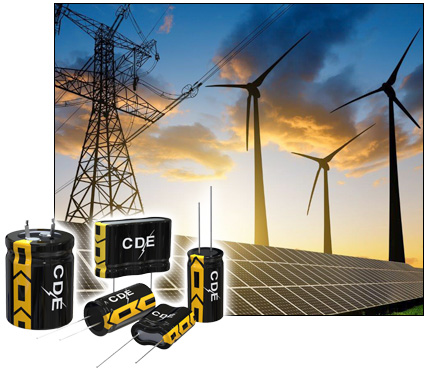
Knowles’ Cornell Dubilier brand, known as Knowles Precision Devices, a segment of Knowles Corporation, announced its latest Electric Double Layer Capacitor (EDLC) modules, or supercapacitor modules, are now available through New Yorker Electronics. Based on Knowles’ Cornell Dubilier brand DGH and DSF Series supercapacitors, these cutting-edge capacitors use a three-cell package for higher operating voltages and printed circuit board space savings.
The brand is a division of Knowles Corporation, a leading global supplier of high performance components and solutions. Knowles Corporation acquired Cornell Dubilier in 2023 to expand its offering of high-quality film, electrolytic and mica capacitors. Like other supercapacitors offered by Knowles’ Cornell Dubilier brand, the new devices provide very fast power discharge that cannot be matched by conventional capacitors or batteries.
That large capacity makes it possible to support brief power interruptions, supplement batteries, or even be used in place of batteries in many applications. These supercapacitors are ideal for applications including solar and wind energy harvesting, mechanical actuators, AGV (Automated Guided Vehicles), EV transportation power, smart utility meters, IoT, pulse battery pack alternatives, memory backup, battery/capacitor hybrids, UPS systems, emergency lighting, LED power, solar lighting or anywhere that significant energy storage is needed.
The new supercapacitors offer a notable jump in voltage rating over typical radial-mount supercapacitors, up to 9.0 WVDC. A key feature of the DGH and DSF Series additions is the unique three-cell radial-leaded package. Compared to single or dual-cell supercapacitors, the compact design saves space and allows for much higher operating voltages, making them ideal for a wider range of applications. Both series include capacitance values from 0.33 to 5 Farads. Multiple devices can be banked for even higher capacitance or voltage.
Their internal cell balancing ensures optimal performance and serves as a production time saver. DGH and DSF Series three-cell supercapacitors are also more cost-effective than other options currently available.
From a performance standpoint, both series offer high energy density and extremely low self-discharge rates, benefiting energy storage applications. Both series are also tolerant of wide-ranging operational environments, with operating temperature ranges from -40 °C to +65 °C for DGH 8.1V/DSF 9.0V and -40 °C to +85 °C for DGH 6.9V/DSF 7.5V. Low equivalent series resistance (ESR) minimizes energy loss for high efficiency. ESR varies by part but is lower than most capacitors with similar storage capabilities. These supercapacitors are designed to withstand over 500,000 charge/discharge cycles, ensuring long-lasting performance without performance degradation. Operating life is expected to be up to 10 years.
For more information, go here.