DC/DC Converter IC for ADAS Achieves Best-in-Class Stable Operation
QuiCur technology remarkably increases design flexibility for power circuits in increasingly sophisticated automotive applications
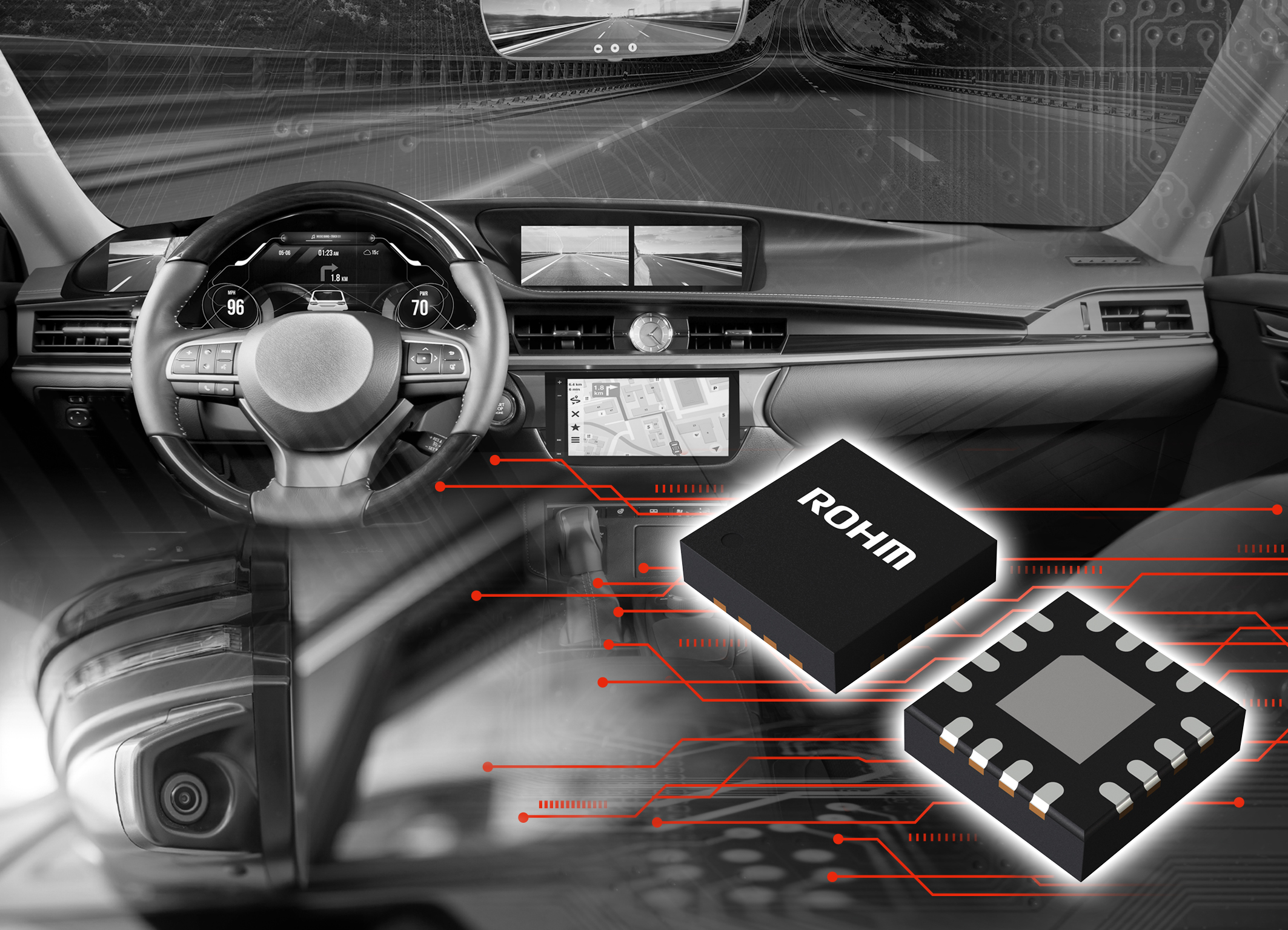
ROHM Semiconductor announced the BD9S402MUF-C, a new buck DC/DC converter IC with built-in MOSFET (switching regulator) for automotive applications such as infotainment and ADAS (Advanced Driver Assistance Systems) incorporating onboard sensors and cameras that are becoming more advanced.
In recent years, safety requirements in the automotive sector have increased as technological innovations in accident prevention and autonomous driving continue to progress. In line with this, SoCs and MCUs that control ADAS incorporating onboard sensors and cameras are leading to greater sophistication, necessitating power supply ICs to operate more stably even under severe load current fluctuation conditions.
To meet these needs, in 2017, ROHM established Nano Pulse Control ultra-high-speed pulse control technology that provides low output voltage at high switching frequencies, followed by QuiCur high-speed load response technology in 2021 that ensures stable operation. The IC to adopt QuiCur technology allows for class-leading stable operation compared with automotive secondary DC/DC converter ICs with equivalent performance.
The new BD9S402MUF-C supports output voltages down to 0.6V and 4A output current at switching frequencies higher than 2MHz in a compact size demanded by increasingly sophisticated secondary power supply applications for high performance MCUs and SoCs. In addition, it is incorporating proprietary QuiCur™ high-speed load response technology and enables stable operation at an industry-leading 30mV (measurement conditions: 5V input voltage, 1.2V output voltage, 44μF output capacitance, load current variation 0 to 2A/2μs). This translates to a 25% reduction in output voltage fluctuation over class-leading standard products with equivalent functionality, making it ideal for use in the latest ADAS with severe power supply conditions requiring stable operation within 5% even with low voltage output.
The BD9S402MUF-C is also equipped with a new load response performance selection function that allows users to easily switch priority between ‘voltage fluctuation’ (for industry-leading stable operation), and ‘capacitance reduction’ (to ensure stable operation at 22μF) via terminal setting. The result is that users can significantly reduce the resources required for power circuit design, as stable operation can be easily achieved not only at the initial design, but also during specification or model changes.
Going forward, ROHM plans to expand its lineup of power supply ICs incorporating QuiCur™ to support a wider range of applications.
New Product Details
The BD9S402MUF-C, in addition to meeting the basic requirements of secondary DC/DC converter ICs in ADAS for 2MHz or higher operation and 4A output current, ROHM’s unique Nano Pulse Control™ ultra-high-speed pulse control technology delivers next-generation low voltage output down to 0.6V – much lower than the typical 1.0V voltage output required by current SoCs and MCUs. At the same time, equipped QuiCur™ high-speed load response technology achieves extremely stable operation. The ability to suppress voltage output variation within 5% even at low output voltages below 1.0V makes it ideal for secondary power supplies for the latest ADAS.
The BD9S402MUF-C is also equipped with a load response performance selection function that leverages the characteristics of QuiCur™ technology, allowing users to easily switch priority between ‘voltage fluctuation’ (for industry-leading stable operation) and ‘capacitance reduction’ (to ensure stable operation at 22μF) by setting High/Low of the GAIN pin. For example, the user can set the GAIN pin to High in the case of a power supply for a high-performance SoC that needs to handle fast load fluctuations. Or the user can set the GAIN pin to Low for a good balance between performance and capacitor cost when the power supply for an MCU does not need to consider high accurate voltage fluctuations. This contributes to a significant increase in design flexibility for application designers, as stable operation can be easily achieved at initial design as well as during specification or model changes.
Application Examples
- ADAS ECU, sensors, cameras, and radars
- Communication systems, including wireless modules and gateways
- Infotainment systems such as clusters and head-up displays (HUDs)
- Secondary power supplies in automotive applications that employ high-performance SoCs, MCUs, and DDR memory, etc.
For more information, go here.