Designing Organic Flow Batteries for Practical Long-Duration Energy Storage

The growth of renewable generation is fundamentally changing how power systems operate.
Figure 1: XL Batteries' Organic Flow Battery™ technology is designed to provide safe, scalable long-duration energy storage that supports renewable energy integration, grid resilience, and growing electricity demand from urban and industrial centers. Rendering courtesy of XL
Wind and solar generation continue to scale rapidly, but their intermittency creates a growing mismatch between when electricity is generated and when it is needed. As grids transition away from fossil fuel plants as they retire, utilities will increasingly require energy storage systems capable of shifting large amounts of energy over long durations.
Lithium-ion batteries have emerged as the dominant storage technology over the past decade, primarily because they leverage manufacturing scale originally built for consumer electronics and electric vehicles. However, as storage durations extend beyond several hours, lithium-ion systems face growing economic and operational challenges tied to fire risk, degradation, and replacement costs.
Flow batteries have long been viewed as one of the most promising alternatives for grid-scale stationary storage because they decouple power and energy into independent systems. This architecture enables long-duration storage without the steep costs associated with duplicating short duration lithium-ion systems to achieve long-duration. Yet despite decades of development, flow batteries have struggled to achieve broad commercial adoption.
The limiting factor has not been the architecture itself. It has been chemistry.
The Limits of Lithium-Ion for Grid Infrastructure
While lithium-ion batteries remain highly effective for mobile applications, utility-scale infrastructure faces three growing constraints:
● Fire risk
● Inability to meet infrastructure lifetime due to degradation
● End-of-life recycling complexity
At utility scale, lithium storage projects contain hundreds of thousands to millions of cells operating simultaneously. Even extremely low defect rates become statistically significant at hundreds of megawatt-hours and millions of cells. Thermal runaway incidents in grid-scale lithium-ion installations continue to demonstrate the operational risks associated with large deployments.
Duration economics are also increasingly problematic at durations beyond approximately eight hours. Extending storage duration requires duplicating large portions of the system architecture which yields diminishing economic returns.
Other emerging long-duration technologies come with their own tradeoffs. Hydrogen systems suffer from low round-trip efficiency due to energy losses associated with electrolysis and power conversion. Thermal systems work effectively for industrial heat applications but face efficiency challenges when converting stored heat back into electricity.
The industry increasingly recognizes that no single storage technology will serve every application. However, for long-duration stationary storage, the combination of scalability, safety, operational flexibility, efficiency, and lower projected system cost continue to make flow batteries one of the most attractive technologies available.
Why Flow Batteries Matter for Long-Duration Storage
Unlike lithium-ion batteries, which store energy directly inside fixed electrode materials, flow batteries store energy in liquid electrolytes contained in external tanks. The electrolyte circulates through a stack of electrochemical cells during charging and discharging.
A useful analogy is a car engine and fuel tank.
In a flow battery, the cell stack acts as the engine. It determines the system’s power output. The electrolyte tanks act as the fuel tank. They determine energy duration.
This distinction is significant because it allows megawatts and megawatt-hours to scale independently. Increasing duration does not require duplicating the entire electrochemical system. Instead, operators can increase storage volume while maintaining the same power stack.
In practical terms, this creates a fundamentally different cost curve than lithium-ion storage. Extending a lithium-ion system from four hours to twelve hours requires substantially more battery packs, containers, thermal management systems, controls, and safety infrastructure. In a flow battery, extending the duration only requires larger electrolyte tanks and additional active material.
This architecture has already demonstrated technical viability at the largest utility scales. China recently deployed an 800 MWh vanadium flow battery system, one of the world’s largest energy storage installations. The challenge preventing broader adoption is not scalability, it is cost.
The Chemistry Problem
Most commercial flow batteries rely on vanadium dissolved in strongly acidic electrolytes. Vanadium offers stability and long cycle life, but it introduces several economic and engineering constraints.
First, vanadium itself is a commodity that is expensive and subject to market volatility. Historically, it has been as much as $125/kWh for just the metal itself.
Second, acidic systems require highly corrosion-resistant infrastructure. Components such as pumps, seals, piping, membranes, and gaskets must withstand harsh chemical environments for 20 years of operation. This often requires fluorinated polymers, specialty elastomers, and Teflon-based materials that increase both system cost and manufacturing complexity.
Many of these materials are also increasingly associated with PFAS-related regulatory concerns. The chemistry itself therefore propagates cost throughout the entire system architecture.
For decades, researchers at institutions including Harvard, MIT, and many national laboratories have pursued organic molecules as a lower cost alternative to vanadium. Organic, redox-active materials offer theoretical advantages because their molecular structures can be modified and engineered for stability, solubility, and electrochemical performance while leveraging abundant feedstocks and established petrochemical manufacturing processes. Unlike elemental chemistries such as zinc, iron, sulfur, air, etc. that cannot be changed, organic molecules can be manipulated and derivatized.
Historically however, organic systems have encountered a critical limitation: instability.
Stability as the Missing Link
Organic flow batteries rely on molecules that become radicals during charging and discharging. In chemistry, radicals are generally highly reactive and short-lived. Many exist for only microseconds before decomposing or reacting into other compounds. That instability has historically prevented organic flow batteries from achieving the long cycle life required for utility-scale infrastructure.
XL Batteries stems from a fundamental discovery at Columbia University of stable radical molecules. This foundational discovery allows XL to approach the energy storage problem from an entirely different perspective than other elemental battery chemistries such as zinc, iron, sulfur, etc. By finding a stable organic molecule, XL can avoid engineering increasingly complex systems around difficult chemistries that cannot be modified. Rather we can adjust the molecular design itself. That approach enabled us to develop a patented, stable organic molecule that is soluble in pH-neutral water and maintains long-term electrochemical stability.
In addition to being composed from exceptionally low cost and extremely abundant petrochemical commodity feedstocks, the chemistry operates in pH-neutral water. This is important because most metal-based systems require extremely acidic or basic electrolytes to dissolve the active materials - generally metals don’t simply dissolve in regular “tap water”. By contrast, XL’s organic chemistry can be engineered using surfactant-like modifications to the molecule to enable solubility under neutral pH conditions.
This innovation at the foundational level changes the engineering requirements of the entire system. Instead of requiring highly specialized corrosion-resistant materials, the battery can utilize more conventional plastics, rubbers, desalination membranes, and commodity industrial components. Simplifying the chemistry reduces the need for increasingly complex downstream engineering solutions and expensive components.
Click image to enlarge
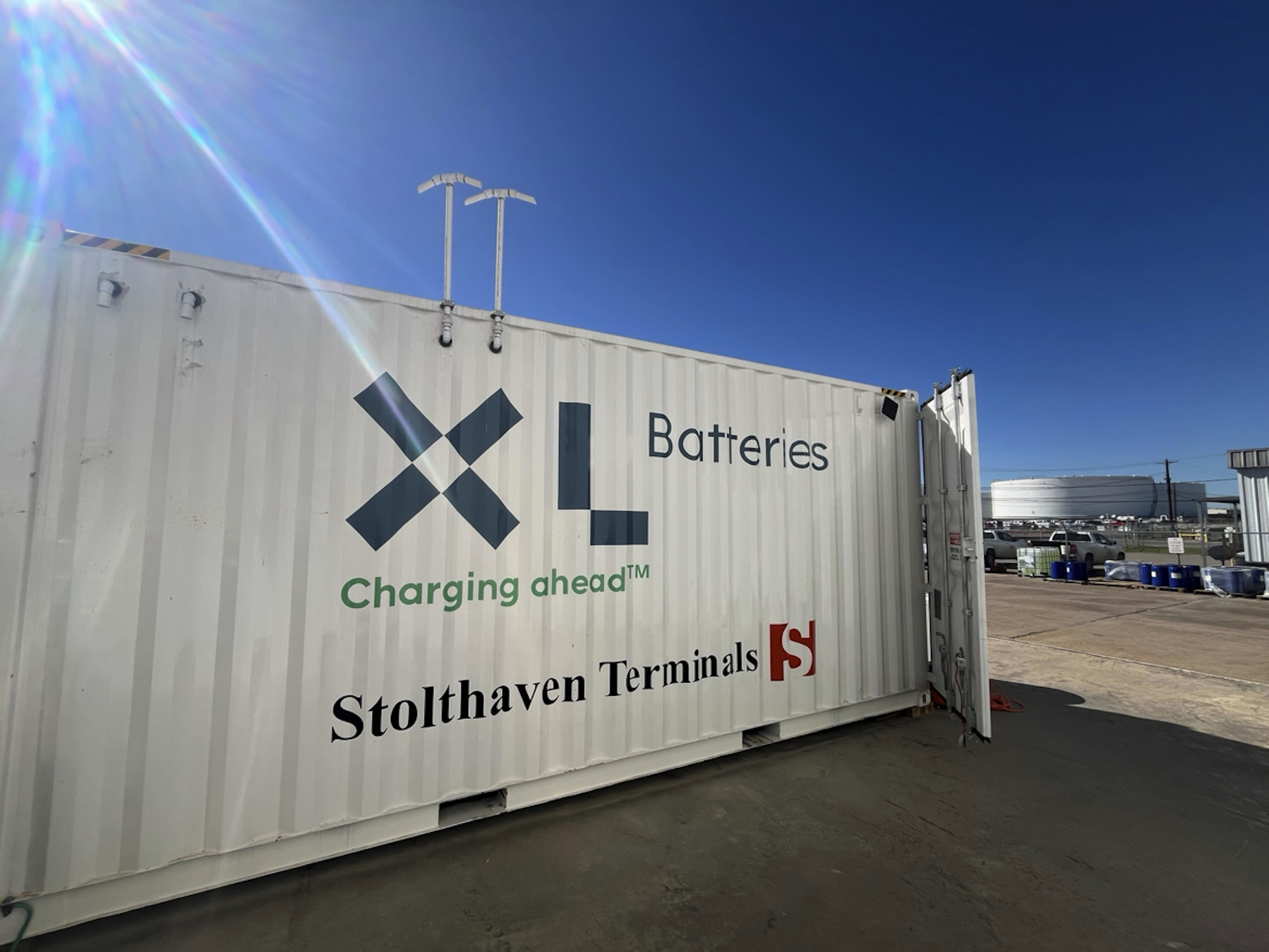
Figure 2: XL Batteries commissioned its Organic Flow Battery™ in partnership with Stolthaven Terminals. This is the first deployment of XL's innovative long-duration energy storage (LDES) technology. Photo credit: XL Batteries
System Design and Operational Simplicity
The resulting system architecture is mechanically straightforward, leveraging proven flow battery architecture while introducing a fundamentally new chemistry.
The electrolytes circulate continuously through porous electrodes in the electrochemical stack. Pumps regulate flow through the system while sensors monitor pH, state of charge, and electrolyte conditions. Nitrogen blanketing systems minimize oxygen exposure, while crossover between electrolyte tanks can be monitored and isolated when necessary via simple consumer sensors.
One advantage of the chemistry is that the active molecules exhibit different colors, enabling standard colorimetric sensors to easily detect crossover between the anolyte and catholyte liquids, allowing for simple isolation of defective stacks rapidly.
Because power and energy remain decoupled, the architecture scales flexibly for different use cases. XL’s commercial product is based on a 333 kW containerized platform, and duration is adjusted through sizing of a separate set of electrolyte tanks.
This flexibility is particularly important for long-duration grid applications where operators increasingly require eight to twelve hours of storage rather than the two-to-four-hour duration common in current lithium-ion deployments.
Toward Utility-Scale Long-Duration Storage
Long-duration storage is not simply about replacing short bursts of peaker plant operation, a common lithium-ion utility scale application. At sufficient scale, long-duration storage changes how utilities operate their baseload generation and transmission assets across the grid.
Storage durations of eight to twelve hours enable operators to shift renewable generation across large portions of the day, reduce transmission congestion, improve overnight asset utilization, and support broader deployment of intermittent generation resources.
The economics become particularly compelling in regions where solar generation already represents the lowest-cost source of electricity. Achieving this transition requires storage technologies capable of delivering infrastructure-scale performance and lifetime at infrastructure-scale cost.
Flow batteries have long offered the technological advantages needed for this role. The missing piece has been stable, low-cost chemistry capable of making the broader system commercially viable.
That is the problem the industry has been trying to solve for decades. XL’s stable organic chemistry may finally provide the path forward.