DIP8 optocoupler delivers enhanced Isolation for IPM motor control
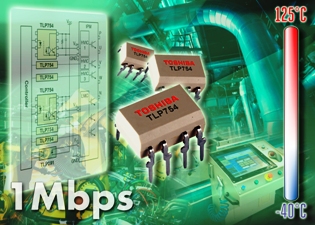
DIP8 optocoupler delivers enhanced Isolation for IPM motor control Ideal for motor control and inverter applications designed for noisy, extended temperature industrial environments, the TLP754 optocoupler IC from Toshiba Electronics Europe provides a low-power, space-saving isolation interface between an IPM (intelligent power module) and its control circuitry. Combining guaranteed operation at temperatures from -40°C to 125°C with a minimum input-to-output isolation voltage of 5000Vrms (AC, 1 min), the device is supplied in a DIP8 package measuring just 9.6 x 7.6 x 3.6mm. A wide supply voltage of -0.5V to 30V and a wide output voltage of 4.5V to 30V enhance design flexibility, while a maximum input current of just 1.3mA meets requirements for high-efficiency designs. Data rates of 1Mbps are guaranteed thanks to a maximum propagation delay time and pulse width distortion rating of 550ns and 400ns respectively. The optocoupler is built around a long-life GaAlAs infrared LED that is optically coupled to an integrated, high-gain, high-speed photodetector IC and an inverter logic open-collector output. An internal Faraday noise shield ensures a guaranteed common mode transient immunity of +/- 20kV/?s.