Complex structured light can be obtained via spatial structure variation of laser beams in the nonlinear frequency conversion process
Extension of laser beam structures promises new laser applications. Exploration of how beam structures change during nonlinear frequency conversion processes has drawn increasing interest in recent years. Nonlinear conversion is an excellent route for structured beam generation and represents a growing, hybrid field for researchers in nonlinear optics and laser technology, as well as the emerging area of light-field regulation technology.
For structured beam generation and nonlinear frequency conversion, researchers have considered both intracavity oscillation and external cavity spatial modulation. To achieve flexible outputs, spatial light modulators can be used to obtain structured beams both inside and outside the laser cavity. But this is an indirect, inefficient method. Intracavity nonlinear frequency generation of structured beams offers a direct, efficient method that has only rarely been investigated, until recently.
Inside a laser cavity, an effect known as "transverse mode locking" (TML) enables the direct generation of the vortex beams or optical vortices from a laser cavity. It is known that both solid-state microchip lasers and VCSELs can produce quite similar outputs of TML beam patterns under large Fresnel number pumping conditions. The complex transverse patterns formed by the TML effect, commonly composed of different basic modes with different weight coefficients and different locking phases, make for abundant spatial information in fundamental frequency modes. Nonlinear frequency conversion of these directly generated TML beams is of great interest, but not yet well studied.
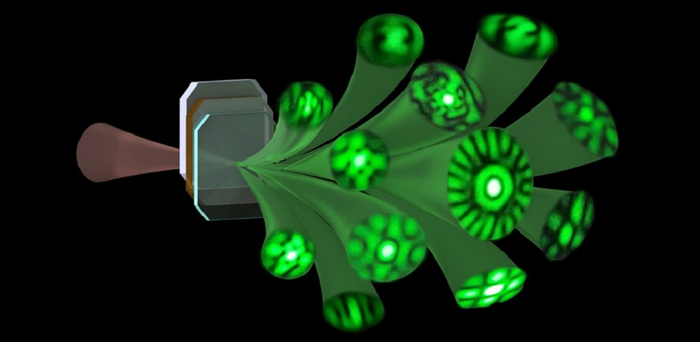
As reported in Advanced Photonics, researchers from the Beijing Institute of Technology, Tsinghua University, and Arizona State University recently investigated intracavity second harmonic generation (SHG) of various passively Q-switched laser beams in TML states. They analyzed the electrical field transformation and propagation principle of the SHG of TML mode, precisely predicting the complex far-field beam patterns of the SHG beam, fundamental frequency, and transverse modes. Structured TML beams and their SHG beams are generated simultaneously by a sandwich-like microchip laser cavity that is passively Q-switched. The team observed many rare SHG far-field beam patterns and their experiments showed good agreement with the simulations.
The study shows that parametric variation (especially the phase difference of fundamental frequency modes) for the TML modes greatly changes the far-field beam patterns of the SHG beam. Generated SHG beam patterns vary with the propagation, from the beam waist to several times the Rayleigh length, and then they remain stable into the far field. The SHG beam patterns were observed to have more obvious structural characteristics than those of the fundamental frequency beam.
The generation of TML laser modes, especially the frequency-converted ones, opens intriguing new avenues for obtaining various structured beams with a direct, intracavity method. This work will help advance future applications of structured beams, particularly in optical 3D printing, optical trapping of particles, and free-space optical communication areas.
EurekAlert!, the online, global news service operated by AAAS, the science society.