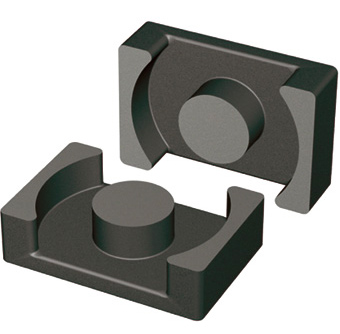
Micrometals is proud to introduce its new series of EQ distributed gap cores. The rectangular geometry of the EQ body is ideal for surface mount applications while the round center post readily accepts helical flat wire coils, or bobbins with round wire. The cores are offered in six industry standard geometries from 20mm to 50mm, three exclusive material formulations, and three reference permeability values.
The new EQ geometries are available in Micrometals exclusive material formulations of Sendust (MS), Hi-Flux (HF) and FluxSan (FS - Iron Silicon) with 26, 40 or 60 permeability values. These uniquely formulated materials offer a combination of high saturation magnetization and low losses, making them well suited for switching applications up to 1MHz. The distributed gap nature of these materials means that they can be used with little or no center-leg gap, greatly reducing the losses associated with fringing flux at higher frequency. EQ cores offer several key advantages over toroid or E core geometries including better self- shielding and high winding density.
The EQ series offering has been incorporated into the Micrometals Online Inductor Design Tool, for facilitating material selection and design optimization - https://www.micrometalsapc.com/design-software
.jpg)