DOE Funds Field Test of Rice's Solar Desalination Technology
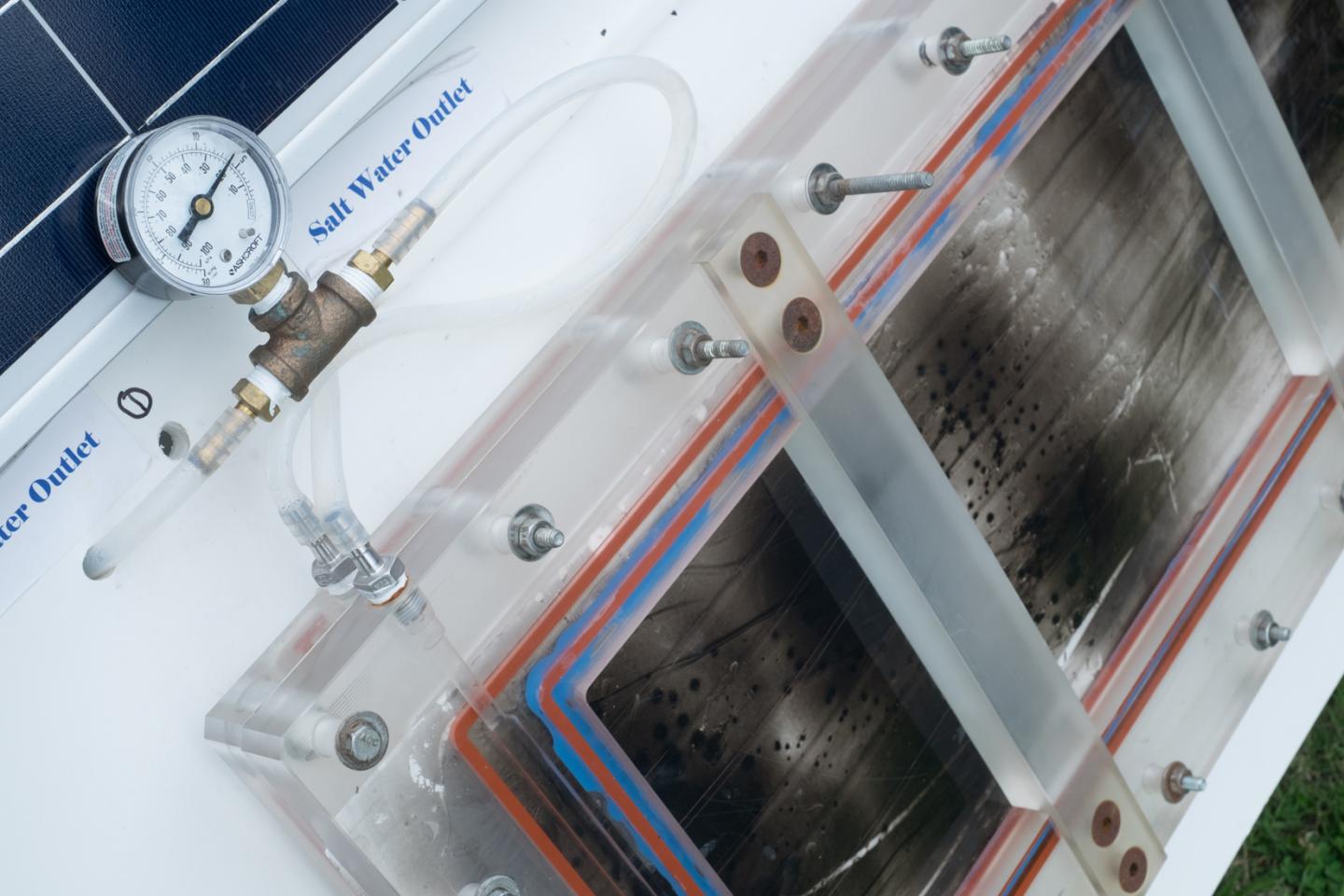
NEWT Center's light-harvesting membranes heat, desalinate water in one step
HOUSTON -- The Department of Energy (DOE) has awarded $1.7 million to a Rice University-led team for further development and field testing of an innovative desalination technology that uses nanoparticles and sunlight to treat water.
Rice's "nanophotonics-enabled solar membrane distillation" technology, or NESMD, is one of 14 projects funded June 19 through the DOE Solar Energy Technologies Office's Solar Desalination program.
NESMD combines tried-and-true water treatment methods with cutting-edge nanotechnology. By adding low-cost, commercially available nanoparticles to a porous membrane, the researchers essentially turn the membrane itself into a one-sided heating element that drives membrane distillation. The technology is in development at the Rice-based Center for Nanotechnology Enabled Water Treatment (NEWT), a multi-institutional engineering research center funded by the National Science Foundation.
"We're creating off-grid systems to provide water anywhere it's needed," said NESMD inventor and NEWT Co-director Qilin Li, a professor of civil and environmental engineering at Rice.
The oldest method of desalination is boiling brine and capturing the steam, which turns into fresh water after it cools. But boiling large volumes of water takes energy, so much so that energy costs account for the majority of operational expenses for thermal desalination plants. Membrane distillation is a lower-energy alternative in which hot brine is flowed across one side of a porous membrane and water vapor is drawn naturally through the membrane to the other side, where the temperature is lower.
NESMD builds upon membrane distillation by incorporating light-capturing nanoparticles directly into the membrane. Li developed it with NEWT colleagues, including Rice Professor Naomi Halas, NEWT's lead researcher for photonics, whose lab pioneered the creation of light-harvesting nanoparticles that can convert sunlight into heat, and Yale University Professor Menachem "Meny" Elimelech, NEWT's lead researcher for membrane processes.
In 2017, Li, Halas, Elimelech and colleagues published results showing that laboratory-scale NESMD prototypes could desalinate water at a rate of up to 6 liters per hour per square meter of light-harvesting membrane. Li said many parts of the NESMD technology can be optimized to improve upon those results as the system is scaled up for operational field tests.
EurekAlert!, the online, global news service operated by AAAS, the science society: https://www.eurekalert.org/pub_releases/2018-06/ru-dff062518.php