One must safely deliver low-voltage power to the device
Sensors play a major role in enabling Industry 4.0 applications, but their underlying electronics are complex. On-board voltage regulators are typically needed to deliver power more efficiently with minimum heat generation. One big challenge, however, lies in safely delivering low voltage power to these tiny sensors, which operate in high-voltage industrial environments, while also minimizing solution size and maximizing efficiency. A good solution to this dilemma is to use a switching regulator—instead of an LDO—to efficiently and safely deliver power in a small form-factor.
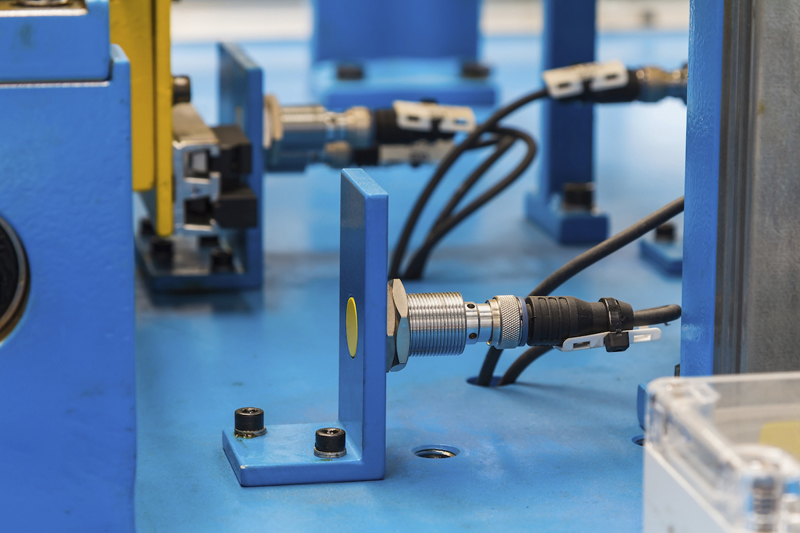
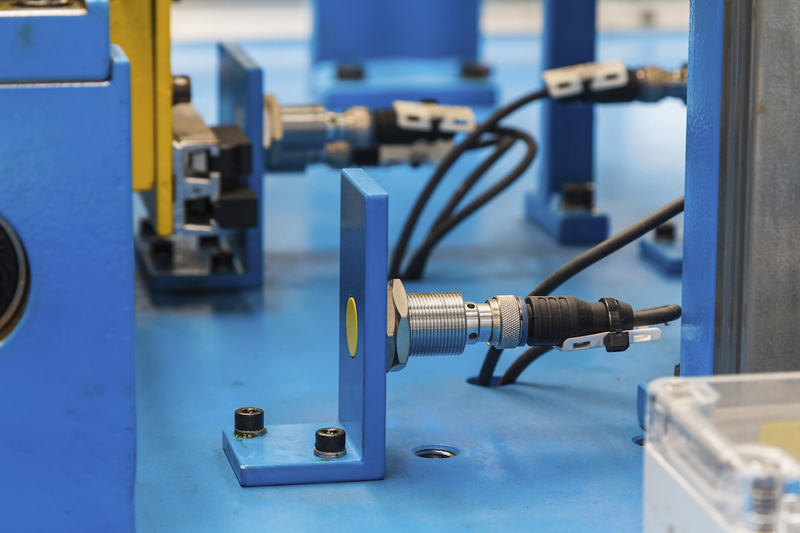
In an industrial environment, sensors are responsible for detecting, diagnosing, and deciding, so they must be durable and reliable. Proximity sensors (see Figure 1), temperature sensors, and pressure sensors are used in a variety of industries and can be located anywhere on the factory floor. A sensor sends information to a control center, which then sends the appropriate action to the actuator via a field bus. Typically, the sensor ‘box’ includes a front-end connector/interface that handles data and routes power to a step-down voltage regulator. The regulator then delivers the appropriate voltage to the ASIC/microcontroller/FPGA and the sensing element.
Click image to enlarge
Figure 1: Proximity sensors in a factory environment.
Operating Under Safe, Low Voltages
An isolated 24V DC power source usually powers the sensor. But, keep in mind the harsh environment of a factory floor. Long cables and strong electromagnetic interference can lead to high voltage transients. That’s why the step-down converter inside the sensor must be able to withstand voltage transients of 42V or 60V—much higher than the sensor operating voltage. According to SELV/FELV regulations, an isolated device handling up to 60V is considered safe to touch. Dedicated TVS devices can provide protection above 60V.
Reducing Power Losses in the Sensing Element
For most industrial sensing elements, it’s essential to have an input voltage that’s significantly lower than that supplied by the system. Many systems use an LDO to step down a 24V system voltage to 5V to power the microcontroller (3mA) and the sensing element (100mA). This is a lossy process (η=21% in this example) that ends up dissipating 2.5W of power. However, the power losses can be reduced down to 624mW by using a buck switching regulator with 85% efficiency to perform the voltage step down.
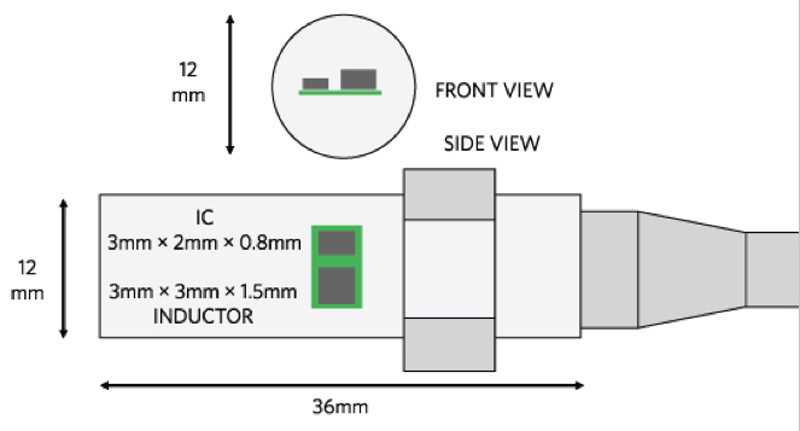
While sensor electronics are becoming more complex, sensor housings are shrinking to support smarter factories. That’s why it’s important for the on-board voltage regulator to be small while efficiently delivering power with minimum heat generation. In Figure 2, you can see the size of a Himalaya switching regulator IC (MAX17552) and the companion inductor housed in a small, M8 sized proximity sensor.
Click image to enlarge
Figure 2: Buck IC, Inductor, and Sensor Size Comparison