Automotive lighting is undergoing a fundamental change as more lighting solutions shift from conventional bulbs to light emitting diodes
Automotive lighting is undergoing a fundamental change as more lighting solutions (both interior and exterior) shift from conventional bulbs to light emitting diodes (LEDs). LEDs present unique challenges in automotive applications, but they also promise unique advantages and possibilities. While driving LEDs requires more complicated electronics, and more electrical components, LEDs provide better light, with more display controls, less power, less heat loss, smaller size, and longer life. Overcoming the challenges presented by more widespread LED use, in order to more fully realize their benefits, is vital for the future of automotive lighting.
The Challenges of Automotive Electronics
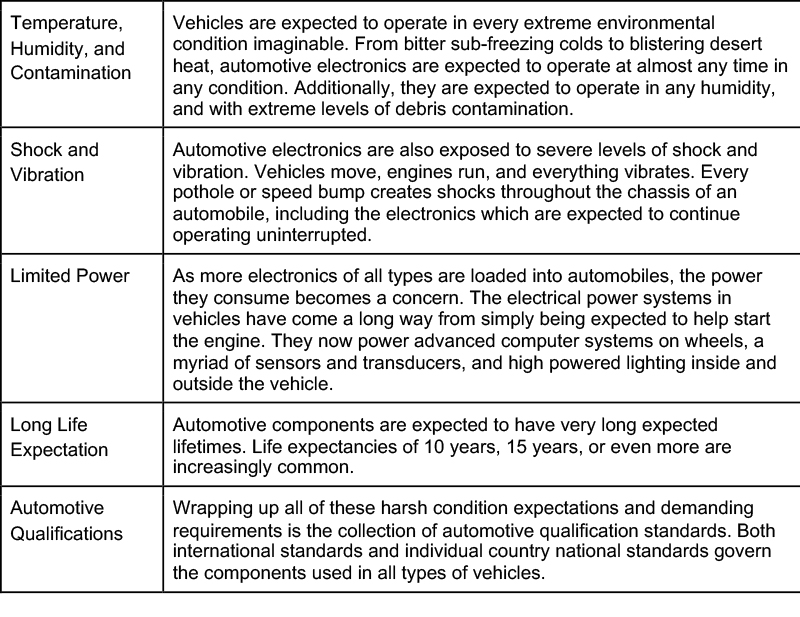
Electronics in automobiles (and, therefore, the LEDs in automobiles as well) face harsh conditions and demanding requirements.
Despite these harsh conditions and demanding requirements, automotive electronics are expected to operate with a high reliability commensurate with the expectations for other automotive parts and components. Failure rates at or near zero during rated life are expected for many automotive electronic components.
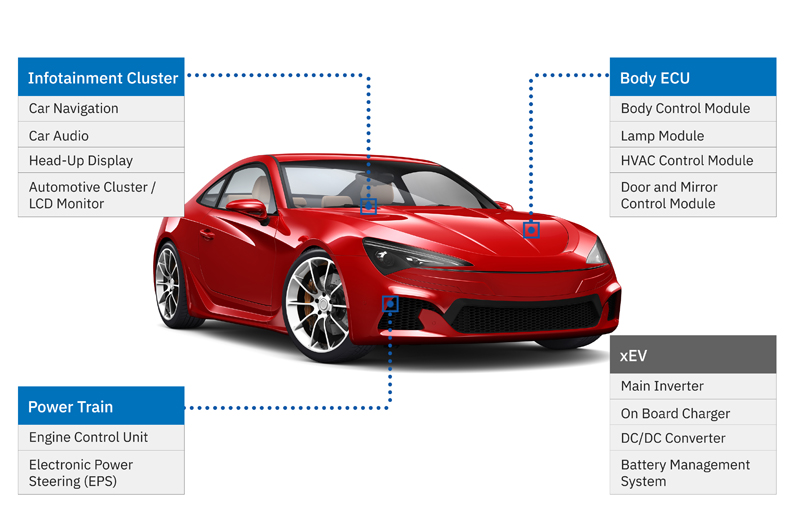
ROHM offers many components suitable for automotive applications. These components range from resistors and diodes to transistors and integrated circuits.
Click image to enlarge
Figure 1: A sampling of the electronic components found in modern automobiles
All of these components need to be rated for automotive use and meet the stringent requirements. Driving LEDs for external lamps, headlights, running lights, and brake lights, present some unique challenges that are in addition to the non-trivial concerns listed above.
The Challenges of Driving LEDs
- Power Consumption / Thermal Control
High powered LEDs used for external lamps require a lot of current, and that power needs to be controlled in order to control the temperatures in and around the electronics.
2. Space Constraints
Automotive LED lamps are space constrained, so the size of the LEDs, their control circuitry, and the printed circuit board(s) is critical. Fitting LEDs into the space traditionally reserved for lamps was the first challenge - shrinking even smaller and accommodating unique lamp shapes for future automotive advances is the next.
3. Cost of Solution
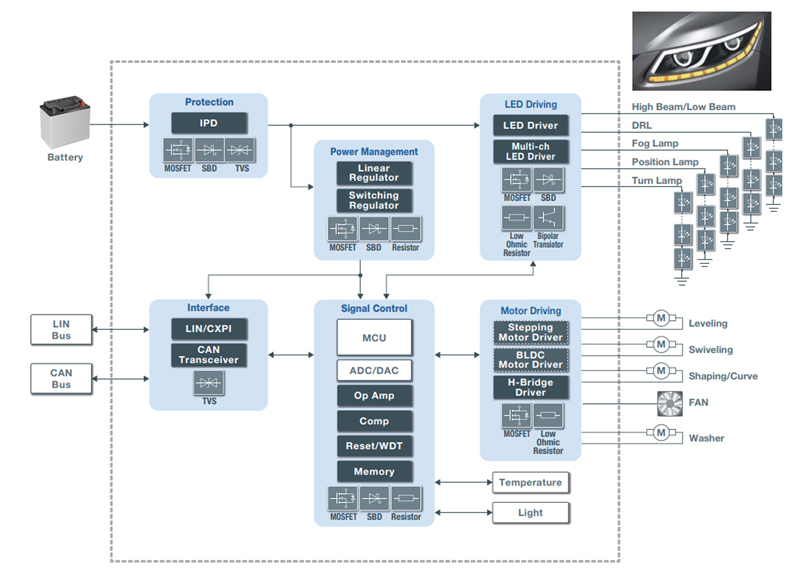
LED technology has existed for decades, but the cost of the LED driver solutions has been a limiting factor slowing their adoption in the automotive space. LED lamps require more control circuitry and components to operate efficiently.
Click image to enlarge
Figure 2: Example LED Lamp Module Circuitry
Today, ROHM offers driver ICs and LEDs for automotive lamp modules that lead the industry in solutions to these challenges.
ROHM’s Automotive LED Driver Family and the BD183x7EFV
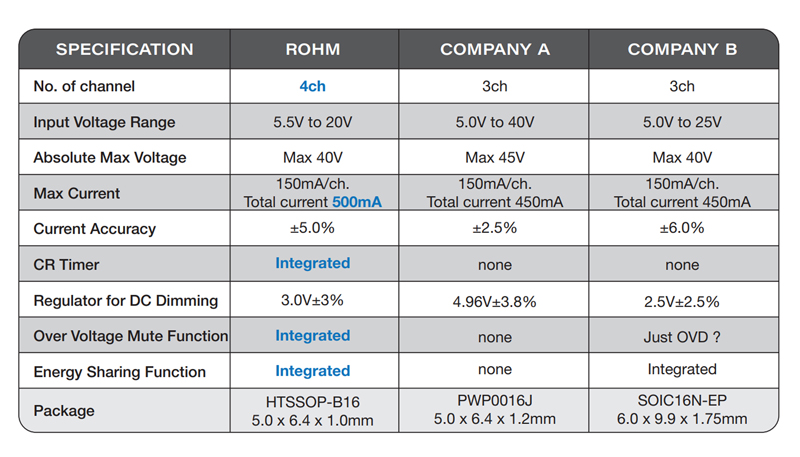
ROHM has a comprehensive offering of LED drivers for automotive applications - for internal or external lighting, switching or linear drivers, buck or boost converters. One driver IC worth a closer look is ROHM’s new BD18337EFV/BD18347EFV device. The BD183x7EFV is a 4-channel linear LED driver that is AEC-Q100 qualified for automotive designs. It has a number of significant advantages over competitive devices on the market today.
Click image to enlarge
Figure 3: Specification comparison between BD183x7EFV and competitors
BD183x7EFV Advantage: 4 LED Channels
While competitor devices can drive only three LED channels, this new ROHM device can drive four LED channels. This is a tremendous advantage for cost and space concerns. This driver is also capable of driving one LED string per output channel, or driving one string with two, three, or four output channels, providing design flexibility.
BD183x7EFV Advantage: Individual Channel Control
Individual channel control means that advanced lighting techniques such as dimming, fading, or directional indications are made possible. Competitor devices do not typically enable individual control of the LED channels, instead only driving all channels with one control PWM.
BD183x7EFV Advantage: Energy Sharing Function with External Resistors
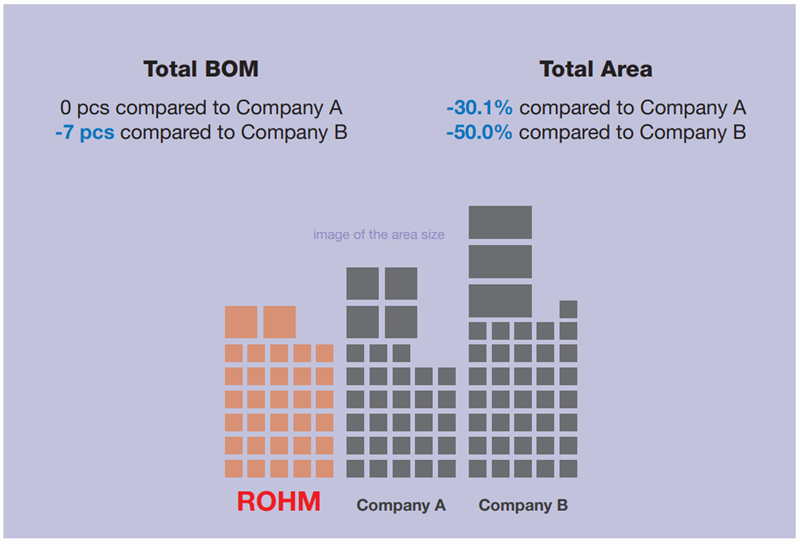
Rather than dissipating all of the LED power in the driver IC, as competitor devices do, these new ROHM devices include a pin to allow the power to be dissipated in external thermal resistors. Instead of requiring two driver ICs to reduce the power dissipated in each, these external power resistors reduce the size and cost of the design while separating the thermal concentration on the PCB.
Click image to enlarge
Figure 4: Example BOM and Board Space Savings with BD183x7EFV
BD183x7EFV Advantage: PBUS Function
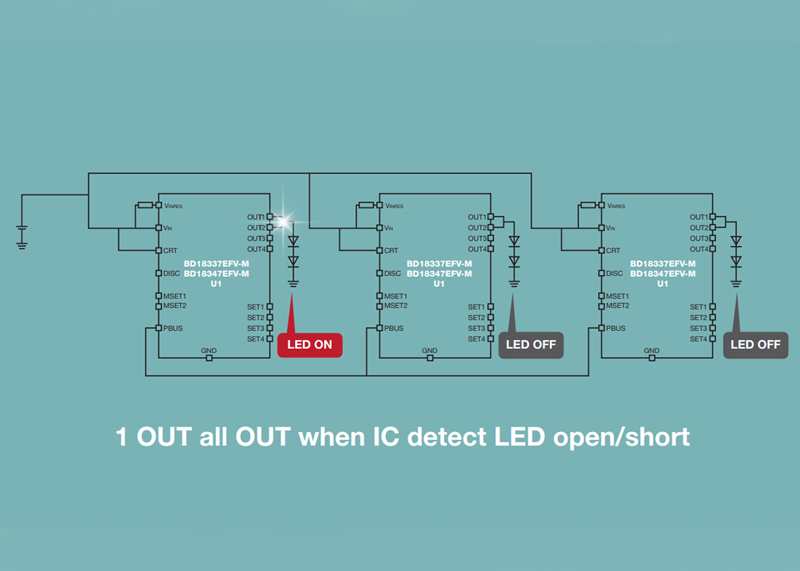
The PBUS function reduces the need for additional control circuitry by integrating the control function between multiple driver ICs to turn off all LEDs when an open or short is detected on any LED channel. This function is currently required in automobiles in the EU, and it can be accomplished without additional components with the BD183x7EFV driver IC.
Click image to enlarge
Figure 5: PBUS Function
ROHM is the Industry Leader for LED Drivers
Electronic components for automotive applications face serious challenges. They are expected to operate in harsh conditions and meet demanding requirements. Automotive LED lamp modules, therefore, need components that meet every qualification and provide every technical advantage.
ROHM continues to push what is possible in the LED driver design space because of their understanding of the needs of designers and engineers who want to innovate and push what is possible with something as fundamental as the lighting used in an automotive design. ROHM’s BD18337EFV/DV18347EFV device provides critical space savings and superior PCB thermal design, along with PBUS function and a 4-channel output contributing to advanced rear lamp design. This, combined with ROHM’s automotive-qualified LEDs, makes ROHM uniquely positioned to overcome critical design challenges for automotive lighting in the future.