Empower Semiconductor Launches First Quad-Output IVR Series
Industry’s highest density IVR integrates four voltage rails in miniature IC that offers industry - leading performance and extensive fault protection without external discrete components
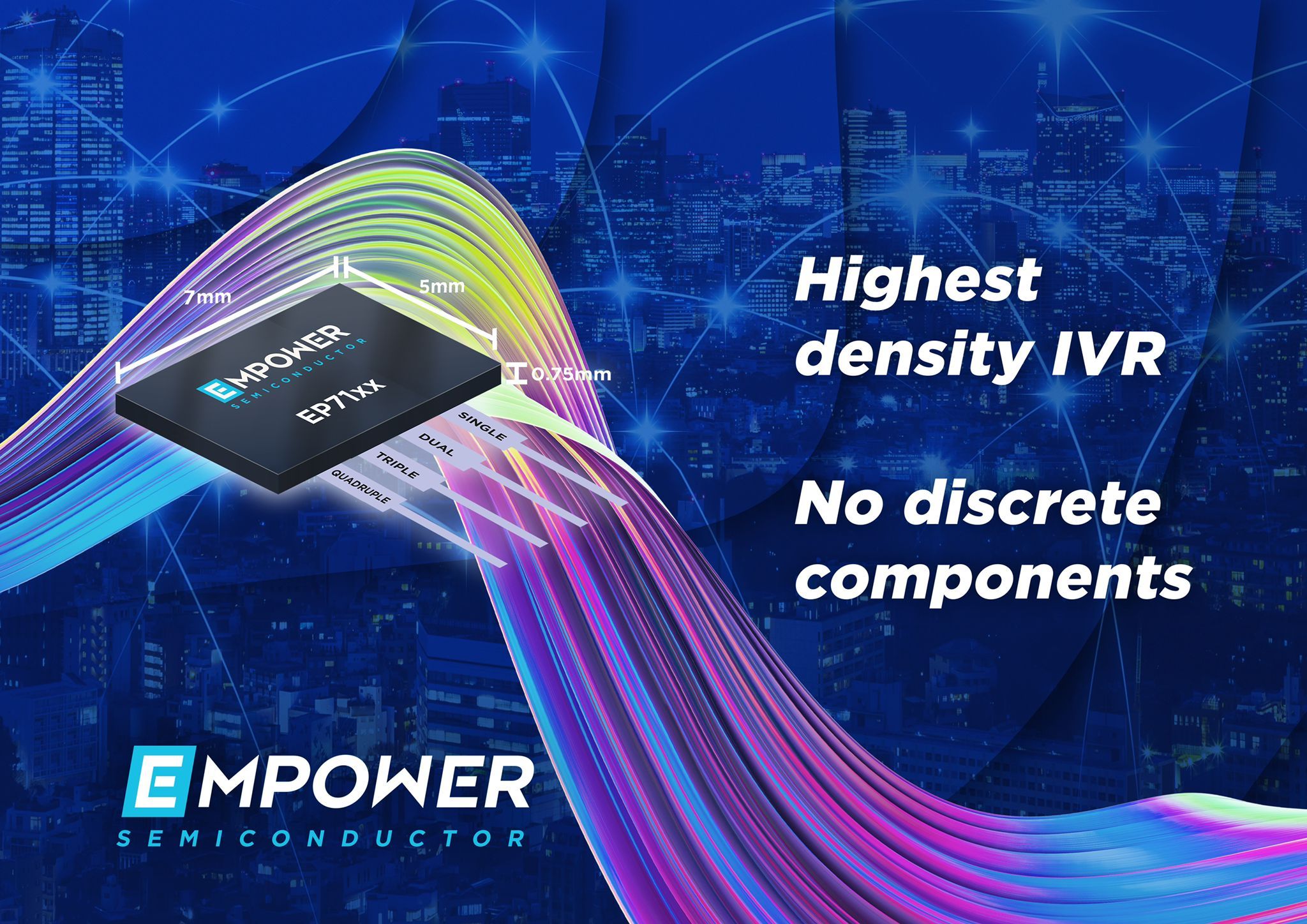
Empower Semiconductor, Inc. has announced a series of quad-output step-down converters that combine the industry’s highest current density and efficiency, the fastest dynamic voltage scaling (DVS) and transient response, and extensive fault protection. As with previous members of Empower’s IVR family, the new digitally configurable EP7 1xx series can deliver complete voltage regulation and protection functionality without the need for external discrete components.
Furthermore, the EP71xx series can eliminate other system components that increase cost and area by integrating those system functions. Empower’s IVRs are high-performance power management chips designed to provide efficiency, size, and cost benefits to energy-hungry, data-intensive, electronics applications by replacing traditional power management integrated circuits (PMICs) with a single tiny IC. IVRs monolithically integrate the voltage regulator semiconductor and all the necessary discrete components into a single device. Such integration simplifies the design and implementation of voltage regulation circuitry, improves efficiency by eliminating connection losses, reduces susceptibility to EMI, minimizes the bill of materials, enhances overall reliability, and reduces PCB footprint.
The EP71xx series delivers an impressive 12A of continuous current with up to 4 voltage regulators in a single FcCSP package that measures just 5mm x 7mm and only 0.7mm in height! Maximum efficiencies can be achieved, minimizing losses across the widest possible range of operating conditions. Ultra-fast transient response supports regulation through a load step and the programmable ‘ExpressV’ DVS-on-demand is capable of up to 6mV/ns. This feature is more than 1000x faster than other competing technologies and enables rapid, lossless, processor state changes that can significantly reduce processor power.
For more information, visit here.
.jpg)