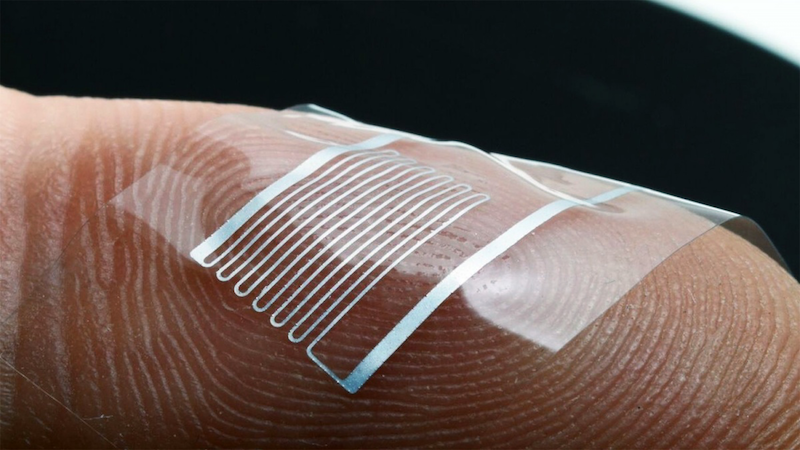
With an eye on next-generation wearable technology and even artificial skin, researchers at the École Polytechnique Fédérale de Lausanne (EPFL) have developed a fully-flexible polymer that’s imbued with liquid metal — a groundbreaking new material that can be used to create stretchable electronic circuits. The material is still just a proof of concept at this point, but if refined, it could help usher in a new era of wearable tech.
Thus far, creating sensor-studded textiles has proven extremely difficult, since hardwired circuitry doesn’t allow for a whole lot of flexibility. The EPFL material, however, can be stretched to four times its length a million times, without damage to the integrity of the material and its embedded circuitry. A stretchy polymer film serves as the base for an ultrathin layer of liquid metal alloy.
Since the polymer itself is stretchy and flexible, only a liquid metal could facilitate conductivity without keeping the material rigid. The alloy is made up of gold and gallium, which remains liquid at room temperature so it can still conduct the current in a circuit while the polymer is manipulated or stretched.
This isn’t the first time that scientists have tried to manipulate liquid metal in this way, but its high surface tension has always resulted in thick, rigid materials. That’s why the EPFL researchers had to come up with a new approach: “Using the deposition and structuring methods that we developed, it’s possible to make tracks that are very narrow – several hundredths of a nanometer thick – and very reliable,” said Stéphanie Lacour of the EPFL’s Lab for Soft Bioelectronic Interfaces.
Read more at Digital Trends