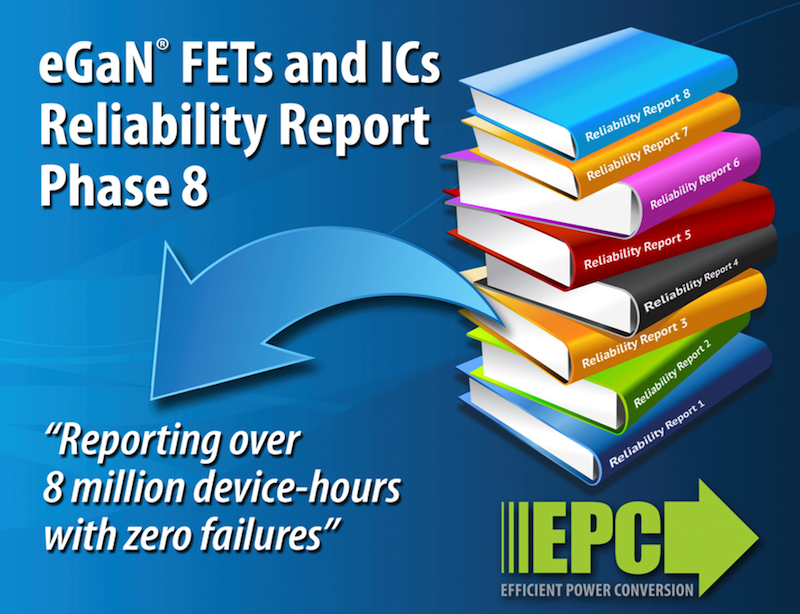
EPC announced its Phase Eight Reliability Report, showing the results of the rigorous set of JEDEC-based qualification stress tests eGaN FETS and integrated circuits undertake prior to being considered qualified products. In this report, product-specific detailed stress test results for over millions of actual device hours are provided. In addition to product qualification stress testing, due diligence is necessary in other areas of reliability such as field experience, failures over device operational lifetime, and board level reliability.
This report, coupled with the excellent field reliability of eGaN FETs and ICs given in the Phase Seven Reliability Report, which documented the accumulation of over 17 billion device operation hours combined with a very low failure rate below 1 FIT (failures per billion hours), demonstrates that the stress-based qualification testing is capable of ensuring reliability in customer applications. The cumulative reliability information compiled shows that eGaN FETs and ICs have solid reliability and are able to operate with very low probability of failures within reasonable lifetimes of end products manufactured today.
According to Dr. Alex Lidow, CEO and co-founder of EPC, “Demonstration of the reliability of new technology is a major undertaking and one that EPC takes very seriously. The tests described in this report, along with the reported results, show that EPC gallium nitride products have the requisite reliability to displace silicon as the technology of choice for semiconductors.”
Efficient Power Conversion


.jpeg)