EPCOS CeraLink capacitors offer compact solution for converters
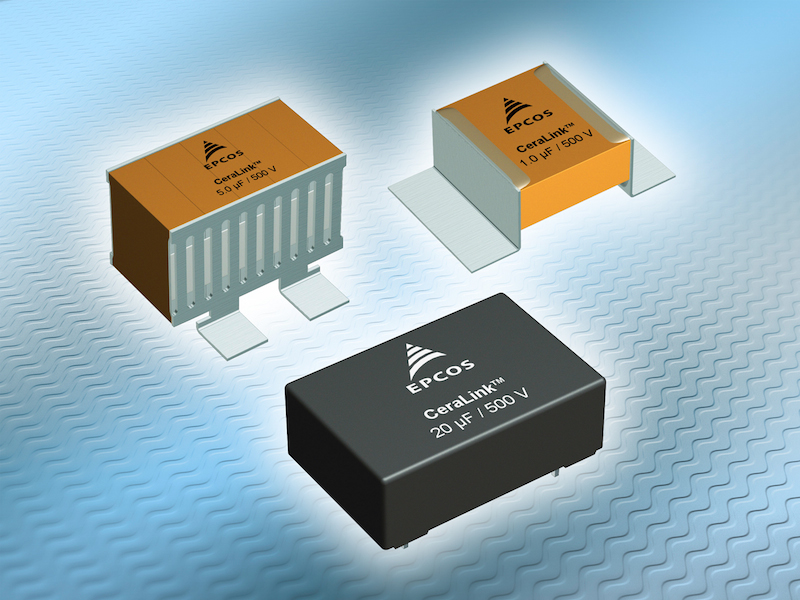
TDK announced their latest generation of EPCOS CeraLink capacitors, a highly compact solution for snubber and DC links of fast-switching converters based on SiC and GaN semiconductors. These new capacitors are based on the ceramic material PLZT (lead lanthanum zirconate titanate). In contrast to conventional ceramic capacitors, CeraLink has its maximum capacitance at the application voltage, and this increases proportionately to the share of the ripple voltage.
The smallest version of the CeraLink is the SMD low-profile variant with a capacitance of 1 µF at a rated voltage of 500 V DC. It has dimensions of 4.25 mm x 7.85 mm x 10.84 mm. A further type with solder-pin contacts is also available. This 20- µF capacitor has a rated voltage of 500 V DC and measures 33.00 mm x 22.00 mm x 11.50 mm. Both types offer extremely low ESL values below 3.5 nH. The capacitors are designed for an operating temperature of -40 to +125 oC and can even withstand brief exposures to 150 oC.
A great advantage of the SMD low-profile CeraLink versions is that they can be embedded in IGBT modules because of their compact dimensions. This results in a very low-inductance design, so that no significant overvoltages are produced with the semiconductors are switched.
In addition, samples are available for two more types: An SMD variant with a capacitance of 5 µF at 500 V DC and measuring 3.25 mm x 14.26 mm x 9.35 mm. the second type, which is fitted with solder-pin contacts, has a capacitance of 5 µF of 1000 V DC and dimensions of 33.00 mm x 22.00 mm x 11.50 mm.