EPC's 500W eighth-brick DC/DC converter achieves 96.7% efficiency
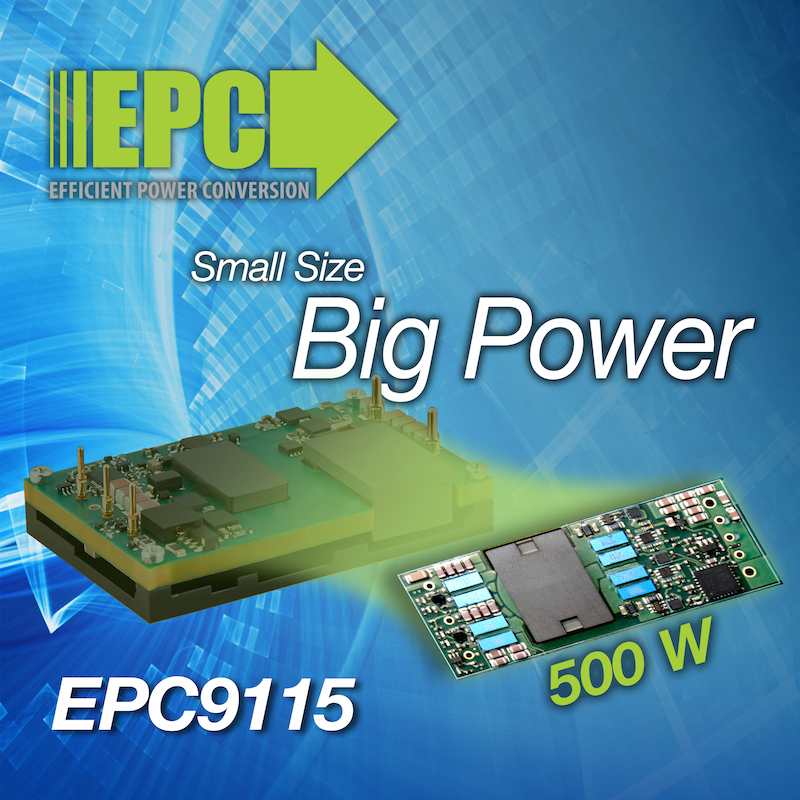
Efficient Power Conversion Corporation (EPC) introducesd the EPC9115, a demonstration design for a 12 V, 42 A output with an input range of 48 V to 60 V. The demonstration board features enhancement-mode (eGaN) power transistors – the EPC2020 (60 V) and EPC2021 (80V) – along with the LM5113 half-bridge driver and UCC27611 low side driver from Texas Instruments. The power stage is a conventional hard-switched 300 kHz isolated buck converter.
Performance of a Quarter Brick in an Industry Standard Eighth Brick Format
The complete converter fits within a standard eighth-brick envelope, but the EPC9115 demonstration board is deliberately oversized to allow connections for bench evaluation. The design provides various probe points to facilitate simple waveform measurement and efficiency calculation.
The EPC9115 uses a full-bridge primary power stage, a 4:1 transformer, and a center-tapped output stage with active reset snubbers. Control is provided by a Microchip dsPIC controller and basic voltage-mode control is implemented. Operating at 300 kHz, the EPC9115 switching frequency is 50% - 100% higher than similar commercial units.
Alex Lidow, EPC CEO and co-founder, notes, “With the introduction of the EPC9115, the industry has the performance of a 500 W DC-DC converter in the footprint of an industry standard eighth brick. This unprecedented power density is made possible with eGaN FETs.”
EPC9115 demonstration boards are priced at $812.50 each and are available for immediate delivery from Digi-Key.