Everlight introduces low-power color sensor for display apps
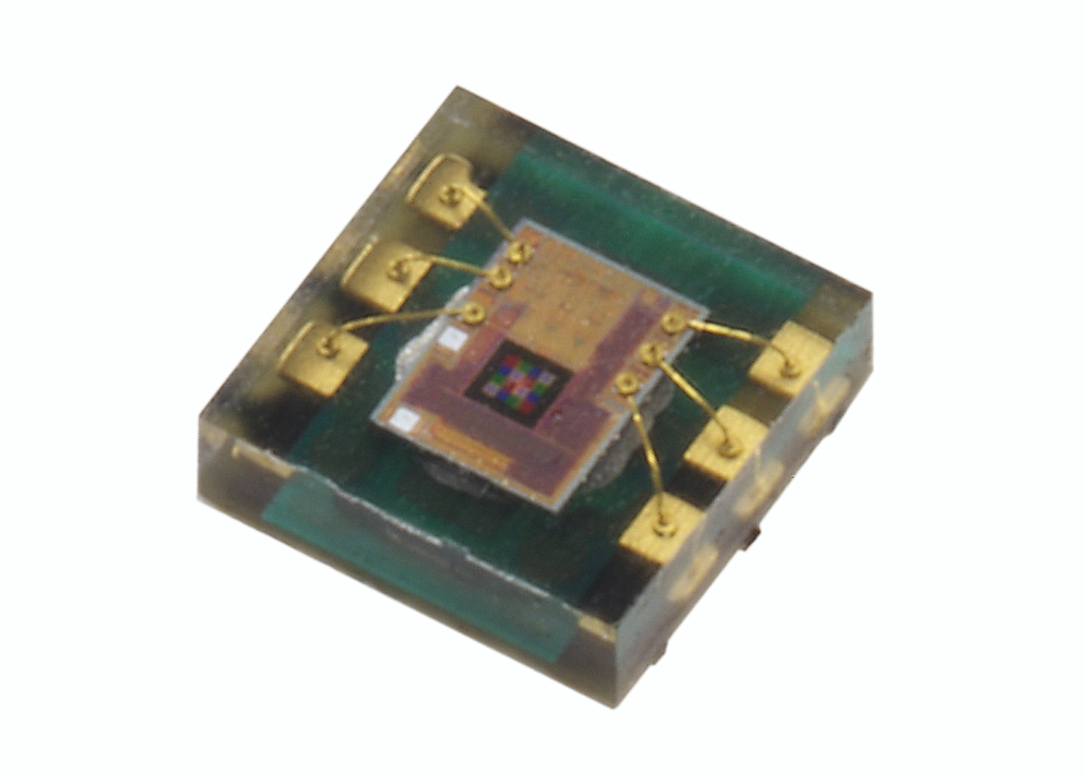
Everlight Electronics, a leading player in the LED and optoelectronics industry,
announced the introduction of the company’s first RGB integrated color
sensor. Based on CMOS technology and therefore able to operate at a minimum
supply voltage of 1.7 volts, the CLS-16D17-34-DF6 adjusts the brightness of
display equipment with less power consumption than comparable color sensor
devices which almost all operate at a minimum of 2.7 volts.
Highly sensitive, EVERLIGHT's digital RGB color sensor CLS-16D17-34-DF6
features a four channel digital output for sensing red, green, and blue
(RGB) via an I˛C interface. CCT and Lux sensing work through the master
control unit (MCU). Due to a special RGB algorithm, infrared light noise is
effectively avoided to calculate CCT and Lux figures accurately. Even in a
less bright environment, it still can reach high sensor resolution of 0.002
lx per count.
EVERLIGHT's CLS-16D17-34-DF6 excels in display equipment including smart
watch, mobile phone, tablets and notebooks, navigation systems, virtual
keyboards and sensor for Internet Of Things (IoT). Thanks to RGB color
sensing, the brightness and color temperature of backlight can be adjusted
based on the ambient light source, which makes the display applications more
comfortable for human eyes.
Other features include: programmable exposure time; convert incident light
intensity to digital data; 16-bit CS ADC resolution; automatic light
flickering cancellation supporting; excellent transmittance of glass
package; spectral response close to human eye; linear CS response for easy
design; low dark noise and a low stop current of typical 1uA.