Join the fast track to profitability and grid stability
Figure 1: Flexibility capacity additions to 2050 (Energy Transition Scenario)
In modern power systems, flexibility is more than just a technical necessity – it’s also a highly effective tool to unlock new profit-boosting revenue streams. As the share of renewables increases, the need for flexibility in power systems is increasing with it. Plants that integrate reciprocating internal combustion engines can monetize their flexibility across multiple markets, with agility that translates into higher returns and shorter payback periods.
Why flexibility is key to the energy transition
Bloomberg NEF estimates that 6,972 GW of flexible capacity will be added globally by 2050, of which 1,686 GW is peaking gas and 5,286 GW battery storage (see Figure 1).
The IEA defines flexibility as “the ability of a power system to reliably and cost effectively manage the variability and uncertainty of supply and demand across all relevant timescales.”
Plants with flexible assets like reciprocating internal combustion engines (RICEs) can adjust output quickly in response to changing system needs, enabling increasing integration of renewables.
With flexible assets, utilities and IPPs can better manage the risks associated with renewable energy integration and hedge exposure to extreme market prices. Beyond mitigating the intermittent nature of renewables, flexible engine power plants boost system efficiency and reduce fuel use as the engines only need to run when needed.
They also improve stability and reliability by maintaining real-time balance between supply and demand, controlling frequency and voltage deviations, and providing fast reserves during unexpected events.
How to turn volatility into profitability
Utilities and IPPs can leverage the flexibility of RICEs to maximize returns, manage risk, and future-proof their portfolios in increasingly volatile energy markets.
Unlike traditional baseload plants, RICE power plants can respond in minutes rather than hours, allowing operators to capture price spikes, avoid negative pricing events, and participate in ancillary and capacity markets with precision.
With flexible RICE plants, utilities and IPPs can:
- dispatch at short notice and “cherry-pick” between price points, switching between sourcing from the grid and their own generation
- keep assets offline during periods of overcapacity, mitigating financial losses from negative market prices, because RICE plants can start, stop, and rapidly change output without incurring excessive wear or penalties
- maintain financial returns by ensuring reliable supply, using multiple smaller units that can operate efficiently at multiple load points
- unlock new revenue streams and market opportunities with the ability to participate in ancillary service markets providing services such as primary or secondary regulation
To maximize revenues and shorten payback periods, utilities and IPPs need to understand the main differences between power-generation technologies and their flexibility to provide services across different timeframes.
Battery energy storage systems can store or discharge energy to handle millisecond and minute-level fluctuations and provide support during peak demand periods. This makes them ideal for providing ancillary services and energy up to two to four hours in duration when in a charged state.
Flexible thermal generation technology such as reciprocating RICE power plants can be dispatched on demand to fill gaps in renewable energy across minute-level, daily, seasonal and inter-annual variations.
There are five key properties used to measure flexibility of thermal generation technologies:
- Start-up time to full load: Shorter start-up times enable rapid response to sudden gaps in renewables or supply-demand changes.
- Ramp rate: The ability to ramp up and down quickly is essential for providing balancing and firming capacity.
- Minimum uptime and downtime: Minimum uptime is the minimum operational time required after start-up before a safe shutdown, while minimum downtime is the minimum time required after shutdown before a safe restart.
- Plant net efficiency: High efficiency at different load levels helps minimize fuel costs and emissions, maximizing operational flexibility as thermal power plants shift from pure baseload operation to balancing renewables.
- Minimum stable load: The lowest power output at which a power-generating unit can operate continuously and in a stable fashion, without time limitations.
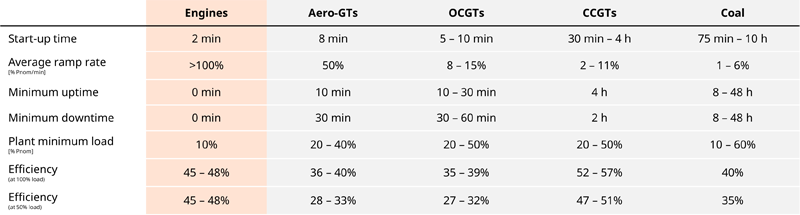
Across all five of these properties, reciprocating RICEs and battery energy storage consistently outperform traditional, less agile baseload assets like coal, nuclear, and combined cycle gas turbines (see Table 1).
Click image to enlarge
Table 1: Comparison of RICEs against other thermal generation technologies
In a comparison between Wärtsilä engines and aero gas turbines, Wärtsilä has proved how engines can cycle continuously and operate more efficiently, even at partial loads and under extreme conditions.
Maximize profitability and system reliability with fast-response assets
The US energy markets – ERCOT, PJM, MISO, SPP – are shifting towards shorter trading intervals and more granular price signals. In this dynamic environment, flexible, fast-response assets give utilities and IPPs the capability to respond to five-minute market signals, capture price spikes, and participate in ancillary and/or capacity markets.
Let’s look at some examples of how Wärtsilä’s fast-response assets are maximizing profitability and system reliability in similarly dynamic markets around the world.
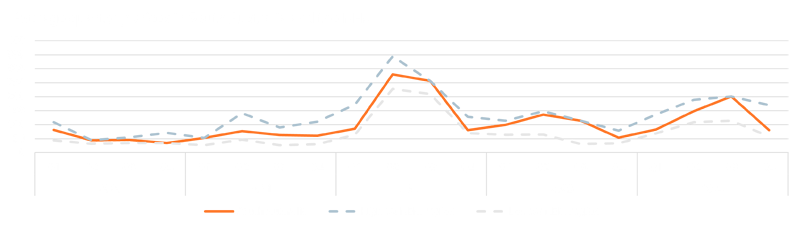
South Australia, which boasts one of the highest renewable energy penetrations in the world, is connected to the National Electricity Market (NEM). NEM is a real-time wholesale market settled on five-minute intervals to provide more accurate pricing signals as the share of renewables grows. Figure 2 shows average quarterly prices in South Australia and the NEM.
Click image to enlarge
Figure 2: Average quarterly prices in South Australia and the NEM
The Barker Inlet Power Station, a 211 MW engine power plant operating in the South Australia NEM features 12 Wärtsilä 50DF engines that have better operational flexibility and efficiency compared to other gas firming assets in the state.
Compared to other gas firming power stations in the region, the plant:
· runs more frequently outside morning and evening peaks
· has two to five times more running hours than open cycle gas turbines (OCGTs)
· delivers 20% higher operating profit based on dispatch revenues
Japan is aiming for 40–50% renewable energy in its power mix by 2040, so the need for flexible generation to balance the intermittency of sources like wind and solar is increasing.
The 100 MW Sodegaura power plant in Chiba prefecture, east of Tokyo, features ten Wärtsilä 34SG engines. Owner and operator Tokyo Gas uses the plant as a balancer to respond to fluctuations in renewable energy supply and electricity demand. The plant allows Tokyo Gas to participate in and earn revenues from balancing (revenue from availability payments and directional dispatch payments) and capacity markets (revenue from dispatch payments).
The Philippines operates one of the most advanced electricity markets in Southeast Asia, with five-minute dispatch and settlement intervals. These instruments lead to high price granularity and volatility, creating new opportunities for flexible technologies to respond to short-term price spikes. A reserve market launched in 2024 enables real-time trading of ancillary services on the same five-minute interval basis as the energy market, further increasing the value of flexibility.
The reserve market was launched but co-optimization is up to the users’ decisions.
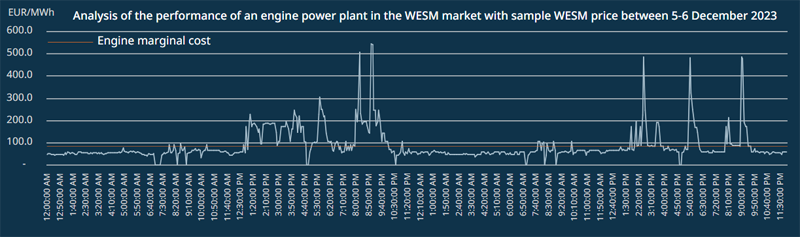
A simulation conducted using Wholesale Electricity Spot Market (WESM) price data from 2023 demonstrated the business potential for a 100 MW engine power plant operating purely as a merchant balancer. Figure 3 shows the data from the simulation.
Click image to enlarge
Figure 3: Analysis of engine power plant performance in the WESM market with sample WESM price (December 5–6, 2023)
The results showed:
· Annual running hours of 3,400 hours (39% capacity factor)
· Gross profit of 20 MEUR
· High equity IRR of 25%
· Short payback period of only five years
These impressive achievements were driven by the engine’s ability to start and stop quickly, ramp throughout the day, and shut down entirely during periods of low or negative pricing – without incurring start-up penalties or excess maintenance costs.
The key success factors behind successful flexibility monetization in US markets
There are several different factors to consider when preparing a business case for monetizing flexible power generation assets. Here is a list of six things to look for when evaluating power markets in the US:
· Existence of spot markets with dynamic pricing
· High share of renewables and price volatility
· Short trading periods (five or 15-minute intervals)
· Well-functioning ancillary services markets
· Low entry barriers for market participation
· Flexible fuel supply agreements
As we have seen, flexibility is an essential component of modern power systems – both as a technical necessity for stability and as a strategic asset that can unlock additional revenue streams. For utilities and IPPs, it is no longer a question of whether to invest in flexible assets like reciprocating RICEs, it is a case of how to do so effectively and profitably.
Wärtsilä Energy is at the forefront of the transition towards a 100% renewable energy future, helping our customers and the power sector to accelerate decarbonization through our market-leading technologies and power system expertise. With Wärtsilä as your partner, you can turn power generation flexibility into a profit-maximization strategy.