Change the DC-DC converter output from 12V-48V by switching only two components
Figure 1 A single Vicor module is a complete DC-DC converter consisting of hundreds of tiny, integrated and optimized components
The legacy 12V architecture that has supported vehicles for decades is no longer capable of sustaining the rising electronic load in automotive systems.
Current-generation vehicles rely on high-performance ADAS computers, multi-sensor perception stacks, electric chassis systems, zonal controllers and high-power thermal loads. While all these features make the car smarter and safer, they also complicate the power designer’s job. These features increase power density demands and create I2R losses that are difficult to manage on a 12V bus. As a result, OEMs across the industry are preparing for a full transition to 48V as the new SELV (safety extra low voltage) domain.
The switch to 48V is not straightforward. Automakers need to consider compatibility with existing 12V loads and new safety constraints at higher system voltages. Every transition cycle also triggers requalification, PCB redesigns and thermal revalidation.
All things considered, engineers want a path to 48V that avoids rebuilding each power stage from the ground up. Modular power conversion architectures provide the most practical approach because they support rapid scaling, flexible reconfiguration, and qualification reuse across multiple vehicle platforms.
Why traditional approaches are struggling
Conventional discrete converter designs rely on large component arrays that consist of MOSFETs, magnetics, drivers and control ICs. This approach works, but it becomes cumbersome when design targets change, and a redesign becomes necessary. Every new requirement forces teams to generate a fresh PCB layout because the component arrangement, loop geometry and thermal paths rarely carry over from one revision to the next.
For example, discrete converters that aim for 95-97% efficiency often require bulky topologies to stay within thermal margins. These designs depend on heavy heat spreaders or liquid cooling loops, and each change in requirement forces a new PCB layout with new thermal considerations and new validation.
These demands intensify when the converter operates from an 800V traction battery. Higher system voltage increases creepage and clearance requirements, which expands the PCB and requires using more expensive insulation materials. EMI performance also becomes harder to control because the parasitics associated with large board areas and high device counts compound with each update. Even when the architecture performs well at its initial operating point, it becomes increasingly cumbersome to maintain as requirements grow.
Qualification adds a further constraint. A typical HV-to-48V discrete converter may contain more than 200 components, and every device requires supply-chain control and PPAP documentation. When an OEM updates a platform or adds new ADAS or chassis loads, engineers must requalify the entire converter.
Discrete design becomes a bottleneck when the power delivery network (PDN) must evolve faster than engineers can redesign the converter hardware.
Modular design for scalable, flexible systems
Modular power architectures flip this narrative on its head. Instead of reinventing a converter for each new application, teams can assemble interoperable elements.
The modular approach replaces large converter fields with compact, high-density building blocks that integrate switching, magnetics, and control into a single thermally optimized unit: a module (Figure 1). Each module behaves like a known-good element that is always electrically predictable. Once designers qualify a module, they can redeploy it in future programs without repeating its validation. All the internal components of the module do not need to be prequalified—only the module needs to pass qualification. Modules therefore simplify compliance and reduce the time engineering teams spend designing around new loads.
At the system level, modularity adds flexibility to the PDN. Engineers can configure modules in series or parallel to change power levels without altering the board layout. And the approach supports both centralized and zonal architectures. Engineers can take a converter that once delivered HV-to-48V power in the central power box and later deploy it inside a battery housing or at a zonal node with minimal design changes. Engineers who previously needed to create unique designs for ADAS computers and distributed actuator clusters can reuse a common set of modules instead.
The challenges of converting high voltage to SELV
High-voltage-to-SELV conversion is the stage at which the limitations of a discrete approach become most apparent. The step from the traction battery to SELV places the greatest electrical and mechanical stress on the converter and amplifies any weakness in layout, parasitic control or thermal design. Engineers need to manage high dV/dt edges, strict creepage and clearance requirements and EMI sensitivity that grows with every added component.
These constraints become even more pronounced as the SELV loads grow more dynamic. Active suspension actuators and ADAS compute rails impose rapid current steps that the converter must support without sag, overshoot or delay. Discrete converters struggle with these demands because their transient response depends on the layout of large power stages and the interaction of many discrete elements.
Modern fixed-ratio resonant topologies solve the problem by delivering high efficiency and fast transient response in a compact package. With soft-switching and low-parasitic construction, they reduce switching losses, improve EMI control and offer stable performance under dynamic load conditions. The BCM6135 fixed-ratio converter, for example, converts bidirectionally between 800V and 48V with efficiencies approaching 99% and a transient slew rate near 8MA/s.

Click image to enlarge
Figure 2: With fast transient response and incredible efficiency, fixed-ratio-based converters can eliminate the need for auxiliary batteries in automotive systems. With the converter able to be the source of current for all loads, the architecture no longer requires traditional buffers or auxiliary batteries. This concept of a “virtual battery” significantly reduces the weight, cost and complexity of an EV system
As modular converters reach this level of transient performance, they begin to support dynamic loads in a way that previously required dedicated energy storage on the SELV bus (Figure 2). With the converter acting as the immediate source of current for fast loads, the architecture no longer depends on traditional buffers or auxiliary batteries. This concept of a “virtual battery” significantly reduces the weight, cost and complexity of an EV system.
Centralized versus zonal power delivery networks
Moving from 12V centralized power delivery to a 48V zonal architecture introduces new electrical and mechanical considerations.
In a centralized system, a single housing down-converts high-voltage battery power and distributes 12V using thick wire harnesses. But as vehicles become more functional the 12V current becomes too large, and harnesses become heavier and more complex. A zonal system solves this by distributing 48V through the vehicle and performing 48-to-12V conversion at the point of load.
At the same power level, a 48V rail reduces the system current by a factor of four. With lower current designers can reduce harness mass by up to 85% and significantly simplify wire routing. Zonal controllers then benefit by serving local loads without long high-current paths. High-power functions such as electric roll stabilization or electric brake boosters also fit more naturally within a 48V architecture because they incur lower losses and produce less heat.
Until 48V becomes the dominant low-voltage bus, 12 and 48V loads will continue to coexist inside the same platform. In that interim period, modular converters can offer flexibility to support both domains without adding complexity or forcing redesigns.
Flexibility at the core of next-generation demo system
To illustrate the design flexibility possible with modular power, Vicor created the Paladin reference platform. Paladin is a 4kW 800V-to-12V/48V demonstration platform with a total volume of only 1.1L and a power density of 3.6kW/L. The platform includes two high-voltage conversion stages for the HV-to-SELV step and two interchangeable low-voltage positions that can accept either PRM™regulators or DCM™ DC-DC converters. The modules mount on carriers with a common mechanical interface, which allows engineers to reconfigure outputs without altering the PCB, enclosure or qualification file.
Click image to enlarge
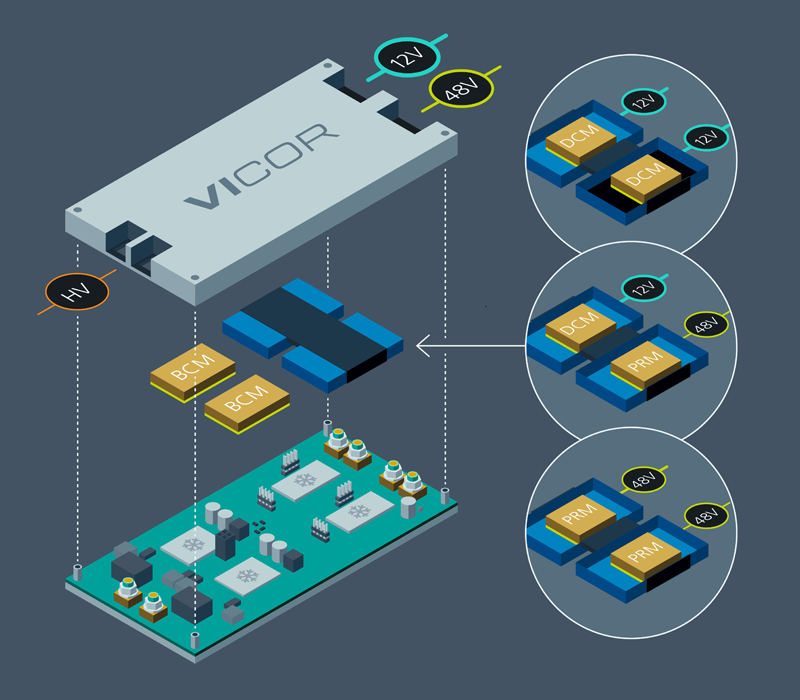
Figure 3: An exploded view of the Paladin system shows high-voltage to-SELV power stage mounts in a carrier with a common mechanical interface that supports rapid reconfiguration. By changing only the module selection, designers can generate regulated 12V outputs, regulated 48V outputs or mixed-rail configurations
The high-voltage converters occupy one side while the PRM and DCM modules sit in carrier assemblies (Figure 3). These carriers accept the mechanical differences between modules and create a uniform interface for the PCB. By changing only the module selection, designers can generate regulated 12V outputs, regulated 48V outputs or mixed-rail configurations.
Electrically, Paladin is a full proof-of-concept power delivery network. It supports bidirectional operation, high transient performance, and a compact thermal profile. A similar discrete design that supports three different output configurations would require three unique PCBs and hundreds of component changes. The Paladin accomplishes the same three variations with a single board using 50% fewer components while allowing output voltage changes by switching only a single component per output rail.
Engineers looking to build production systems can use Paladin as a starting point for their design.
Making HV to SELV faster, easier and simpler
Transitioning to 48V can present many complications. A modular approach, however, reduces complexity and offers engineers an easier path to designing compact and flexible solutions that can scale. Systems like the Paladin are real-world proof that modular designs are ready to support the rigors of the industry as it evolves.
Click image to enlarge
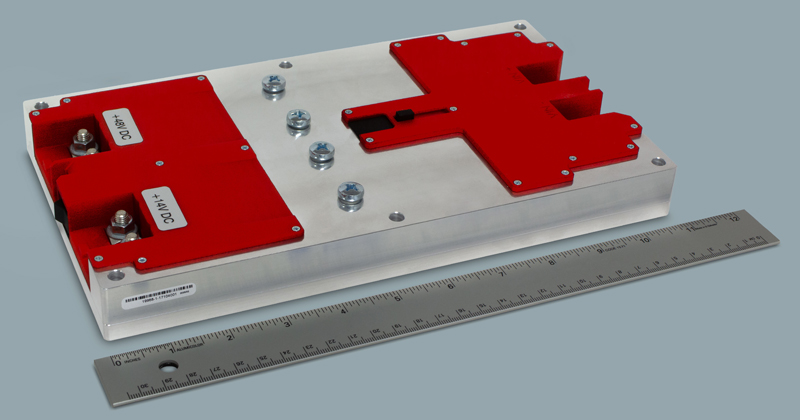
Figure 4:Paladin is a 4kW 800V-to-12V/48V demonstration platform with a total volume of only 1.1L and a power density of 3.6kW/L. The platform, which measures only 275 x 155 x 27.3mm, includes two high-voltage conversion stages for the HV-to-SELV step and two interchangeable low-voltage positions that can accept either PRM regulators or DCM DC-DC converters
A modular approach enables downsizing of the DC-DC converter while offering the flexibility to support 12V and 48V with no more than two component changes. A modular approach is a far simpler alternative to discrete designs when it comes to designing a high-voltage-to-SELV power solution that is futureproof.