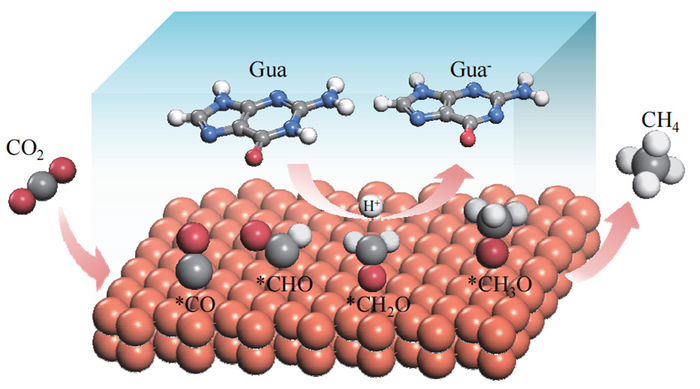
Electrochemical CO2 reduction is an effective way to realize the artificial carbon cycle and has attracted more and more attention in recent years. Cu is the only metallic catalyst that can realize CO2 deep reduction to various carbonaceous products, but it suffers from low selectivity. Surface modification is an effective strategy to alter electrochemical CO2 reduction behaviors. Electrochemical CO2 reduction involves multi-step proton-coupled electron transfer processes, so regulating proton transfer has a substantial effect on CO2 reduction pathways. Inspired by the proton transfer in many biological processes, a research team led by Prof. Lin Zhuang from Wuhan University, China reported “guanine-regulated proton transfer enhances CO2 to CH4 selectivity over copper electrode” recently. They present a well-controlled proton transfer through the surface modification of several purines with similar molecular structures, and reveal a direct correlation between surface proton transfer capability and CO2 reduction selectivity. With a moderate proton transfer capability, the guanine modification remarkably boosted CH4 production and suppressed C2 product formation. In-situ ATR-SEIRAS suggests a weakened *CO intermediate adsorption and a relatively low local pH environment after the guanine modification, which facilitates the *CO protonation and detachment for CH4 generation.
EurekAlert!, the online, global news service operated by AAAS, the science society.