Han-Fast(R) Lock provides simple interface between printed circuit boards and high-current connectors
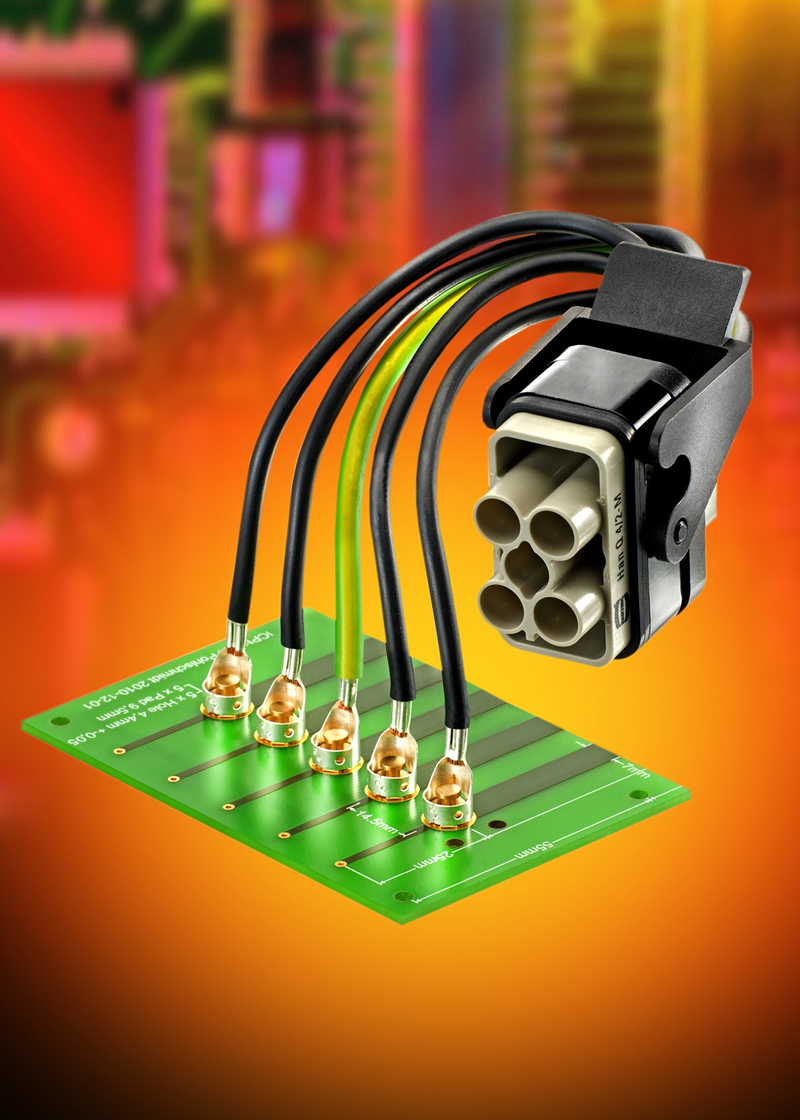
Han-Fast(R) Lock from HARTING is a new circuit-board connection technology that allows the company's Han(R) range of high-current connectors to be connected directly to printed circuit boards with ease and flexibility and without the need for additional components. The Han-Fast(R) Lock circuit-board connector is a compact, easy-to-handle interface that can handle currents up to 60 A and requires only one contact point to make the connection. Conductor lines are through-plated, and are each provided with a drill hole and supporting point. Han-Fast(R) Lock is supported by a range of pre-assembled system solutions. For example, a Han(R) Q 4/2 connector with pre-connected litz multi-stranded wires and circuit board contact can be supplied as a pre-tested system for direct connection to the circuit board. Litz wire is a type of cable that is designed to reduce the skin-effect and proximity-effect losses in conductors at frequencies up to about 1 MHz. It consists of many thin wire strands, individually insulated and twisted or woven together, following one of several carefully prescribed patterns that equalise the proportion of the overall length over which each strand is at the outside of the conductor. The term "litz wire" originates from the German term Litzendraht, meaning braided, stranded or woven wire. Litz wires measuring up to 10 mm² can be used with the Han-Fast(R) Lock contact. The pre-assembled contact is fitted to the prepared circuit board and the pin provided is engaged to lock the circuit board. The system is extremely easy to use and the assembly time is comparable to that for any commercially available snap connector. www.harting.com