How to Manage Increased Power Demand with High-Density Charging Infrastructure

Managing electrical capacity constraints while minimizing costly service upgrades is crucial
Figure 1: The modeled annual electricity consumption from electric ground support equipment at Atlanta Airport in 2025. Each column represents a percentage of electric ground support equipment in the fleet
From material handling forklifts to airport baggage tugs, many industries are adopting electric equipment to enhance operational efficiency and meet sustainability targets.
However, deploying the power infrastructure required to charge these electric vehicles introduces new challenges for engineers and facility managers. Integrating high-density charging infrastructure into existing facility power systems requires careful consideration of available electrical capacity, utility constraints and long-term load growth. This article will examine how charging infrastructure increases power demand and explores methods to install scalable solutions.
How Electric Equipment Increases Facility Power Demand
Electric equipment places additional strain on a facility’s existing electrical distribution infrastructure. To provide an example, many airports are transitioning from ground support equipment (GSE) vehicles with internal combustion engines to electric vehicles with batteries. GSE is used to support aircraft between flights, including baggage tractors, aircraft tow vehicles and belt loaders.
When airports adopt electric GSE, their peak power demand and average energy consumption increase to supply the necessary energy for charging.
· Peak power demand represents the maximum instantaneous load placed on the facility and is measured in kilowatts (kW) or megawatts (MW).
· Energy consumption reflects the total electrical energy used over time and is measured in kilowatt-hours (kWh) or megawatt-hours (MWh).
The scale of impact varies by an airport’s eGSE fleet size. A recent study found that GSE electrification at medium and small airports generally requires peak power loads below 5 MW. Depending on eGSE fleet size, major airport hubs can require up to 10-20 MW for peak demand and up to 51,000 MWh for annual electricity consumption.
A report from the U.S. National Renewable Energy Laboratory modeled eGSE energy consumption by airport using user-defined electrification targets and hourly flight schedules. The model relies on several assumptions, but the general trend highlights the increased load as electric fleets expand. To select one specific scenario, the report’s 2025 Atlanta International Airport model demonstrates:
· Annual energy consumption increases alongside a fleet’s proportion of electric ground support equipment (Figure 1).
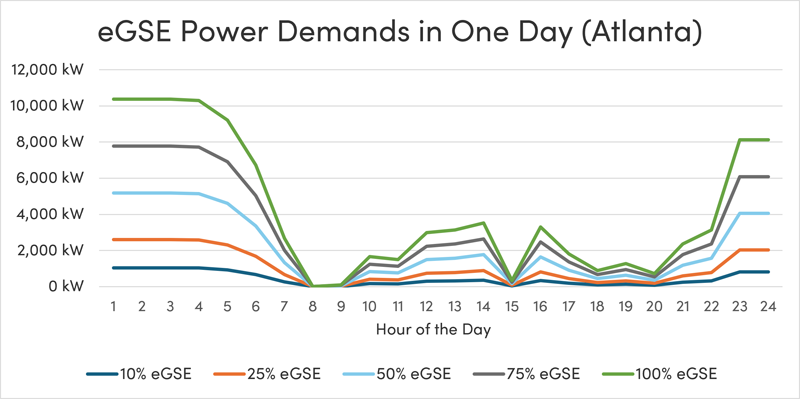
· Peak electricity demand over a 24-hour day increases alongside a fleet’s proportion of electric GSE (Figure 2).
Figure 1 estimates that a completely electrified GSE fleet at Hartsfield-Jackson Atlanta International Airport would require up to 40,759 MWh annually. Figure 2 demonstrates that charging demand from electric equipment is dynamic rather than static, creating peak stress conditions as each day progresses.
Click image to enlarge
Figure 2: The modeled peak power demands from electric ground support equipment over the course of one 24-hour day (February 1) at Hartsfield-Jackson Atlanta International Airport in 2025. Each line represents the fleet’s percentage of electric ground support equipment
How Lithium-Ion Batteries Can Impact Energy Load Profiles
Facilities farther along in their electrification transition may also face new energy complexities. Many facilities are gradually replacing their traditional lead-acid battery-powered vehicles with lithium-ion models. Compared to lead-acid, lithium-ion enables easier maintenance, advanced smart monitoring capabilities, superior depth of discharge and more efficient, faster charging.
Facility load profiles are shaped by overall system efficiency, which includes both charger conversion losses and battery efficiency. Lithium‑ion batteries typically achieve ~90–95% efficiency versus ~70–85% for lead‑acid, reducing total energy drawn from the grid.
However, higher efficiencycombined with faster chargingconcentrates load into shorter, higher‑power intervals. Fast charging with lithium-ion batteries typically results in elevated C-rates, or the rate at which a battery is charged or discharged relative to its maximum capacity. C-rates can be calculated as:

This shifts lithium-ion’s impact from total energy consumption (kWh) to peak demand (kW).
As a result, facilities with Li-ion equipment may see sharper peak power demands even if their total energy consumption is reduced compared to lead-acid. Since many utilities assess charges based on peak demand, this spike may still impact operational costs.
How Electric Constraints Impact Charging Infrastructure Decisions
The GSE example demonstrates the impact that electrification can have on facility power. Even transitioning from lead-acid to lithium-ion equipment can complicate energy profiles. The question is how to proactively anticipate the electricity demands of high-density lithium-ion charging while managing electrical capacity constraints.
The first step is to quantify both energy (kWh) and peak power (kW). Required grid input power increases as system efficiency decreases:
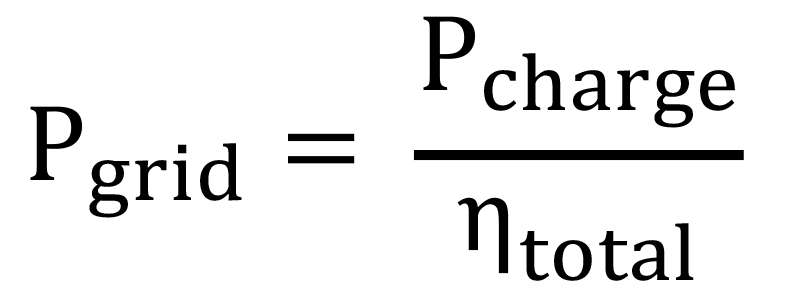
Losses directly increase upstream loading on transformers, feeders and switchgear.
Peak demand is primarily driven by coincident (simultaneous) charging events, particularly in high-utilization operations with opportunity charging. This can be approximated as:

Pi represents charger ratings, while CFireflects the likelihood of simultaneous use. As equipment fleets expand and charging windows compress, coincidence factors rise and drive higher peak loads even when total energy grows more gradually.
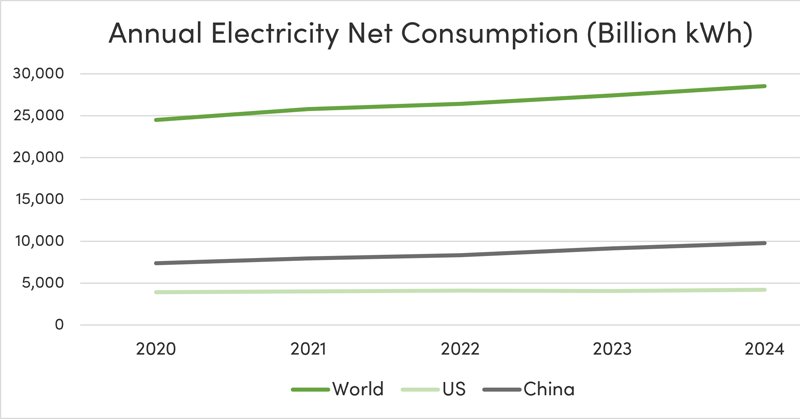
Once demand profiles are estimated, engineers and facility managers must determine whether the facility has sufficient capacity. A key challenge is that many sites cannot accommodate new demand with their existing transformer capacity, feeder capacity, switchgear ratings or distribution infrastructure. Upgrading utility services is an option, but this often involves high capital costs and long lead times to procure necessary equipment. Many regions are also experiencing increased competition for electrical grid capacity due to data center and AI workloads, further complicating the issue. Figure 3 demonstrates how global electricity consumption continues to increase year-over-year.
Click image to enlarge
Figure 3: The annual electricity consumption for the world and the two largest individual consumers (U.S. and China) from 2020 to 2024.
To respond to power constraints and budget limitations, new methods of power generation and storage are being explored:
· Renewable energy suppliescan reduce dependency on the grid and offset costs. Photovoltaic cells are one common option.
· Battery energy storage systems (BESS)charge during off‑peak hours and discharge during periods of high demand, easing strain on existing electrical infrastructure and lowering peak demand charges. Battery chargers with energy storage also increase system resilience by allowing charging to continue during short power outages.
Though energy storage systems and renewable energy require up-front investment, they can still deliver long‑term cost savings in electrifying industries like airside ground support equipment.
How Battery Charger Decisions Can Manage Power Demand Challenges
Another method to manage utility constraints involves the selection of the charger itself. The design of battery chargers can also help reduce infrastructure engineering complexity and build-in capacity for future electric fleet growth. Three of the most important features involve an industrial battery charger’s efficiency, scalability and flexibility.
Efficiency: Why Higher Efficiency Rates Help Manage Utility Constraints
Battery chargers with higher efficiency rates minimize energy losses as the charger converts AC grid power to DC power useable by the battery. Less input power is required for a given charging output.
Charger efficiency is measured by manufacturers as ‘peak efficiency,’ which refers to the highest point of efficiency a charger can achieve under optimal conditions. (Real-world efficiency is lower and influenced by factors such as battery chemistry, environment and system architecture.) A typical Li-ion battery charger might offer ~90-95% peak efficiency, compared to a high-efficiency battery charger with 97% peak efficiency.
A high-efficiency charger will not offset large gaps in facility power capacity on its own, but it can still contribute to power and utility cost savings over time. For example, upgrading a fleet of thirty 48V electric vehicles in the U.S. from an 85% to 97% peak efficiency charger could save up to $9,255 in annual electricity savings.
Flexibility: The Importance of Multi-Voltage and Multi-Chemistry Support for Mixed Fleets
Another important feature involves an airport GSE battery charger’s operational flexibility. Airside electric vehicle fleets often span a wide range of operating voltages and battery types (lithium-ion, lead-acid, etc.). Supporting this diversity with discrete charging systems increases infrastructure complexity, fragmentation and lifecycle costs.
Instead, flexible charging architectures enable charging across a wide range of voltage and battery chemistries to simplify infrastructure planning. Industrial battery chargers that support fleet diversity with multi-voltage and multi-chemistry compatibility reduce hidden engineering complexity.
Scalability: Why Charger Modularity Enables Future Fleet Growth
Charger scalability is another important consideration to prepare for fleet expansion. Many facilities adopt a phased approach to electrification to minimize operational disruptions and spread capital investment over a longer period.
Modular industrial chargers support incremental vehicle electrification. As electric fleets expand over time, facilities can increase their existing charger’s kilowatt capacity by integrating additional power modules. This approach aligns infrastructure investment more closely with actual load requirements.
Click image to enlarge
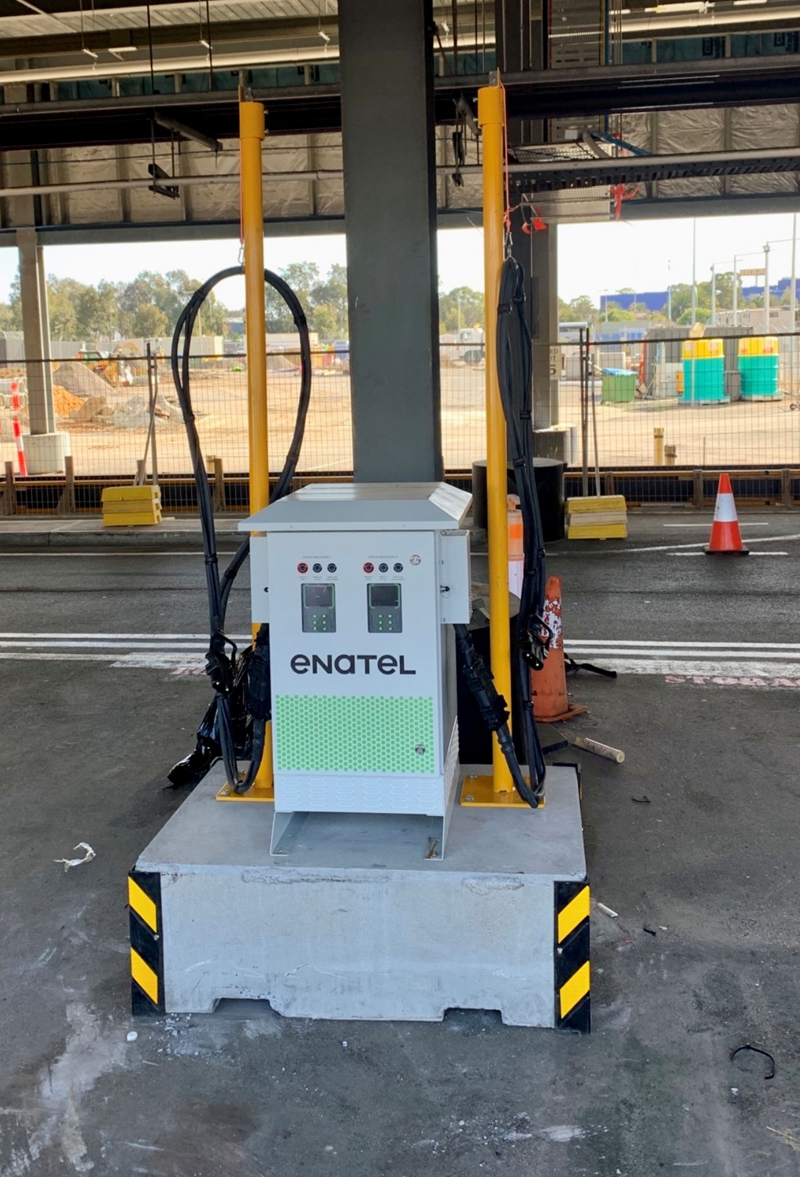
Figure 4: The Enatel Outdoor is an example of a charger designed to support eGSE with peak efficiency rates of >97% and scalability from 5kW to 30kW
Modular designs also enhance system resilience and promote easier maintenance. In the event of module failure, the charger remains operational at a reduced capacity using the remaining modules rather than going offline. This capability reduces operational risk in fast-paced environments where equipment uptime is essential, such as airport aprons.
Together, battery chargers that support higher efficiencies, mixed fleets and modularity provide engineers and facility managers with one method to respond to power utility constraints and prepare for future load growth.
How Engineers are Responding to Charging Infrastructure Challenges
To successfully navigate this transition to high-density charging infrastructure, engineers and facility managers must calculate demand profiles and determine existing capacity. One method to respond to grid constraints includes installing renewable energy sources and adopting battery energy storage. Another involves selecting industrial fleet charging solutions that deliver enhanced energy management, flexibility, efficiency and scalability. These combined approaches can minimize costly upgrades while building resilient electrical infrastructure ready for future fleet growth.