Hybrid Supercapacitors Deliver up to 220 Farads at 3.8 V
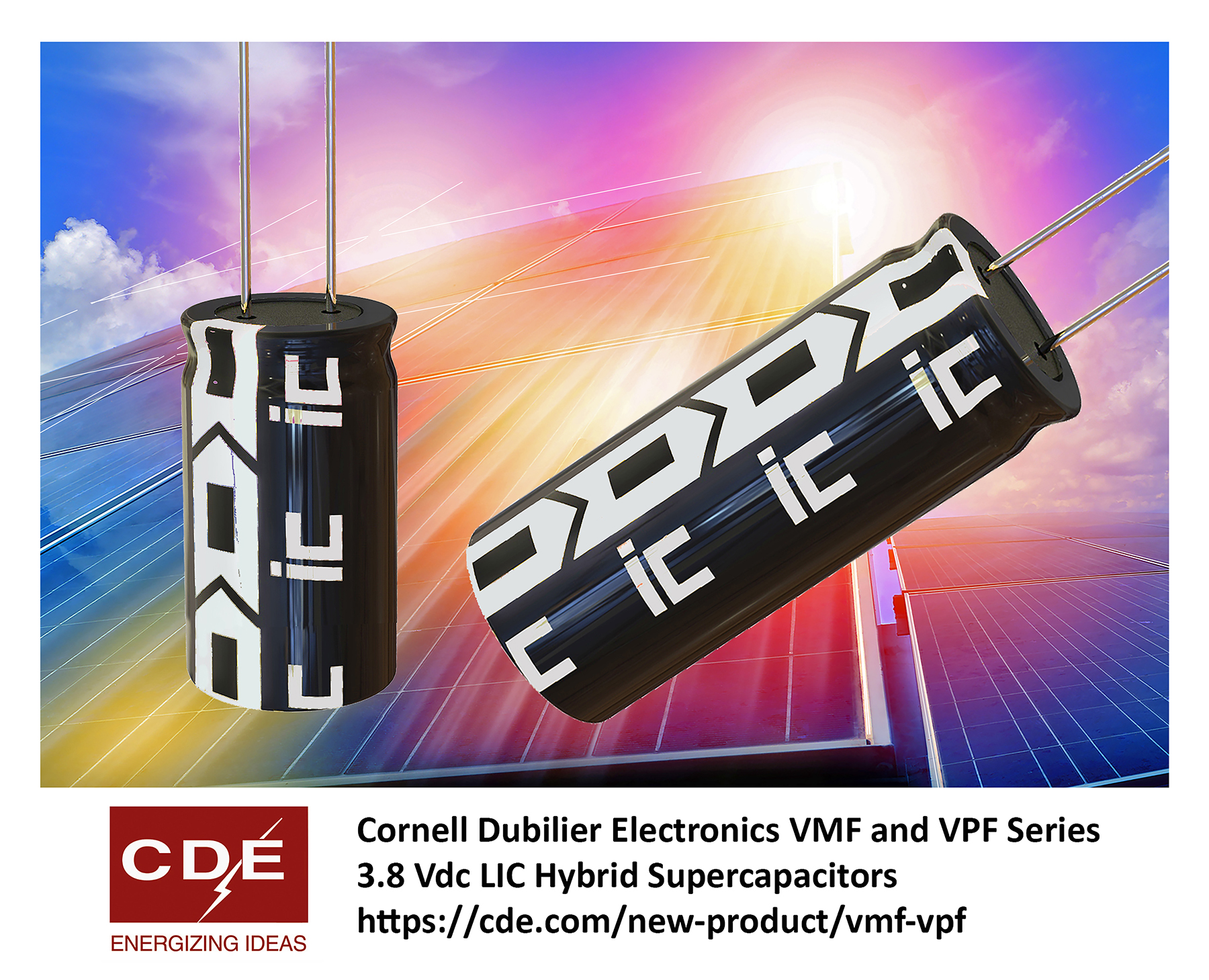
Cornell Dubilier Electronics introduces two new series of Hybrid LIC Supercapacitors in response to the growing need for ultra-high capacitance values at higher operating voltages. The new VMF and VPF Series operate at 3.8 WVDC with capacitance values up to 220 Farads. The higher voltage results in increased energy density.
With nearly eight times the energy density and a fraction of the leakage current of similar volume 2.7V supercapacitors, designers can use smaller or fewer components to achieve the desired amount of energy storage. In addition, VMF and VPF have an advantage in applications with long standby and run times. Both series candeliver quick bursts of energy that may be used to maintain voltage when power is interrupted, or they may be used to extend battery life by reducing peak repetitive current demands on the battery. Due to their high energy storage capacity, some applications can use these components in place of costly batteries. Unlike batteries, hybrid supercapacitors do not degrade with each charge/discharge cycle. They are also inherently safer than batteries, with no risk of thermal runaway. For applications requiring higher voltage or capacitance, CDE can design custom series-parallel banks of components, packaged into modules with the desired lead configuration.
Standard componentswithin the series are offered in a radial board-mount package. Sizes range from 8mm to 16mm in diameter with lengths from 16mm to 25mm. Life cycles are rated up to 500,000 charge/discharge cycles. Operating temperature ranges from -25 °C to 85 °C. Both series are fully RoHS compliant and UL recognized.
Applicationsfor VMF and VPF hybrid supercapacitors include IoT systems, mechanical actuators, smart meters, pulse battery pack alternatives, memory backup, UPS systems, emergency lighting, LED-powered solar lighting, and energy harvesting from solar or wind power.
For more information, visit CDE's website.