Ideal diode bridge controller minimizes power loss & heat in PoE-driven devices
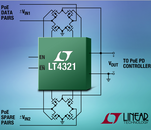
Linear Technology introduced the LT4321, an ideal diode bridge controller that replaces two diode bridge rectifiers with low-loss N-channel MOSFET bridges to increase the available power and reduce heat dissipation in a Power over Ethernet Powered Device (PoE PD). IEEE 802.3 PoE specifications require PDs to accept DC supply voltages of any polarity over their Ethernet inputs.
The space- and power-efficient LT4321 dual active bridge rectifies and smoothly combines power from both the data and spare pairs into a single, polarity-correct supply output. Circuit size and cost are reduced as the enhanced power efficiency eliminates heat sinking requirements. Power savings of 10x or more enables PDs to stay within PoE classification levels or to add value-rich functionality while maintaining class.
Carefully designed to be compliant with IEEE 802.3, the LT4321’s bias current does not corrupt detection and classification. Working with 2- or 4-pair Ethernet, the controller is compatible with PoE, PoE+ and LTPoE++™ standards. An integrated charge pump provides the gate drive for the eight low on-resistance N-channel MOSFETs without requiring external capacitors. Although designed for PoE PDs, the LT4321’s 20V to 80V operating range with a 100V absolute maximum makes it suitable and robust for telecom applications employing batteries or reversible supplies. Dual-polarity enable pins provide shutdown capability to the LT4321, reducing its bias current to 32µA from the 0.5mA operating current.
Specified over the -40°C to 125°C ambient temperature range, the LT4321 is offered in a compact 16-pin 4mm x 4mm QFN package. Pricing begins at $2.95 each for 1,000-piece quantities.