Ideal diode bridge controller minimizes rectifier heat & voltage loss
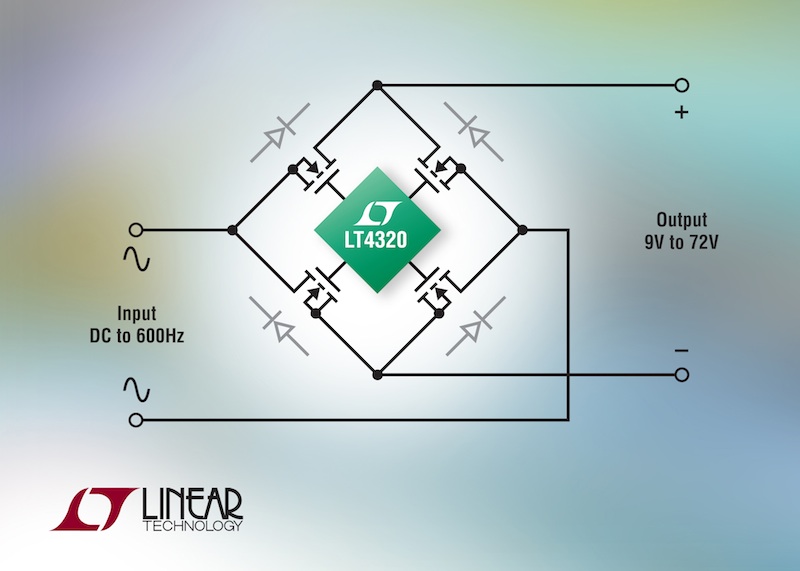
Linear Technology introduced the LT4320 ideal diode bridge controller for 9V to 72V systems, replacing each of the four diodes in a full-wave bridge rectifier with a low loss N-channel MOSFET to significantly reduce the power dissipation and increase available voltage. Power supply size is reduced as the enhanced power efficiency eliminates bulky heat sinks. Low voltage applications benefit from the extra margin afforded by saving the two diode drops inherent in diode bridges. Compared to the traditional alternative, the MOSFET bridge enables a rectifier design that is highly space- and power-efficient. The controller operates from DC to 600Hz. The LT4320 switch control smoothly turns on the appropriate two MOSFETs, while keeping the other two off to prevent reverse currents. An integrated charge pump provides the gate drive for the external low on-resistance N-channel MOSFETs without requiring external capacitors. The choice of MOSFETs offers the greatest flexibility in power levels ranging from one to thousands of watts. The LT4320 is available in two options: the LT4320 is designed for DC to 60Hz voltage rectification, whereas the LT4320-1 rectifies DC to 600Hz. Specified over the ?40oC to 85oC industrial temperature ranges, the LT4320 is offered in a compact 8-pin 3mm x 3mm DFN package, and a 12-lead MSOP package with enhanced high-voltage pin spacing. Priced beginning at $2.95 each for 1,000-piece quantities, the device is available today in production quantities. Linear Technology