Improve response time to critical system events on CAN networks with new 8-bit MCU with Core Independent Peripherals
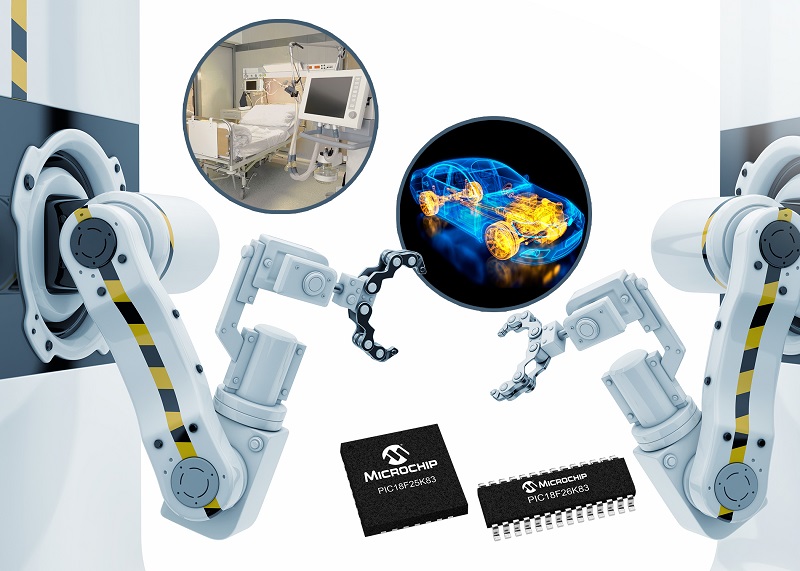
Microchip announces an expansion to the PIC18 product line with a new family of 8-bit microcontrollers (MCUs) that combine a Controller Area Network (CAN) bus with an extensive array of Core Independent Peripherals (CIPs). The CIPs increase system capabilities while making it easier for designers to create CAN-based applications without the complexity of added software.
A key advantage of using a K83 MCU in CAN-based systems is that the CIPs provide deterministic response to real-time events, shorten design time and can be easily configured through the MPLAB® Code Configurator (MCC) tool. The new family is ideal for applications using CAN in the medical, industrial and automotive markets, such as motorised surgical tables, asset tracking, ultrasound machines, automated conveyors and automotive accessories. The CIPs enable system designers to reduce time-to-market with fast configuration of a hardware-based peripheral rather than writing and validating an entire software routine to accomplish a task.
The PIC18 K83 devices contain 15 time-saving CIPs including: Cyclic Redundancy Check (CRC) with memory scan for ensuring the integrity of non-volatile memory; Direct Memory Access (DMA) enabling data transfers between memory and peripherals without CPU involvement; Windowed Watchdog Timer (WWDT) for triggering system resets; 12-bit Analogue-to-Digital Converter with Computation (ADC2) for automating analogue signal analysis for real-time system response; and Complementary Waveform Generator (CWG) enabling high-efficiency synchronous switching for motor control. For more information on these and other CIPs visit: 8-bit MCU design centre.