Three Reasons Why Physical Test is Irreplaceable in the Automotive Validation Chain
Figure 1: Design V diagram showing the connection between simulation and physical test
It’s no secret that automotive test teams are under increased pressure to push the bounds of innovation, move faster than ever, and maintain quality and consumer trust -- all while keeping budgets low.
The increased prevalence of simulation and model-based test engineering in the past years has been a much-needed release value to ease this pressure. Simulation can provide a valuable cost-saving, time-efficient mechanism for covering a wide range of test scenarios and is an automotive validation trend which is certainly here to stay (see Figure 1). However, despite the airtime that model-based testing is often given in conferences and in trend reports, physical test is a necessary complement which should not be overlooked. Physical test is essential for comprehensive vehicle assessment, model validation, and safety and reliability by ensuring physical components stand-up to the stress of real-world testing.
In recent months, a new complication has emerged: an increase in tariffs and a push towards best-cost-geography optimization resulting in increasingly distributed teams. This creates challenges for data and asset management, which are especially crucial as physical test tends to be long-running and generate some of the most expensive data in the validation process. Despite these challenges, physical test remains essential, but there are steps that teams can take to ensure they get the most out of these tests.
The Three Pillars of Physical Test’s Value
1.Complexity: Systems-of-Systems Require Real Integration
No model, no matter how sophisticated, can simulate a complex system in a real-world scenario with perfect accuracy, so it is important to screen for edge-case scenarios that only emerge in physical environments. Examples of unexpected interactions can include the importance of noise, vibration, and harshness (NVH) testing on an autonomous vehicle body component, as vibrations in sensor housing can impact collision avoidance algorithms. Similarly, it is important to ensure that the crucial in-vehicle-network backplane’s throughput does not experience a performance hit during environmental extremes resulting in data loss and critical systems failures.
2. Security: Hardware-Level Vulnerabilities Require Real Interaction
With increasingly software-defined vehicles, cybersecurity is front of mind for automotive manufacturers and consumers alike. Threats can present as physical interference, not just over-the-air hacking, which is why testing for tamper resistance, signal spoofing, and fault injection on real ECUs in real-world scenarios is essential.
3. Regulation: Compliance Isn’t Just a Means to an End
Aside from the numerous benefits stated above, sometimes physical testing is simply a regulatory requirement. There are numerous ISO, ASTM and EEC standards that govern mechanical characterization, wear test, thermal analysis, electromagnetic compatibility, fire testing, and more which must be performed on consumer vehicles.
Aside from compliance, physical test can also provide return on investment through reducing recalls, improving reliability, and building brand trust.
The Role of Physical Testing in a Hybrid Validation Strategy
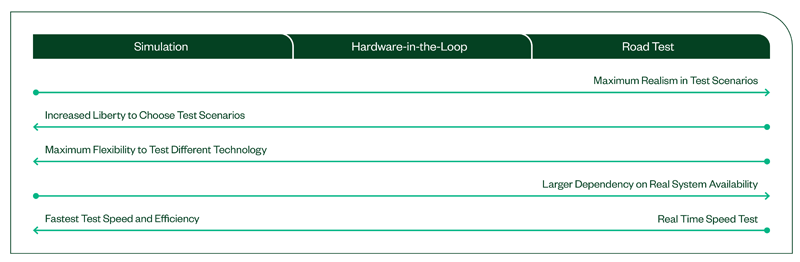
With the value of physical test clear, manufacturers’ focus can shift to how best to fit this into a hybrid validation strategy. If done well, simulation layers: model-in-the-loop (MiL), software-in-the-loop (SiL), and hardware-in-the-loop (HiL) can result in a more realistic physical test setup, and likewise physical test can serve to validate the models to improve the fidelity of future simulation. In this way, the two test paradigms complement each other well to maximize test coverage, efficiency, and confidence (see Figure 2)
Click image to enlarge
Figure 2: When used together, simulation and physical test have complementary strengths
Investing in the Right Test Infrastructure to Maximize Data Use
Physical test data has always been some of the most expensive to acquire, and so efficient test teams ensure that they get the most out of this data. One step in doing so is pushing the limits of model-based test scenarios so that by the time physical test occurs manufacturers have confidence in the software, hardware, and test scenarios. The other is standardized logging with a consolidated pool to store data, ensuring easy access to relevant data across teams and sites.
Because of technology and methodology limitations, it’s common to analyze only a portion of test-specific data (which, subsequently, is rarely linked back to previous test stages or pushed forward as test intelligence to future test stages). One way to minimize this is by prioritizing standardized logging and data repositories to break down silos and improve access to test data, despite geographically distributed teams.
Teams should strive to make data work in favor of their test strategy, instead of it being another challenge to overcome. This is especially important when testing complex, software defined vehicles across geographically distributed teams. Data aggregation, consolidation, and access are pivotal.
Fully utilizing test data can:
- Provide the best simulation and statistical modeling, which is increasingly important when testing new, previously untested or documented technologies (such as autonomy).
- Improve and help automate test-case generation, which eliminates unnecessary test reruns and increases test coverage with traceable results.
- Protect from risk and eventual failures (or recalls) by rigorously tracking every product from design to test results.
- Show a wider, multiangle, multi-process test view in virtual, lab, and physical environments, helping users to better understand test coverage.
- Assist with test and development investment decisions (capital expenditures and operating expenses).
- Become the first step to truly leveraging artificial intelligence, machine learning, and other industrial process technologies.
- Perhaps most importantly, using data to bridge communication between groups working on a specific product expedites decision-making, collaboration, and course-correction.
This may seem daunting, but investing in a comprehensive data management solution can yield impressive results, with a major European luxury car manufacturer’s powertrain calibration and controls division analyzing up to 95% of their data, reducing both test cost, and the number of annual tests run (due to fewer re-runs) after implementing a comprehensive data management solution based on Emerson’s NI DIAdem software.
Asset management is another crucial lever in physical test strategy that becomes increasingly essential in a world of distributed test teams. Asset management is often prioritized in production to reduce line downtime. However, equally important and often overlooked is ensuring validation testers are efficiently scheduled, managed, and maintained to prevent loss of data and schedule slip that results from failed days or weeks long endurance test. No lab or team is too small to benefit from a purposeful asset management strategy, such as that enabled by Emerson’s NI SystemLink™ software.
Conclusion: Physical Test is a Strategic Imperative
Physical test isn’t a relic—it’s a requirement. If data is successfully connected, hybrid validation strategies result in a complementary mix of simulation and real-world test that maximizes test confidence and coverage. This empowers automotive teams to innovate at the pace the industry requires without compromising regulatory compliance or customer safety. The future of automotive includes smarter, faster, safer vehicles—enabled by a balanced approach to testing.