Industrial PoE Switches: Powering the Edge Computing Revolution

Integration of AI at the edge is expanding power requirements and deployment complexity
Figure 1: The IEEE has evolved PoE standards from 15.4W (802.3af) to 30W (802.3at) and up to 90-100W (802.3bt) to meet rising demand for power-hungry devices
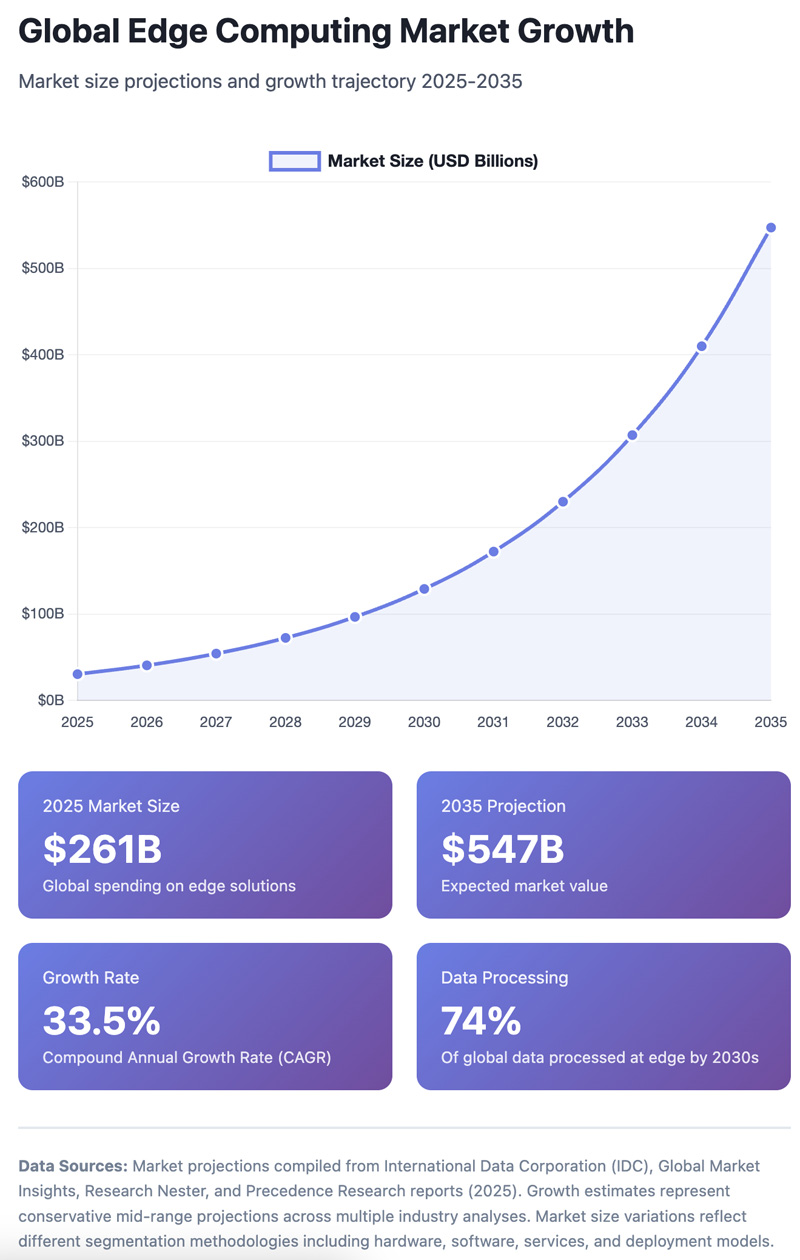
The global edge computing market has reached a transformative inflection point. With valuations ranging from USD 21.4 billion to USD 554.39 billion in 2025 depending on market segmentation, and projected growth rates approaching 28-33.5% CAGR through 2035, the infrastructure demands of distributed computing are fundamentally reshaping enterprise technology strategies. Industry projections indicate that 74% of global data will be processed outside traditional data centers by the early 2030s, creating unprecedented requirements for reliable, scalable power delivery at the network edge.
Edge computing eliminates the latency inherent in transmitting data to geographically distant datacenters by processing information at or near collection points. This architectural shift enables the sub-5-millisecond response times essential for autonomous vehicles advancing toward Level 5 autonomy, industrial automation systems requiring real-time process control, and predictive maintenance applications that must detect and respond to equipment anomalies instantaneously. The International Data Corporation estimates nearly 180 zettabytes of new data generated globally by 2025, necessitating processing architectures that can handle massive data volumes with minimal delay.
The Retail & Services sector currently accounts for nearly 28% of total global edge computing investments, driven by video analytics, real-time performance optimization, and operational efficiency applications. Manufacturing & Resources sectors collectively constitute a quarter of worldwide spending, primarily focused on Industrial Internet of Things implementations. Financial services are experiencing the fastest growth trajectory with a compound annual growth rate exceeding 15%, driven by augmented fraud analysis and real-time transaction processing requirements.
Click image to enlarge
Figure 2: Edge computing is experiencing explosive growth as it becomes a foundational component of modern digital infrastructure
However, edge computing's distributed architecture creates a fundamental power infrastructure challenge. Edge devices require continuous, reliable electrical power to function, yet these devices are frequently deployed in locations where traditional AC power infrastructure may be unavailable, impractical, or prohibitively expensive. IT infrastructure teams managing dozens or hundreds of edge devices across distributed locations face critical decisions about power delivery strategies that will determine deployment success or failure.
Conventional Power Solutions and Their Limitations
When readily available electrical outlets exist within proximity to edge devices, standard AC power remains the optimal solution. However, this scenario represents a minority of edge deployment environments. Industrial facilities, remote monitoring locations, outdoor surveillance installations, and distributed IoT networks rarely offer convenient access to properly rated electrical infrastructure at every device location.
DC battery arrays offer apparent simplicity but introduce multiple failure vectors that compromise reliability in mission-critical applications. Batteries require continuous monitoring, frequent replacement cycles, and unpredictable depletion that often occurs during critical operations. Thermal management challenges in extreme environments further reduce battery reliability, while the operational overhead of maintaining battery systems across distributed locations creates ongoing cost burdens that accumulate rapidly at scale.
Solar power infrastructure presents similar reliability constraints. Photovoltaic systems cannot guarantee consistent power delivery for high-draw devices, particularly those requiring 24/7/365 uptime. Complex installation requirements, high failure rates in demanding environmental conditions, and insufficient power capacity for enhanced devices such as PTZ cameras with integrated heating and cooling systems or LED illumination arrays make solar unsuitable as a primary power source for most mission-critical edge applications. The intermittent nature of solar power generation fundamentally conflicts with the always-on requirements of modern edge computing infrastructure.
Industrial PoE Technology: The Convergent Solution
Industrial Ethernet switches with integrated Power over Ethernet capabilities provide robust, scalable power delivery to multiple edge devices through consolidated infrastructure. The technology transmits both data and electrical power over a single twisted-pair cable, eliminating dedicated electrical conduit installation, licensed electrician involvement for device deployment, and redundant cabling infrastructure in space-constrained environments. This convergence of power and data delivery transforms edge device deployment economics while improving reliability and simplifying ongoing management.
The architectural advantages extend beyond initial installation. PoE-enabled infrastructure enables dynamic reconfiguration of power and network topology without requiring electrical infrastructure modifications. Centralized power management provides unified monitoring and control of distributed device power states, enabling remote troubleshooting and automated power cycling without dispatching technicians to remote locations. In confined industrial environments, the reduced cabling footprint created by single-cable deployment optimizes space utilization while reducing electromagnetic interference from parallel power and data cables.
Industrial PoE switches support diverse power requirements across edge device categories ranging from standard sensors and access control hardware consuming minimal power to high-performance wireless access points supporting Wi-Fi 6/6E, PTZ surveillance cameras with integrated environmental controls, smart LED lighting systems with advanced control capabilities, and 4K display systems. This versatility enables organizations to standardize on unified infrastructure rather than deploying multiple power delivery systems optimized for specific device types.
Legacy device integration presents no insurmountable obstacles. Industrial PoE switches incorporate safety protocols that prevent damage to non-compatible equipment through pre-power test current transmission to detect resistor presence, verification of PoE-compatible device signatures, and conditional power delivery based on detection results. PoE splitters enable power delivery to non-PoE devices by separating power and data streams at the endpoint, while PoE injectors add capability to non-PoE switches for incremental infrastructure upgrades, protecting existing investment while enabling migration to converged infrastructure.
IEEE 802.3bt: Current Generation Power Delivery Standards
The IEEE has progressively expanded PoE power delivery capabilities through successive standards evolution. The original IEEE 802.3af standard ratified in 2003 delivered 15.4W from Power Sourcing Equipment with 12.95W available at the Powered Device after accounting for cable losses, supporting basic IP phones and simple sensors through two-pair power transmission. The IEEE 802.3at standard introduced in 2009 increased capacity to 30W PSE output and 25.5W PD available power, enabling enhanced cameras and wireless access points while maintaining two-pair transmission.
The current generation IEEE 802.3bt standard, ratified in September 2018 and incorporated into the consolidated IEEE 802.3 specification in 2022, represents a fundamental architecture evolution. By utilizing four-pair power transmission, 802.3bt dramatically expands power budgets while introducing sophisticated power management capabilities. Type 3 implementations deliver up to 60W PSE output with 51W available at the powered device, supporting PTZ cameras, video conferencing systems, and LED signage. Type 4 implementations, also known as High-Power PoE, deliver up to 100W PSE output with 71.3W available to powered devices, enabling thin clients, laptops, digital signage, and high-performance computing devices.
The standard defines maximum current per pair at 600 milliamps for Type 3 and 960 milliamps for Type 4, ensuring safe operation within cable thermal limits. Advanced features include short maintain power signature functionality that enables PSEs to detect disconnected devices and remove power within 400 milliseconds, autoclass capabilities for automated device classification, and support for both single-signature and dual-signature powered devices. Dual-signature support proves particularly valuable for applications such as outdoor surveillance cameras requiring independent power for core functionality and environmental controls, or Industrial IoT applications with redundant circuitry for safety-critical operations.
IEEE 802.3bt specifications extend to multi-gigabit Ethernet implementations, defining power delivery capabilities for 2.5GBASE-T, 5GBASE-T, and 10GBASE-T, enabling high-bandwidth edge applications without sacrificing power delivery. Standards compliance ensures vendor-agnostic interoperability across manufacturers, while backward compatibility allows PoE++ equipment to automatically negotiate appropriate voltage and current levels for legacy devices. Organizations can deploy current-generation infrastructure confident that it will support both existing devices and future technologies as power requirements continue increasing.
For optimal performance in IEEE 802.3bt deployments, Category 6A or Category 7 cabling is recommended to minimize thermal loading and optimize power efficiency, though all PoE standards support maximum cable runs of 100 meters per Ethernet segment consistent with fundamental IEEE 802.3 specifications.
Industrial-Grade Engineering for Mission-Critical Reliability
PoE technology reliability correlates directly with industrial switch component quality and environmental specifications. Cost-focused procurement strategies may obscure total cost of ownership implications including network outage remediation expenses, production downtime financial impact, limited technical support availability, and shortened equipment lifecycle requiring premature replacement.
Antaira Technologies engineers industrial PoE switches with mission-critical reliability as the primary design criterion. Extended operating temperature ranges typically spanning -40°C to +75°C enable deployment in extreme environments from arctic installations to desert industrial facilities. Shock and vibration resistance to industrial specifications, electromagnetic compatibility compliance, moisture and humidity resistance, and IP-rated enclosures ensure continuous operation in harsh conditions that would destroy commercial-grade equipment.
Click image to enlarge
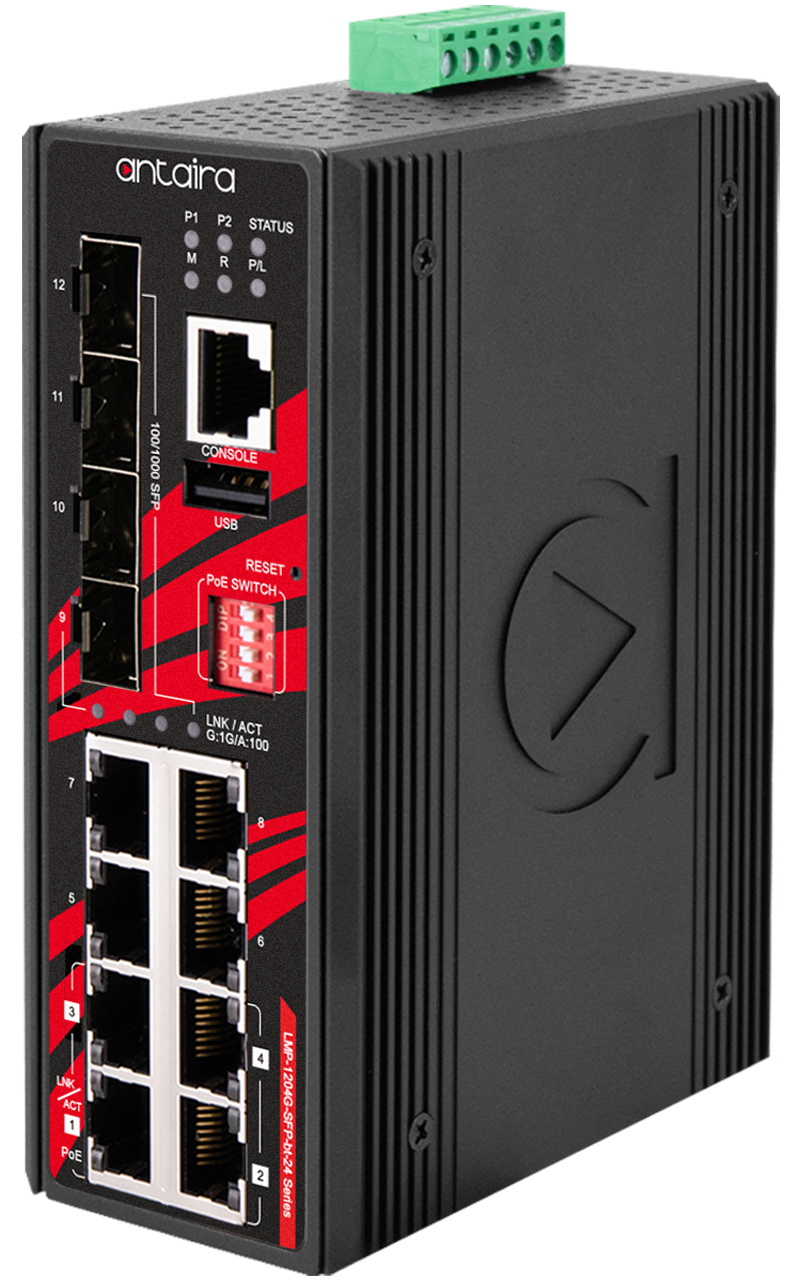
Figure 3: Antaira LMP-1204G-SFP-bt-24-T-BOS Gigabit PoE++ managed switch supports IEEE 802.3bt for a maximum of 95W/port
Electrical specifications include IEEE standard-compliant power delivery supporting maximum 95W per port for PoE++ Type 4 compliance, high port-count configurations enabling consolidated infrastructure, and support for demanding devices including laptops, PTZ cameras, and HD displays. Both managed and unmanaged switch configurations support diverse deployment scenarios, with connection distances up to 100 meters at speeds up to 1000 Mbps over twisted-pair Ethernet cabling. Network redundancy protocols prove essential for critical applications in wind farms, solar installations, and industrial automation environments where downtime creates immediate safety or financial consequences.
Conclusion: Strategic Infrastructure for Distributed Computing
As edge computing transitions from emerging technology to fundamental infrastructure supporting the majority of enterprise data processing, power delivery architecture becomes a critical enabler or constraint on deployment success. Industrial PoE switches represent a convergent solution addressing multiple edge computing challenges through simplified deployment that reduces installation complexity and cost, consolidated infrastructure minimizing physical footprint, standards-based interoperability ensuring vendor flexibility, scalable power delivery supporting current and emerging device requirements, and enhanced reliability through industrial-grade components.
The integration of AI at the edge, enhanced observability requirements, 5G network capabilities, and autonomous systems will continue expanding power requirements and deployment complexity throughout the coming decade. Organizations implementing edge computing strategies must prioritize power infrastructure capable of supporting both current applications and future technological evolution. Industrial PoE switches deliver the robust, flexible, and cost-effective power infrastructure essential for realizing edge computing's transformational potential across industrial automation, smart infrastructure, IoT applications, and autonomous systems.


.jpeg)


