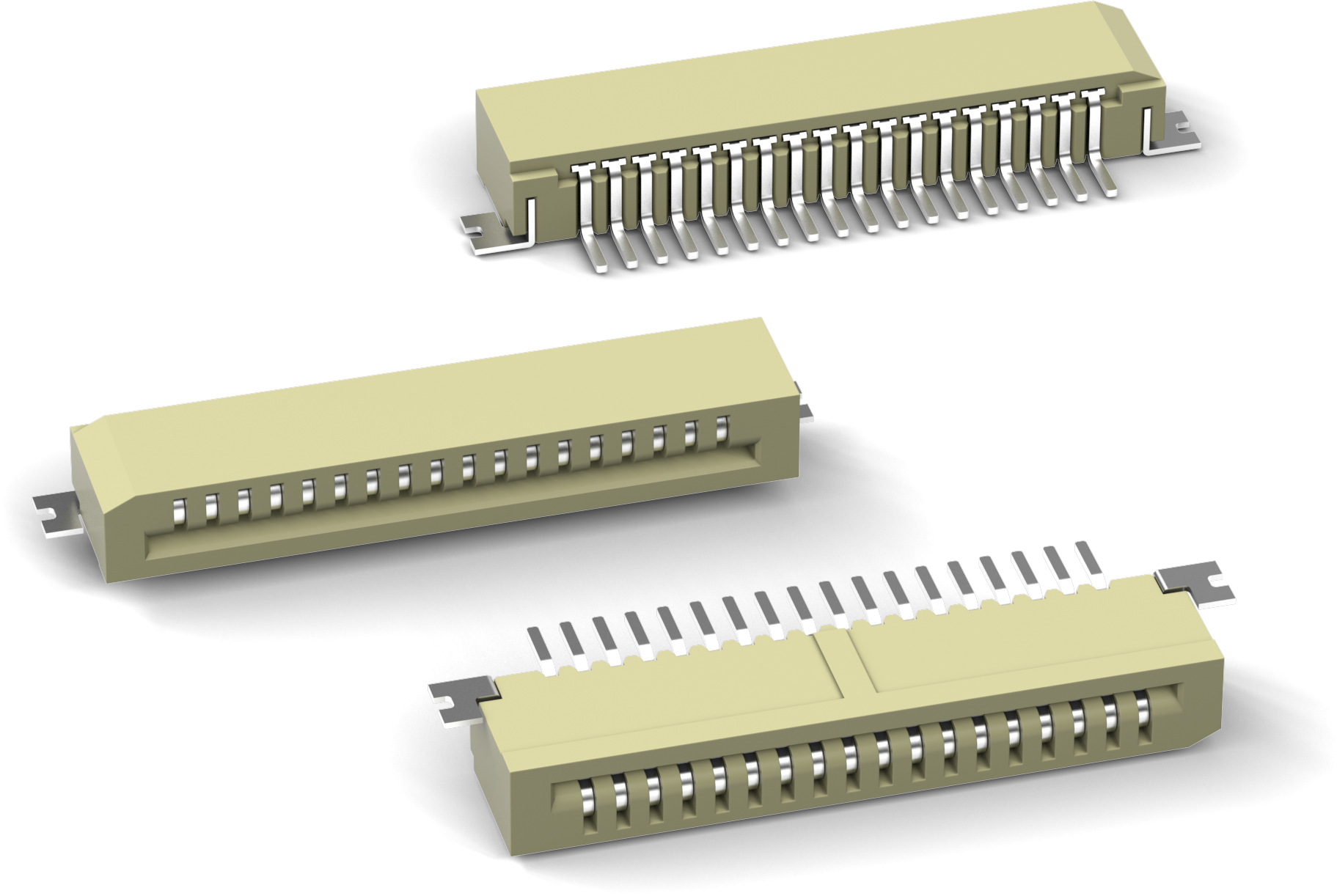
Würth Elektronik now offers the inexpensive and easy to assemble LIF (Low Insertion Force) connector WR-FPC.
Small and flexible flat-ribbon cables are widely used in LCD screens, board-to-board connections for medical equipment, test and measurement devices, industrial applications, entertainment electronics, and the broadest conceivable range of other types of devices. In many of these applications, it’s not important to have a vibration-free interlock for the plug-in connector. For such applications, Würth Elektronik now offers the more inexpensive and easier-to-assemble solution of an LIF connector. Fully suited for SMT pick-and-place assembly systems, the WR-FPCs in the 1-mm grid format are available in a variety of versions, from 4 to 30 pins, in horizontal and vertical plug-in directions. Besides serving as sockets for flat flexible cables, they are also intended for use as connectors for flexible printed circuit boards – hence the designation FPC. The rated current is 1 A, the operating voltage 125 V. To ensure a high degree of elasticity, low wear and tear, and a low resistance (30 mΩ), Würth Elektronik has selected phosphor bronze as the material for the contacts. The connectors have an undercoat of nickel to prevent the so-called tin whisker phenomenon.
To enable development teams and small companies to put these products to use more easily (just as for the entire range of FFC/FPC items), these new WR-FPC low-insertion-force connectors are offered ex stock in component belts without a minimum order volume. Free-of-charge samples can also be supplied on request.