Infineon Adds 40 V Device to its Power MOSFET Family
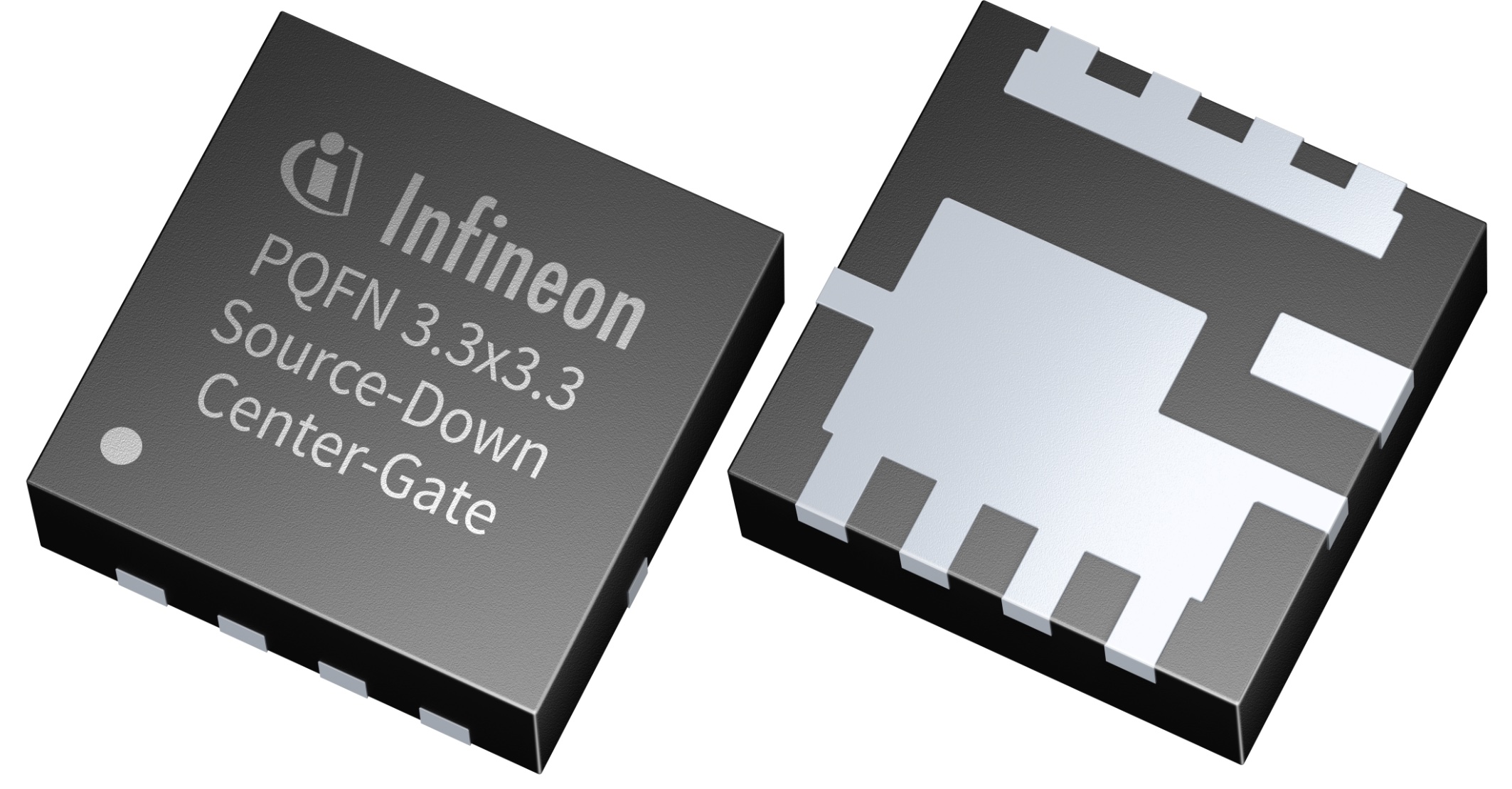
Contemporary power system designs demand high power density levels and small form factors to maximize system-level performance. Infineon Technologies AG tackles this challenge by focusing on system innovation with enhancements on the component level. Adding to the 25 V device introduced in February, Infineon now brings the OptiMOS 40 V low-voltage power MOSFET to the market. It is packaged in the Source-Down (SD) PQFN with a 3.3 x 3.3 mm 2 footprint. The 40 V SD MOSFET primarily addresses SMPS for server, telecom, and OR-ing, as well as battery protection, power tool, and charger applications.
The SD package features silicon that is being flipped upside down inside of the component. With that, the source potential is connected to the PCB over the thermal pad instead of the drain potential. In the end, this variant can lead to a major reduction of R DS(on) by up to 25 percent compared to the current technology. The thermal resistance between junction to case (R thJC) is also significantly improved compared to the traditional PQFN packages. The SD OptiMOS can withstand high continuous currents of up to 194 A. Additionally, the optimized layout possibilities and the more efficient utilization of the PCB allow for greater design flexibility together with highest performance.
Availability
The OptiMOS SD 40 V low-voltage power MOSFET is available in two versions, standard and Center-Gate. The Center-Gate variant is optimized for parallel operation of multiple devices. Both variants in the PQFN 3.3 x 3.3 mm 2 package can be ordered now. More information is available at Infineon's site.
.jpg)