Infineon DC motor control shield for Arduino now at Newark element14
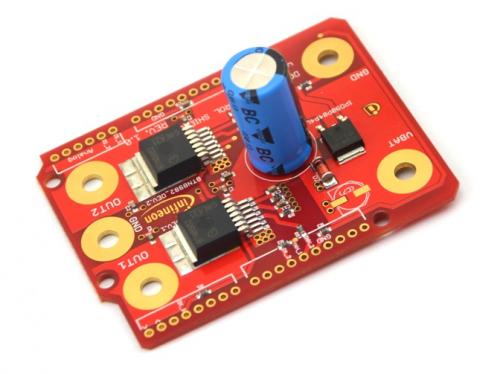
The Infineon DC Motor Control Shield for Arduino is now available for purchase from Newark element14, an electronics distributor and online community for design engineers and electronics enthusiasts. The product enables fast and inexpensive prototyping of DC motor control.
Infineon’s DC Motor Control Shield for Arduino is one of the first high current motor control boards being compatible to Arduino as well as to Infineon’s XMC1100 Boot Kit. The DC motor control shield is capable to drive two uni-directional DC motors (half bridge configuration) or one bi-directional DC motor (H-Bridge configuration).
The implemented integrated BTN8982TA NovalithIC half bridges can be controlled by a PWM via the IN Pin. Interfacing to a microcontroller is made easy by the integrated driver IC which features logic level inputs, diagnosis with current sense, slew rate adjustment, dead time generation and protection against overtemperature, undervoltage, overcurrent and short circuit.
Additional features include compatibility with Arduino Uno R3 and high frequency PWM capability (e.g. 30kHz).
The Infineon DC Motor Control Shield for Arduino is available for $24.17.
.jpg)