Infineon's RC-E discrete IGBTs target induction cookers
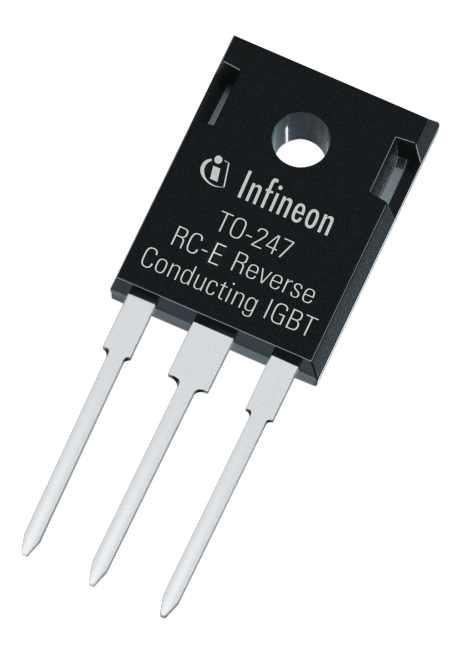
Induction cooking appliances commonly make use of resonant topologies which allow bi-directional current flow. Additionally they demand a discrete IGBT that performs best at switching frequencies from 18 to 40 kHz and has low losses. Infineon Technologies launched a new family of discrete IGBTs to address these needs. The new RC-E devices are cost optimized and specifically meet the demands of low- to mid-price range induction cookers and induction rice cookers.
Monolithically integrated reverse conduction diode
The new RC-E family features an IGBT with monolithically integrated reverse conduction diode for resonant switching. The technology used in RC-E IGBTs is also optimized for low switching and conduction losses. Lower losses allow designers to achieve efficiency and power targets for induction cooking applications more easily. Thus, less energy is consumed for cooking, leading to lower operating costs for consumers. With low E off, V F, R th and V ce(sat) this device sets a new industry benchmark in price/performance and ease-of-use.
The new devices offer Infineon’s proven quality in discrete RC IGBTs and fulfill all the requirements for soft switching applications and efficiency as well as EMI standards. The RC-E delivers the well-established high-performance of its predecessors with a more attractive price for lower BoM cost. The RC-E is offered in a standard TO-247 package allowing a drop-in replacement for existing designs.
Availability
Samples are available now and the devices are in production. The family will be launched with two devices: 15 A and 25 A, both with the most commonly used blocking voltage of 1200 V.